
While the Hockenheimring remains eager to welcome back F1, managing directors Joern Teske and Jochen Nerpel reveal what blocks a definitive path forward.
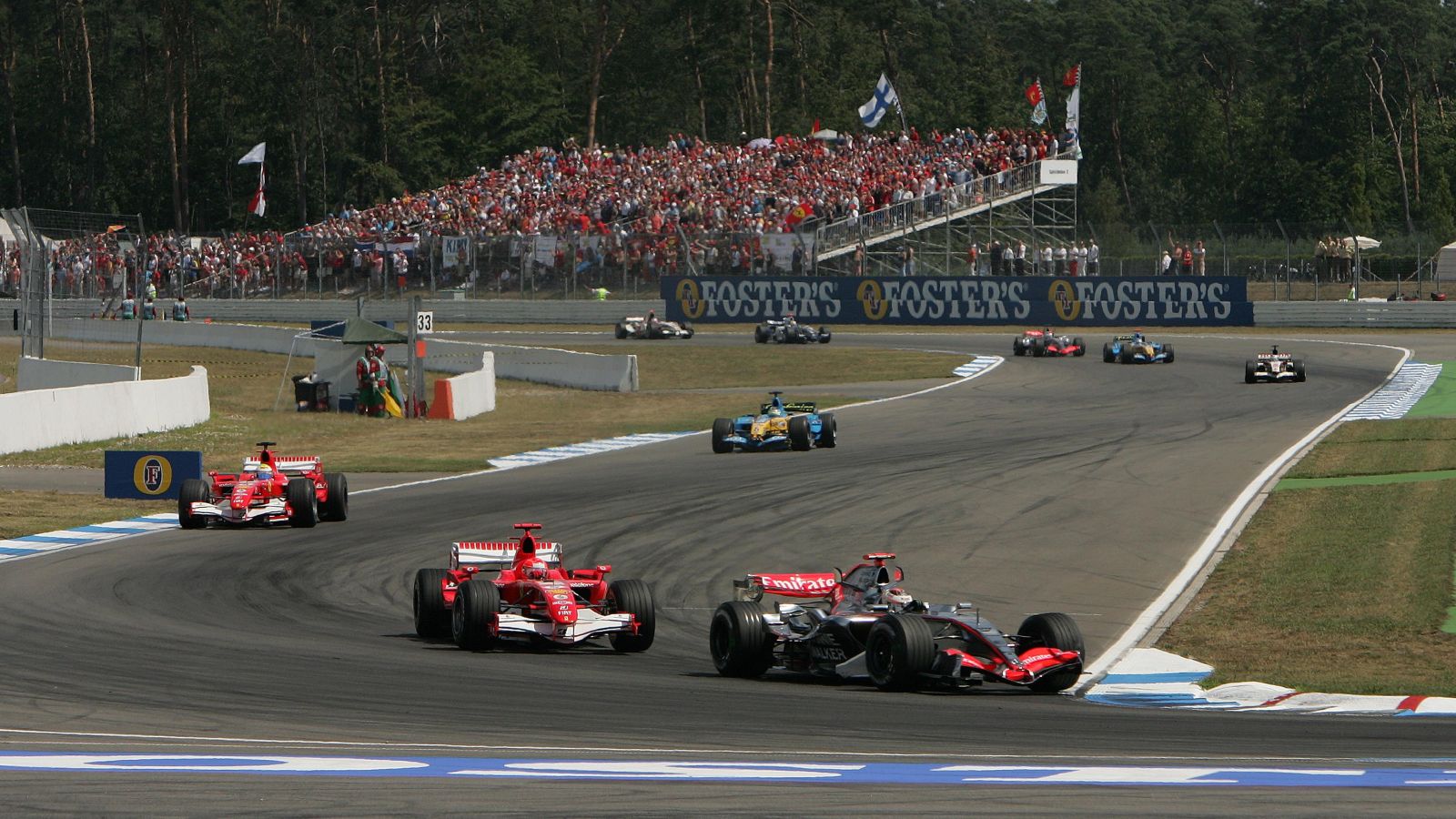
As the fastest circuit on the calendar alongside Monza up until 2002, the Hockenheimring is one of the discipline’s most well-liked traditional tracks.
It hosted Formula 1 37 times since 1970, eventually entering a rotation with the Nürburgring from 2007 onwards. F1 last raced at the Baden-Württemberg circuit in 2019, when Lewis Hamilton won a chaotic, rain-soaked Grand Prix.
Back in the days of local hero Michael Schumacher, the track was immensely popular, drawing record crowds of 232,000 spectators over the three days in 2006 when the German star was fighting for the title, according to Forbes. With four wins to his name, the seven-time World Champion still stands as the driver with the most victories around Hockenheim.

Following the final F1 GP at Hockenheim, Germany hosted the world championship for the last time in 2020 via the Eifel GP at the Nürburgring.
The current state of F1 discussions
Behind the scenes, dialogue between the circuit and Formula 1 is active.
“Formula 1 is naturally watching very closely what is happening here at the Hockenheimring,” managing director Joern Teske said in a recent interview with Formel1.de.
“We are in discussions. Formula 1’s priority, of course, is that the overall conditions at the Hockenheimring are right.
“Motorworld [A new hospitality hub being built at the track] is a beautiful building, but it isn’t the essential element Formula 1 needs to stage a race. I imagine the focus will be more on whether the overall infrastructure is suitable.
“That said, the images we released impressed everyone, and I would include Stefano Domenicali in that. It is simply a fantastic building, and it symbolises the fact that things really are moving forward at the circuit.”
Lack of public backing stalls Hockenheim return
While the Hockenheimring is eager to secure a spot back on the Formula 1 calendar, financial realities are stalling the ambition despite ongoing discussions between the championship and the venue, currently owned by majority shareholder Emodrom Group GmbH (74.99%) alongside the city and the Badischer Motorsport-Club (25.01%).
“When a government or a country shows an interest and says, ’This matters to us,’ look at Rwanda, for example, which is now part of the discussion. We sometimes think it is extraordinary how little standing Formula 1 has in Germany, a country famous for its automotive industry, and how little support there is for it.
“Naturally, we would like much more backing, but the chances of public funding coming from any source are virtually zero, if I may put it that way.
“There are many issues to resolve first. Since we have nothing substantial to announce or discuss publicly at this stage, it remains largely theoretical.”
F1 calendar congestion
Moreover, the F1 schedule is already maxed out at 24 Grands Prix. While the Concorde Agreement permits a strict maximum of 25, expanding to that limit would likely cause heavy fatigue and friction among teams and drivers.
Although Hockenheim counts as an old-school fan favourite, F1 is currently prioritising a more globalised calendar.
Consequently, iconic European tracks like Spa-Francorchamps are already forced to enter rotational agreements, sharing slots with circuits like Barcelona, to carve out space for lucrative American, Middle Eastern, and upcoming African additions, with Rwanda officially slated to join the F1 calendar in the early 2030s.
Hockenheim rejects one-off option
Amid geopolitical tensions in the Middle East, Hockenheim could be a potential emergency replacement venue. However, that prospect has been firmly downplayed by circuit management.
“Let me put it this way: if taking on a replacement race opened the door significantly wider to a multi-year contract and a secure Formula 1 future, then it would certainly be an option we would examine very seriously,” Teske noted.
“But if it were clear that it would be just a one-off replacement race, with no further prospects, I would personally question whether the effort was worthwhile. Financially, it certainly wouldn’t be.
“What lasting value would a single race bring? One burst of media attention, huge visibility for that event, and then it all fades away again. That wouldn’t necessarily be my preference, although I must stress that this is just my personal opinion and hasn’t been agreed internally.”
Logistically speaking, relatively few structural arrangements would be needed for Hockenheim to welcome F1 back on paper, especially given that the venue retains its FIA Grade 1 licence.
Managing director Jochen Nerpel explained that adding temporary grandstands to hold between 60,000 and 100,000 spectators alongside paddock updates to accommodate all 11 modern F1 teams would form the bulk of the changes.
Nevertheless, with a single German representative on the F1 grid in Nico Hülkenberg, local interest continues to stall. Ultimately, the dream of a German Grand Prix return hinges on closing a substantial funding gap that neither the public sector nor private investors seem ready to bridge yet.
READ MORE: Sergio Perez singles out ‘unfair’ rule ahead of F1 Commission vote




Discussion about this post