
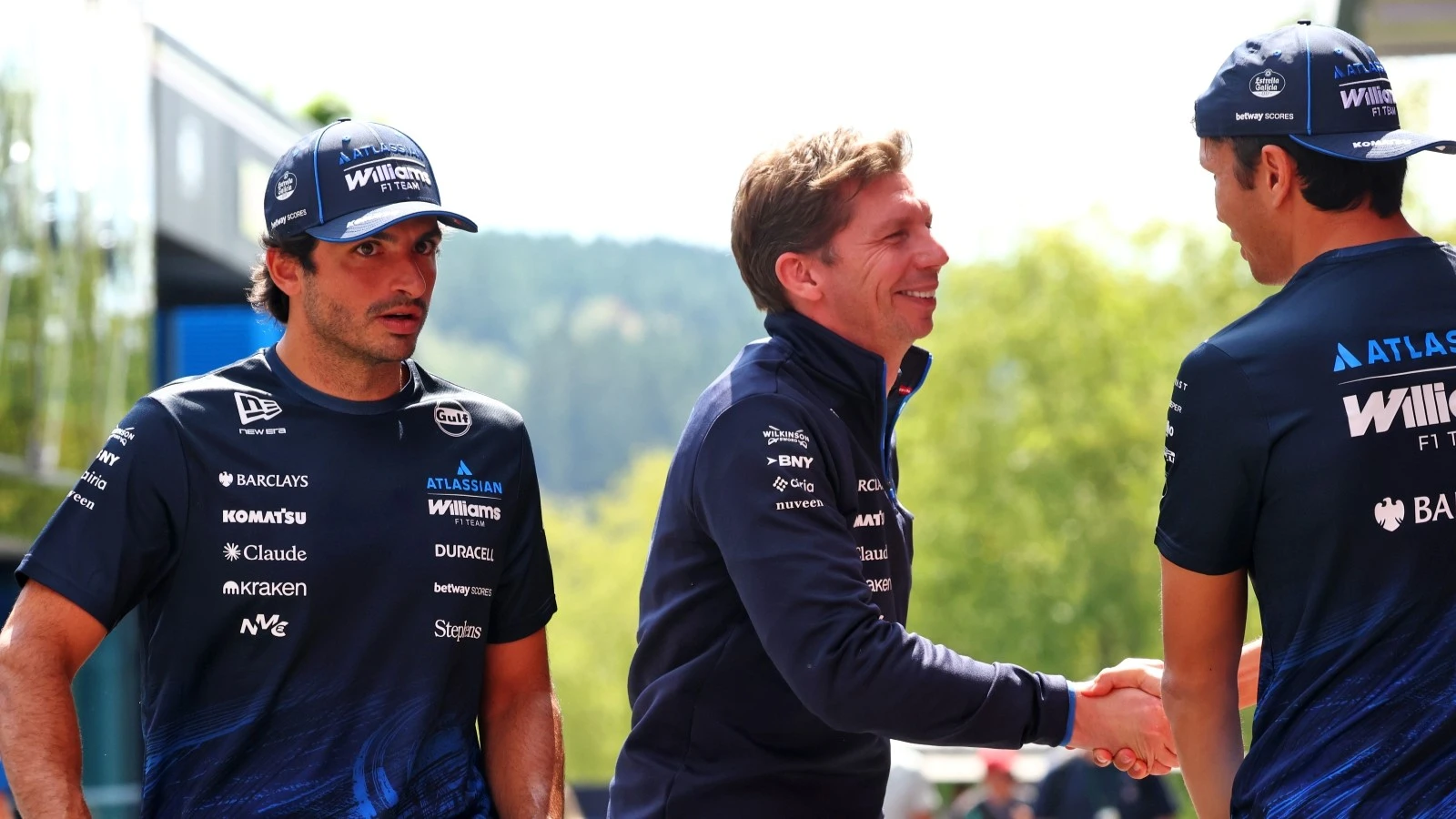
James Vowles has revealed that Williams is effectively “flying the plane and rebuilding it at the same time” as the squad tackles a difficult start to its 2026 campaign.
The Grove-based outfit faced immediate setbacks with its FW47 chassis, missing the Barcelona shakedown and arriving late to pre-season testing.
The car also suffers from significant excess weight. Cost cap restraints prevent Williams from shedding that weight immediately.
Instead, it forces the team to introduce phased light-weighting measures across several rounds.


Williams has scheduled a major upgrade package for the Azerbaijan GP in September.
Vowles explained that a crucial three-week delay early in production triggered a domino effect across the entire factory.
“We have to, as a business, prove to ourselves that we can do the engineering to the right level of quality, and build a car to that level of quality in the season; it is effectively the equivalent of flying the plane and rebuilding it at the same time,” Vowles told media.
“We have to prove to ourselves that we have changed from where we were three years ago, and we didn’t have the process systems, the underlying structure behind it.
“I know what efficient organisations look like, and even today, we are struggling to do a lot of what the others can do at this point, and that is on us to fix. We just have to do it at the same time as moving forward.”
Modernising the traditional Williams F1 team
Vowles acknowledged that modernising decades-old infrastructure while recruiting high-caliber talent takes time due to standard F1 gardening leave periods.
“The first year we did a plan was effectively last year, and you have to change people, typically 24 months before you can get them into the building, if not three years,” he noted.
“We could not attract the best in class three years ago, and people need to see that you are making progress and making fundamental changes to your ways of working is not something you do overnight.”
Vowles candidly admitted that the execution of the FW47 fell short of his internal expectations, pointing to unreliable data and late detection as primary root causes.
“Were [the problems] to the extent I predicted? No. I thought we’d be able to produce a car slightly overweight, but roughly speaking, on time, but not by any means the benchmark,” Vowles conceded.
“That’s not what we achieved, though. We underachieved relative to that, and the reason is that we had some of the data, and we didn’t even trust it.
“The first time that data got flagged up was far too late in the process to make corrections, and a strange thing, and when you fall three weeks behind – that’s what we fell behind – that’s unrecoverable.
“There’s no way of coming back, because everything else is chalked up in the system, ready to go on those dates, and so when one bit falls away, all of it falls away as a result.”
Vowles’ blunt transparency highlights the immense scale of the overhaul at Williams. It proves that dismantling legacy inefficiencies often creates short-term pain before yielding long-term gains.










Discussion about this post