
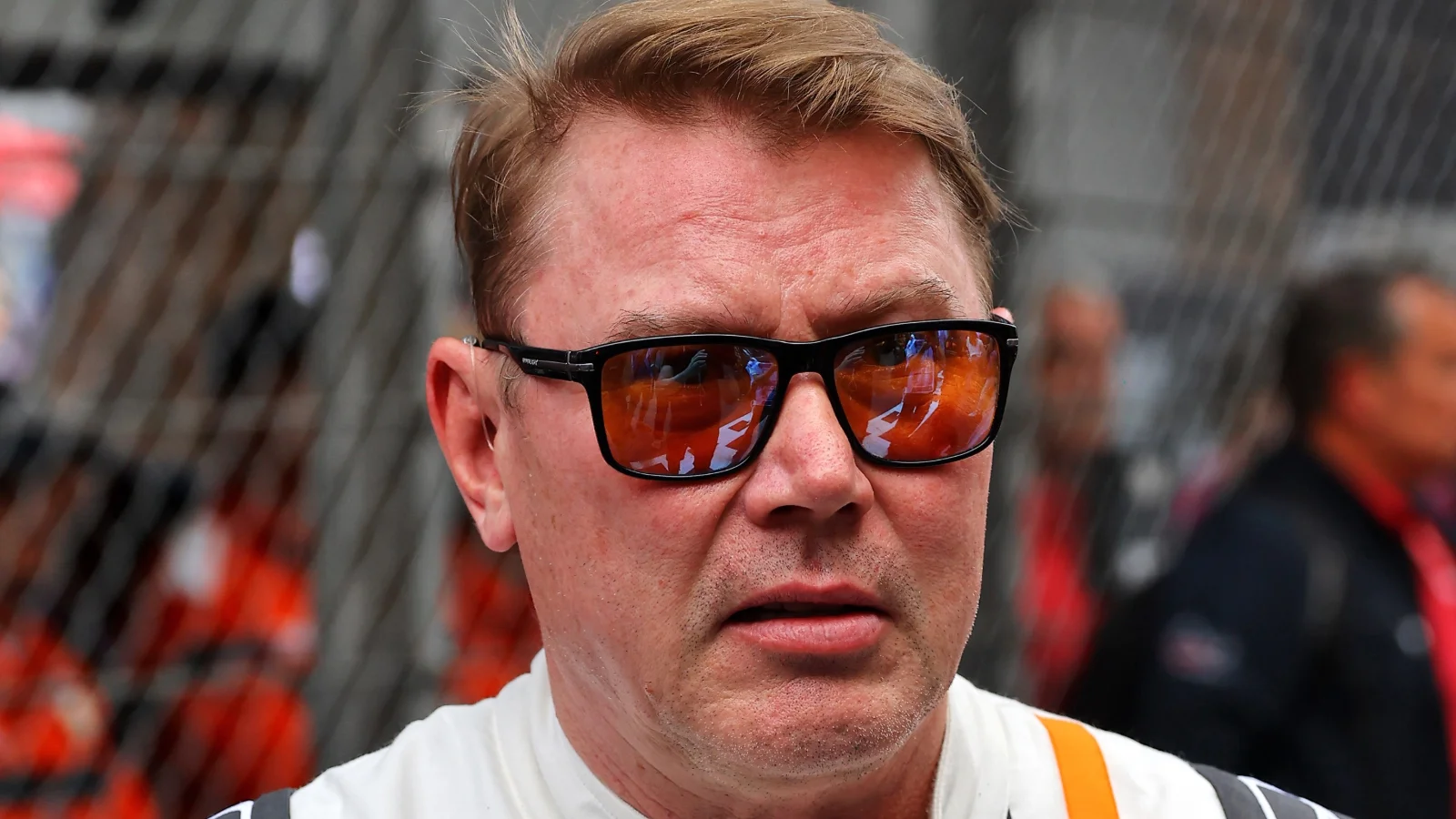
Formula 1 legend Mika Hakkinen has opened up on the dilemma he faced when recovering from a near-death crash when driving for McLaren.
The Finn suffered the accident in qualifying for the Australian Grand Prix – the final round of the 1995 season, coming off the back of a podium finish at the previous race in Japan.
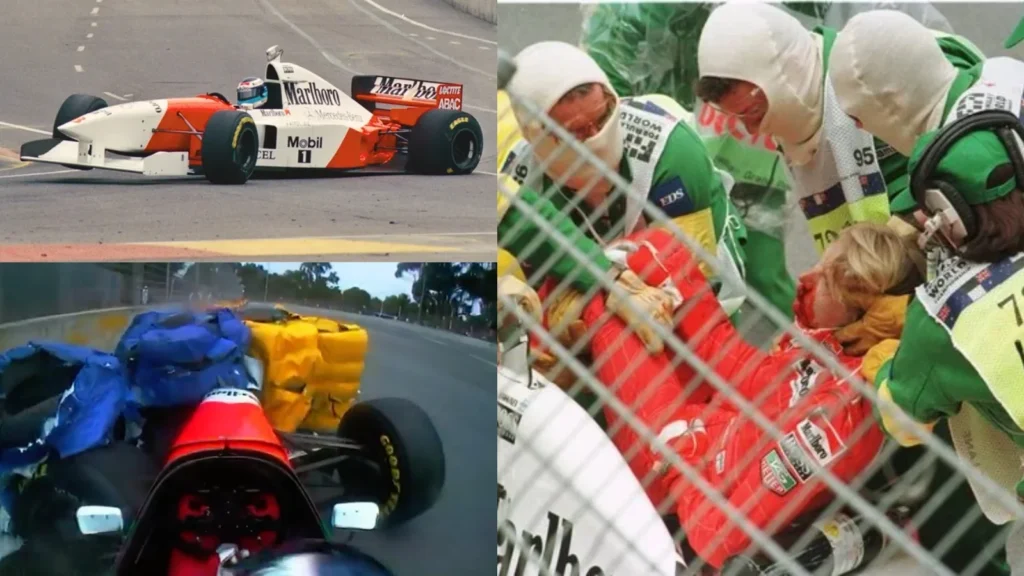
During the first qualifying session at the Adelaide street circuit, Hakkinen was approaching the Brewery Corner when he suffered a left-rear puncture, sending him into a spin.
The McLaren vaulted the kerb on the outside of the corner and with no gravel trap, the car hurtled towards the tyre wall and struck it at an angle, chucking Hakkinen’s head unnaturally far forward.
Speaking on the Up To Speed podcast, co-hosted by former teammate David Coulthard, Hakkinen recalled the frightening crash and the initial physical reaction when tended to by medical staff.
“When I was sideways and I hit that huge kerb in the exit, and the car launched in the air, that was the moment I realised this is going to be a big one,” he said.
“The car didn’t slow down at all, and I knew the barrier was not far away. It was so high speed and then the car was spinning in the air.
“It was challenging to understand when I was going to hit the wall. Normally when you hit the wall, you hold the steering hard as you can, and you put your muscles hard, and I didn’t see that.
“The problem was that when I tried to move my hands or try to move my legs, no chance. And I said, ‘Oh s***.’ When the guy came in front of me and said, ‘Just now relax, don’t do anything, try to stay calm.’
“Then somebody turned off the lights.”
‘I thought I was in heaven…then I saw Ron Dennis’
The quick thinking of respected FIA medical delegate, Professor Sid Watkins, as well as a team of doctors, prevented any further damage, but what had already been caused was severe.
A fractured skull and a blocked airway were the primary injuries that Hakkinen suffered, the latter being remedied by a tracheotomy at the scene of the crash.
Watkins, who had attempted to save the lives of Roland Ratzenburger and Ayrton Senna at Imola just over a year previously, was forced to twice restart Hakkinen’s heart, before he was taken to hospital, where he was placed in intensive care.
“The first people who I saw, actually who came to see me, were Ron and Lisa Dennis [then-McLaren Team Principal and his then-wife],” Hakkinen recalled. “And the first thing I saw was Lisa Dennis in front of me. But of course, I was under so much medication, I thought I was in heaven.”
Hakkinen joked: “Then I looked to the left and Ron Dennis was standing there. So I thought, this is not heaven!”
Utilising ‘Sisu’ to continue his racing
Hakkinen made a miraculous recovery after a two-month stay in hospital, and was then faced with the predicament of deciding to carry on with his F1 career or stepping away.
“I think this decision moment is one of the most challenging. You could easily say, ‘Let’s move life [to] a different direction and let’s forget motor racing,'” he said.
“You have to make this decision alone, and you have to go through so many different things in your life that way. ‘What do you want from your life?’ ‘What is the future of your life?’ The questions are coming to your head all the time: ‘A couple of months ago I nearly just died, so do you want to go back to this same business?'”
Hakkinen ultimately decided to carry on, with the typical grit and determination one could easily associate with him, through ‘Sisu’, the Finnish word that describes such attributes.
“It is such a huge passion, motor racing and driving the car, controlling this incredible Formula 1 car at a very high speed,” he said.
“When everything works, and they’re doing great teamwork with the mechanics, with the engineers.
So I decided to go back, and I don’t know if it’s something to do with your youth when you’re young, your ego, you want to prove that way, yes, I can do it.
“I made the decision to come back, but it wasn’t an easy one, you know. You have to work on your mindset. When you sit in a car after an accident, you have to put your mindset to not think about the fear of the crash.
“It will happen again. You will crash again, but not to be afraid of that crash.”
Hakkinen was as quick as ever, and after several examples of wretched bad luck, finally took his maiden victory in the season finale of 1997 at Jerez.
A year later, he was World Champion for the first time, utilising the dominant McLaren package to see off the challenge of Michael Schumacher.
He followed it up with a second title in 1999, this time resisting the challenge of Eddie Irvine. A narrow defeat in 2000 was followed by a modest 2001 campaign, which proved to be his last in the sport.
READ MORE – Valtteri Bottas celebrates cycling success during F1 season summer break




Discussion about this post