

The Ferrari power unit is still lacking “pure power” despite a second round of engine upgrades under the Formula 1 ADUO scheme.
The Maranello-based team brought an upgraded power unit for its home Grand Prix at Monza last weekend.
Under the second round of the FIA’s ADUO scheme, Ferrari was allowed to make further alterations and improvements to its engine formula.
But despite a brand-new engine spec in the back of the SF-26, the gap to the front-running works Mercedes team was quite substantial.


Qualifying on Saturday saw the duo of Charles Leclerc and Lewis Hamilton only fast enough to lock out the second row of the grid.
Meanwhile, Pierre Gasly, in his Mercedes-powered A526 and George Russell locked out the front row.
The race saw Leclerc crash out with a hefty 60G impact on the first lap, while Hamilton could only take P6 at the chequered flag.
Team Principal Fred Vasseur revealed that even with the upgraded power unit, the team lacked “pure pace” against the likes of Mercedes and McLaren.
“I don’t want to give details, but when you have a lack of pure power, then you start to play with deployment to try to compensate in one straight line,” he explained.
“But if you deploy more somewhere, for sure you will deploy less somewhere else and then you are going in the wrong spiral to try to play with this when you are fighting.
“Honestly, it’s not about deployment. I think deployment was okay-ish, that even McLaren, they were playing a little bit Friday and Saturday morning.
“At the end, we are missing pure power.”
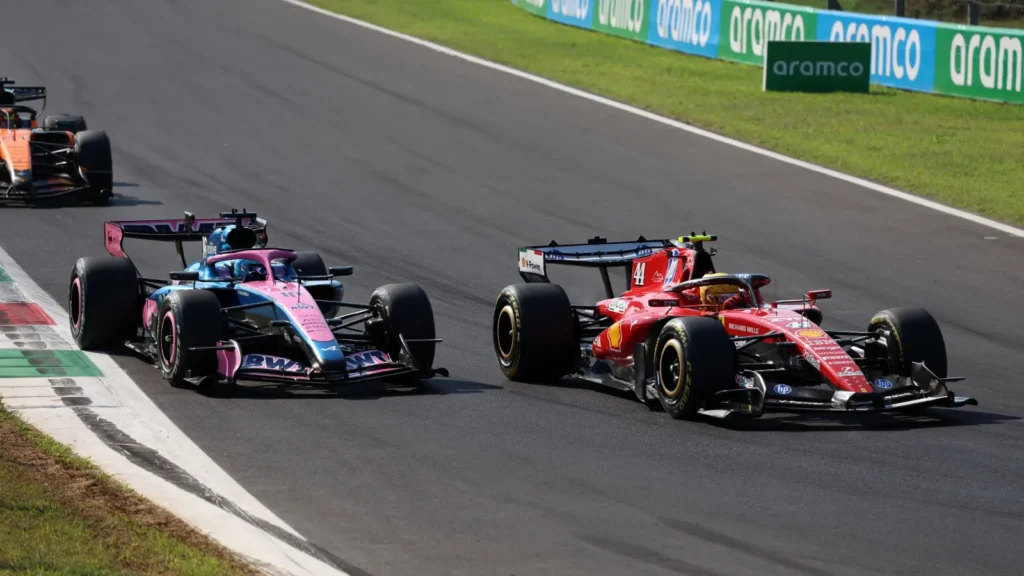
Ferrari makes “two times bigger” Mercedes PU admission after F1 Italian GP
Vasseur explained that power-sensitive tracks like Monza really exposed the power unit delta between the manufacturers on the grid.
The Frenchman believes that the gap to Mercedes was “two times bigger” at Monza than it would have been with the same engine spec at a track like Zandvoort.
“The reality of this is that if you are missing X in Zandvoort, you are two or three tenths [down]. If you are missing X minus – I’m using letters because you will try to extrapolate – if you are missing a bit less than X in Monza, the delta with the Merc is two times bigger,” he added.
Vasseur also insisted that the ADUO upgrades, while helpful, are not a silver bullet for any power unit programme on the grid.
That said, he was optimistic about the incremental improvements made so far and has set 2027 as the target where the competitive reality of the Ferrari engine may truly emerge.
“On the engine, the process is mega long because the lead time of the parts is long and the cost cap is not easy,” Vasseur explained.
“You have to produce the engine for the season. You are already a bit like this and if you want to start to do the development, you have to produce a new batch of engines, and it’s tricky.
“We were not expecting to recover [with] ADUO 1 or ADUO 2. We are doing small steps, but what you have to keep in mind is that if you make a small step on the engine, even if you make a couple of horsepower, it’s a good step on the grid.
“That means that now we will have a new engine next year. For sure, the target is to catch up, to catch up as soon as possible, but I was not expecting that in two months we will recover the delta with Mercedes.”
Under the ADUO scheme, the likes of Audi and Honda also have two upgrades each (for 2026 and 2027) allowed on their power units, along with Ferrari.
Mercedes are allowed one, and Red Bull, who have been judged to have the best internal combustion unit, cannot make any upgrades to their PU configuration.
READ MORE – Motorsport Week’s 2026 F1 Italian GP Driver Ratings









Discussion about this post