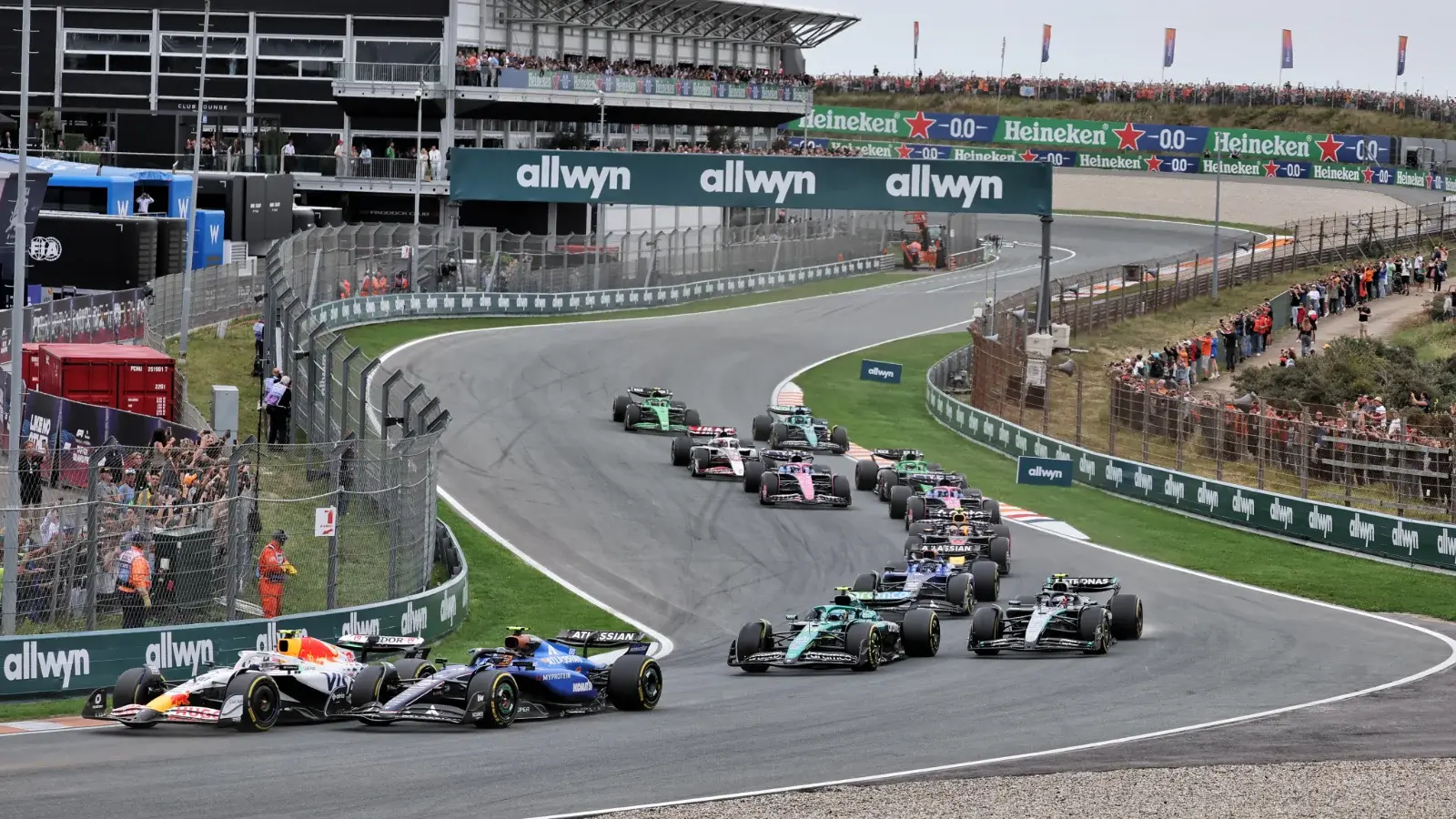
Not all Formula 1 circuits are made the same. The Netherlands’ Circuit Zandvoort is unlike almost anywhere else on the modern calendar.
The 4.259-kilometre, 14-turn circuit is squeezed into the Dutch coastal dunes — a compact ribbon of asphalt that rises, falls and changes direction almost continuously.
The Dutch Grand Prix runs 72 laps and 306.587 kilometres, meaning cars spend a large proportion of the race attacking corners rather than building speed along long straights. Opened in 1948 and first used by Formula 1 in 1952, the championship raced there intermittently through 1985 before returning in 2021 after a 36-year absence.
Modernisation has made Zandvoort safer and more suitable for contemporary cars, but it has not erased the fundamental character of the old circuit. It remains narrow, fast and undulating, with very little room to recover from a mistake.

Why qualifying position matters so much
The defining strategic problem at Zandvoort is that the circuit is much easier to attack over one lap than over an entire race. There is no huge straight comparable with Monza, Baku or Las Vegas where a driver can build a slipstream and launch an attack from distance. The succession of corners makes it difficult for a following car to get alongside before the next turn arrives.
That makes track position disproportionately valuable. A driver at the front can control the pace, choose the preferred line and avoid spending lap after lap in turbulent air. A driver several places back may have the outright pace but still struggle to convert it into actual positions.
The statistics underline this unmistakably: Verstappen took pole at each of the first three Dutch Grands Prix after Formula 1’s return in 2021 and won all three. Lando Norris then took pole and won in 2024, while Oscar Piastri started from pole and won in 2025. Once qualifying is complete, checking the Zandvoort race winner odds immediately tells you a great deal about where Sunday’s race is likely to be decided.
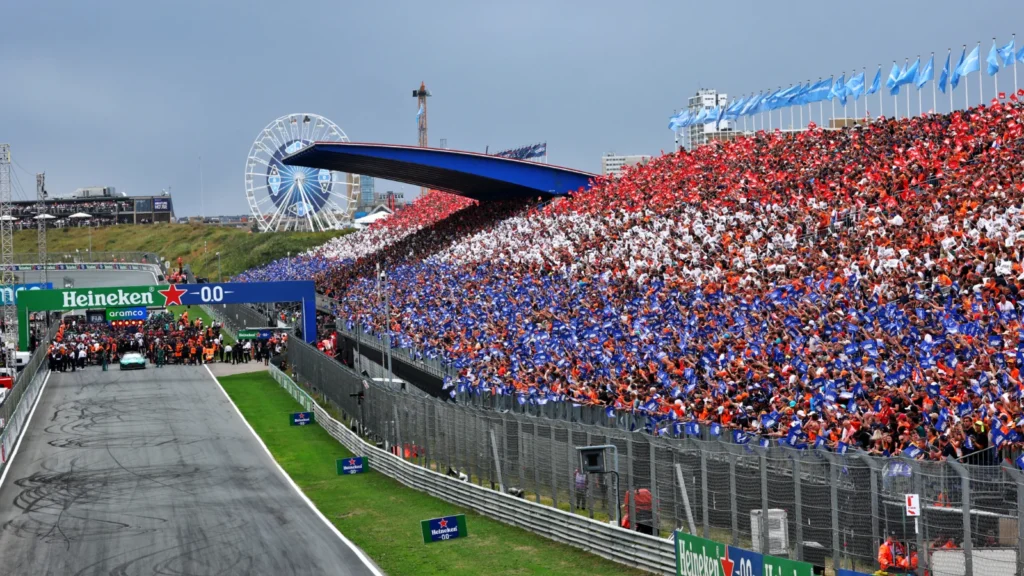
The banking changes the physics
The feature that most clearly separates Zandvoort from other F1 circuits is its banking. Hugenholtzbocht at Turn 3 is banked at 19 degrees, while the final corner, Luyendykbocht, carries 18 degrees. Those numbers are remarkable in contemporary Formula 1, where most corners are essentially flat or only mildly cambered.
Rather than relying entirely on aerodynamic downforce and tyre grip, the inclination of the track creates an additional component of force into the corner, allowing cars to carry enormous speed through turns that would otherwise demand much larger braking. Hugenholtzbocht was widened and transformed into a parabolic banked turn for Formula 1’s return in 2021, with the intention of allowing cars to run alongside one another through the corner. The result is not simply a faster turn, but a place where drivers can exploit the banking to alter the ideal line.
Luyendykbocht is a final corner oddity
The 18-degree banking at the final corner creates an unusual challenge because it is the last turn before the pit straight. A driver who loses momentum there does not merely lose time in one corner — the mistake compromises the entire approach to the start-finish line and the next braking zone. Conversely, a strong exit can provide a valuable opportunity to attack into the opening sector. The unusual geometry helps preserve the old-school sensation of speed that is one of Zandvoort’s defining characteristics.
Tarzan is the exception to the overtaking problem
If Zandvoort has one corner that consistently offers a genuine passing opportunity, it is Tarzanbocht. The first corner is heavily cambered, giving drivers more freedom over their positioning than the narrow circuit generally allows. Cars can attack around the outside or use the inside line, making it one of the few places where a driver can force a move rather than simply wait for a mistake or a pit-stop strategy to deliver a position.
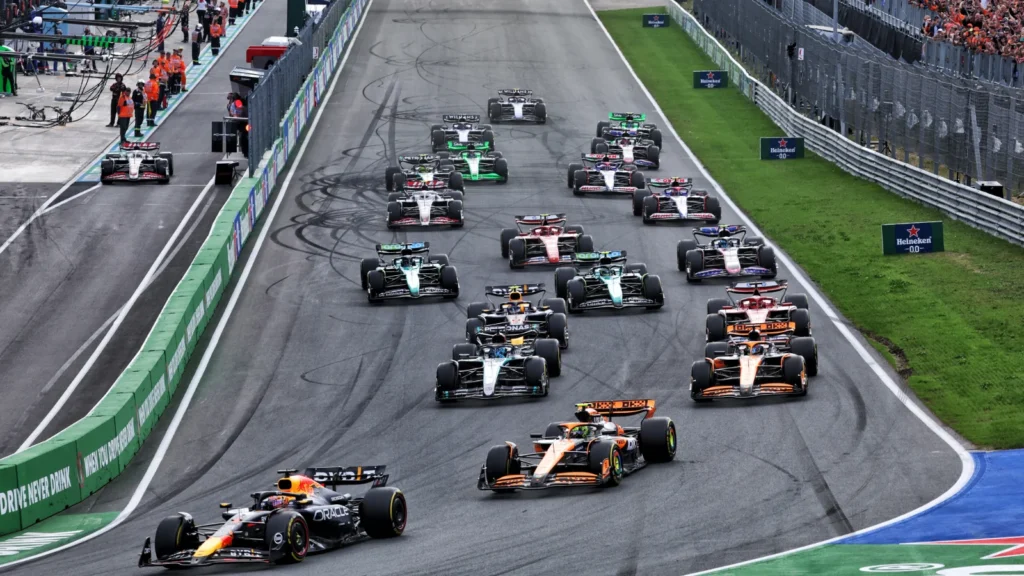
That makes the run from the final corner to Tarzan especially important. The banking and camber help create multiple viable trajectories, so a driver who has built enough momentum can turn a small advantage into a realistic overtaking attempt.
Why the tyres make the circuit even harder
Zandvoort’s compact layout places unusual demands on rubber. There are relatively few long straights on which tyres can recover, while repeated high-speed changes of direction keep loading them throughout the lap. The banking allows cars to maintain extraordinary speed through corners, but that speed comes with sustained lateral forces. A car needs enough downforce to remain stable through the fast sections and enough mechanical grip for the slower turns, while excessive sliding quickly consumes what little tyre life remains.
The quickest driver over one lap may not be the driver who manages the tyres best over 72. The ability to exploit the banking, use different lines and keep the car within the tyre’s performance window becomes a race-winning skill in its own right.
Records, history and the circuit’s darkest moments
Formula 1’s history at Zandvoort contains some of the sport’s most celebrated and most haunting moments. As The Athletic’s deep dive into the circuit notes, the track hosted Jim Clark, Jackie Stewart, Niki Lauda and Alain Prost across the original era, producing some of the most memorable racing of those decades.
The 1973 race was overshadowed by the death of Roger Williamson, whose tragedy became part of the wider push for improved fire protection and circuit safety. Gilles Villeneuve’s 1979 drive — continuing with a severely damaged Ferrari after a tyre failure, sparks flying and a front wheel in the air — became Zandvoort folklore.
René Arnoux recorded three pole positions at Zandvoort in 1979, 1980 and 1982. Verstappen matched that total with three consecutive poles from 2021 to 2023, and they remain joint record holders. Can Verstappen become the sole leader with a fourth in 2026? The current lap record belongs to Lewis Hamilton — a 1:11.097 set during the 2021 race at an average of 215.654 km/h, a remarkable figure for a circuit with no meaningful straight.
The original era ended in 1985 when Lauda beat Prost by 0.232 seconds in one of the closest finishes in the event’s history. Formula 1 then disappeared from the dunes for 36 years. The circuit continued to host other categories, but the absence of grand prix racing lasted until 2021 — and the character that made it special before was still waiting when the cars finally came back.