
Kimi Antonelli arrives at his home race leading the championship by 59 points, the first Italian to top the standings at Monza since Alberto Ascari in 1953. But he won’t start anywhere near the front of the grid.
Mercedes have confirmed Antonelli will take a back-of-the-grid engine penalty this weekend, a decision Toto Wolff made weeks ago and has stood by despite the optics.
“Obviously, algorithms don’t take their nationality into consideration,” Wolff said in Zandvoort. Monza is the easiest circuit on the calendar to overtake at, so if Antonelli has to lose ground, this is where it costs the least.”
George Russell won’t be penalised this weekend, and Antonelli is sacrificing his own qualifying position to tow him, repaying Russell for doing the same earlier this season.
“This week he’s willing to help me out in qualifying, which is great as well. That’s just the way we are as a team,” Russell said, though he stopped short of saying that goodwill survives a tighter title fight: “if it gets closer, it will just be agreed upon.”
Russell resisted the idea that Mercedes’ penalty situation hands them the weekend. Asked if Monza’s power-unit demands make Mercedes favourites, he said only “we definitely probably have a greater opportunity than we’ve had in the last two races,” naming Red Bull’s power unit as a threat and calling it, plainly, “a four-team race.”
Mercedes’ upgrade choices show two changes, both minor drag reductions: winglets removed from the rear wing, mirror stays trimmed, the smallest package on the grid alongside Racing Bulls.
Russell explained why: “We know we’re an upgrade behind most of the grid… it’s the right call for the championship over any single win.”
Ferrari’s honest gamble
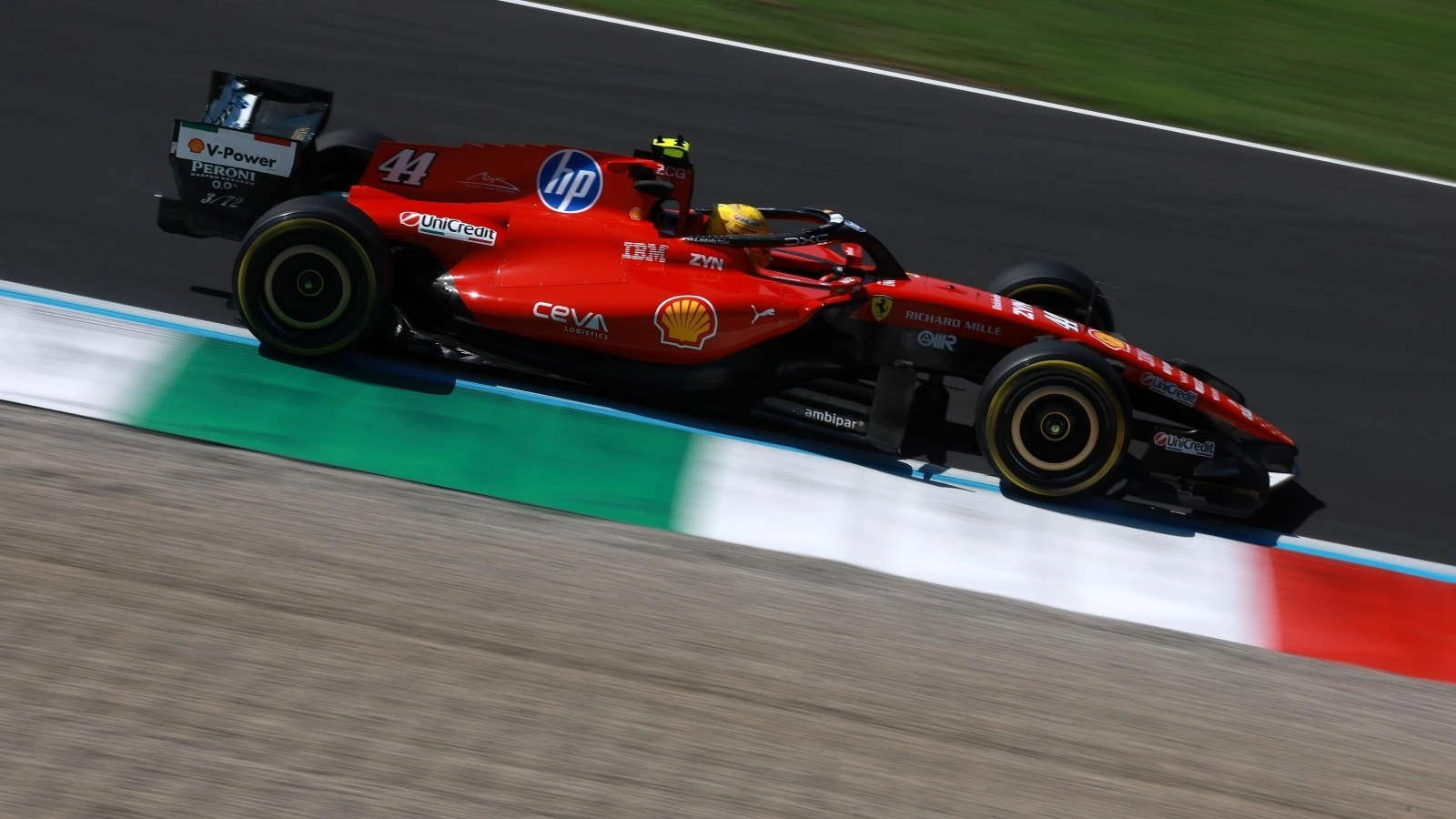
Ferrari’s FIA-submitted package is the most extensive on the grid: front floorboard optimisation, shortened mirror stays, the rear brake duct winglet cascade removed, a slotted central RV tail winglet, described as a coordinated push “targeting aerodynamic drag saving… in a favourable ratio for this track.”
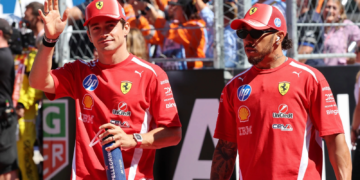
Charles Leclerc’s own framing was telling.
He didn’t claim the upgrades would close the gap, only that he hoped they’d “help us close the gap a little bit to the teams we expect having the upper hand this weekend,” a driver on a car that’s won two of the last three races quietly admitting Ferrari expect to start Monza behind.
He also noted a useful technical detail: unlike previous eras, when teams stripped 100 points of downforce for Monza, the grid is running configurations close to normal this year.
“That will be probably the biggest difference on a track like this,” he said, “other than the obvious one, which is the power unit,” a sign Monza’s old specialism matters less under 2026’s rules.
McLaren’s smaller bet
McLaren’s submission is modest by comparison, having already brought a massive upgrade in Hungary.
To Monza they brought minor changes: a reworked rear wing for straight-line drag, and a floor furniture update for flow conditioning, a fraction of Ferrari’s package.
McLaren’s risk this season hasn’t been pace; it’s been pit-lane execution.
Piastri’s Zandvoort recovery from fifth to third after a red-flag restart was undone by a slow stop that let Russell through.
Norris, meanwhile, has looked comfortable racing at the front, overtaking both Mercedes drivers in one race. If McLaren’s threat at Monza materialises, it’s more likely undone in the pits than on track.
Red Bull’s quieter story
Red Bull’s upgrades show reliability issues, not performance: a revised rear-corner gaitor and trimmed exhaust tailpipe bracket, explicitly framed around running the power unit “reliably around the Monza circuit,” notable for a team whose engine has generally been seen as one of the grid’s strongest.
Liam Lawson has used more major power-unit components than any other driver this season, while Verstappen sits mid-table.
Verstappen himself was unusually resigned in the paddock, calling Monza “very energy inefficient” and admitting Red Bull are being out-developed: “other teams around us are bringing upgrades at the moment… we don’t expect that to change now.”
Bigger betting Haas
Outside the top four, Haas has the most substantial midfield update: a new front floor with revised side geometry and diffuser, new sidepod and coke-line bodywork with a narrower roll-hoop, and realigned rear suspension fairings, a coordinated package in place of isolated tweaks.
Esteban Ocon called it “quite a big package,” adding the team is “excited in the office” to see it translate to track.
But he cautioned Monza as it “is not the most technical circuit for it”, with fuller gains expected in Madrid.
He also won’t run the complete update this weekend: the new aero, but not the second power unit spec, since the team only has one. Any read on Haas’ pace here is partial evidence at best, especially with reduced harvest/deployment limits (down to 4 megajoules) also new this weekend.
Ocon’s read on deployment rules was the most technically useful material from the paddock.
The simulator difference was marginal, roughly “1.5 or 2” tenths, but crucially doesn’t force lift-and-coast: “we make sure that you don’t do lift and coast… and there was none of that at the moment.”
On strategy deviation between drivers, he was frank that Monza offers little room to gain by deploying differently, unlike Zandvoort or Shanghai earlier this season: “if somebody chooses a different deployment strategy, they will pay the price big time,” heralding convergence rather than mayhem.
Ocon also expects Monza to show bigger gaps between teams than last year, since the power unit and deployment rules matter more at a low-downforce, high-speed circuit.
Midfield movement
The rest of the grid is mostly making small, Monza-specific drag adjustments rather than performance steps.
Williams brought three: a vertical fence around the Halo for downstream airflow, a reduced-chord front wing element for balance, and a floor trim shifting the downforce-to-drag ratio at the front.
Racing Bulls updated the rear wing’s straight-line mode mechanism and repositioned the exhaust tailpipe for better flow management, a genuinely Monza-shaped package given how much the circuit rewards straight-line efficiency.
Aston Martin’s update was smaller: revised front suspension fairings and a floor edge tweak ahead of the rear tyre, both for local load rather than drag.
Alpine redesigned a front wing footplate vane for local load and removed a rear wing fairing to cut drag, a direct concession to Monza’s demands.
Cadillac added a revised floorboard stay and a new diffuser vane, both recovering rear-end load that drag reduction elsewhere tends to cost.
Audi were the only team to submit no updates at all, a remarkable absence given how universally the rest of the grid is chasing efficiency this weekend.
None of this reshapes Sunday on its own, but Haas’ package is worth watching both this weekend and as a Madrid marker, and as a cue Monza’s demands touch everyone, not just the four fighting at the front.
The verdict for Monza
Antonelli’s penalty was decided weeks ago, and Mercedes have been transparent about the trade-off.
The more interesting question is what it’s created: a rare weekend where four teams have a credible claim to victory, none of them purely on pace.
Mercedes are playing a longer game with Russell’s own penalty still to come.
Ferrari have the boldest hardware bet on the grid but an unresolved question about whether execution can match it.
McLaren are betting restraint pays off if the pit crew doesn’t hand anything back. Red Bull, on their own admission, are just trying to survive a circuit that doesn’t suit them this year.
Whoever wins Sunday is unlikely to do so because they had the fastest car. It’s more likely to be because they made the fewest mistakes.
READ MORE – Ferrari gives Tifosi hope with strong showing in FP1 at Monza






Discussion about this post