For the average MotorsportWeek.com reader, the weekend is defined by the precision of a sub-two-second pit stop or the aerodynamic nuances of a 2026-spec front wing.
We are accustomed to a world where a millimetre difference means a disqualification from parc fermé. Yet, when the race is over and enthusiasts turn to their own everyday cars or project vehicles, that world of precision often gives way to a chaotic reality of incompatible parts and logistical errors.
The contrast between the high-octane efficiency of the paddock and the hit-and-miss nature of the UK’s online aftermarket is stark. While F1 teams rely on perfect telemetry, the average consumer is often navigating a minefield of bad data and inventory ghosts.
The heavyweights; understanding the scale
To understand why the industry struggles, it is essential to examine the scale of operations involved. Taking AUTODOC UK as a representative example, we can see the sheer volume required to compete in Europe. Based in Berlin, this retailer operates across 27 countries with revenue exceeding €1.5 billion.


With a catalogue of 6.7 million products and a workforce of 5,000, their operational data provides a clear lens through which to view the complex mechanics of the wider market.
However, even with such massive infrastructure, the industry is plagued by a common enemy: the mismatch between database specs and physical reality.
Data failures; the incompatible fit
In racing, a part either fits the regulations, or it doesn’t. In online retail, the lines are blurrier. The most significant “pain point” for UK mechanics is receiving a component that technically matches the description but fails to fit the vehicle – a retail DNF.
Industry data suggests return rates for auto parts hover near 20%, a figure that would be unacceptable in any racing series. The root cause often mirrors a driver error: poor input data.
A recent poll conducted by AUTODOC via their Instagram stories that asked how users search for a part highlighted a critical flaw in consumer behaviour:
Ask my mechanic: 3%
Search by car model: 38%
Search by VIN: 37%
Search by part name/code: 22%
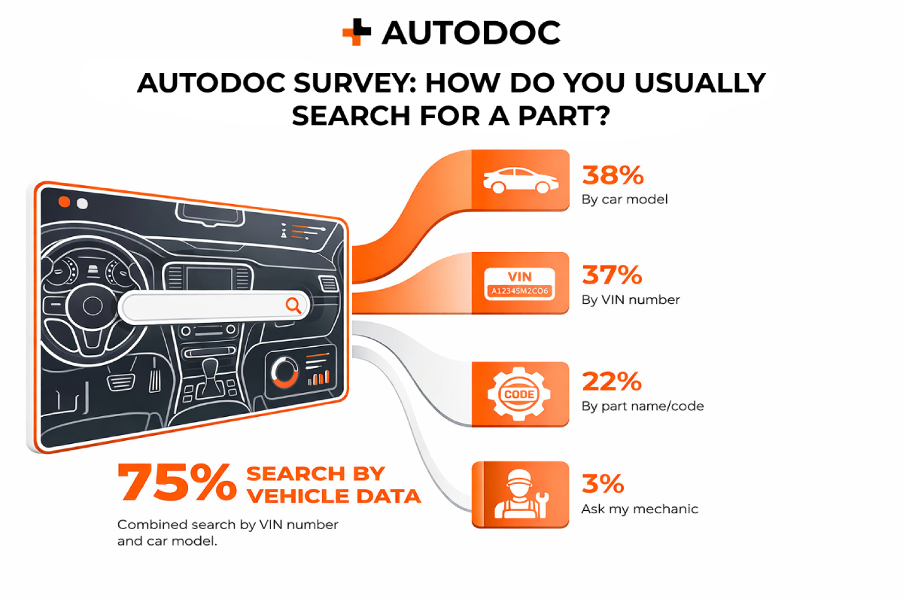
The data reveals that 38% of users rely on the “car model” for search, a vague metric compared to the specific DNA of a VIN (Vehicle Identification Number). In a world where a VW Golf can change braking systems mid-season, relying on the model year is akin to setting up a race car based on last year’s weather report.
While AUTODOC’s platform attempts to mitigate this with a verification system that users verify as “user-friendly” and accurate in Trustpilot reviews (4.3 stars), domestic UK competitors frequently struggle to manage this complexity.
Mechanical failures; the phantom inventory
Nothing frustrates a race engineer more than a strategy based on tyres that aren’t available. Similarly, “phantom stock” is a plague among UK retailers.
While AUTODOC faces the logistical drag of cross-border shipping, their “Safe Order” initiative acknowledges the reality of these variables, offering an insured return loop that acts as a safety car for the consumer’s wallet, preventing a total loss on incorrect or substituted parts.
The chequered flag
For the motorsport enthusiast, maintaining a road car should be a routine pit stop, not an endurance race against logistics. The issues plaguing the UK market highlight a sector that often lacks the precision fans are used to seeing on track.
While major players like AUTODOC leverage massive scale to refine their catalogues and support, the results from the Instagram poll is clear: the first step to a successful repair, much like a successful race, is starting with the right data rather than a guess.