

Sebastien Bourdais has pointed to the prescribed restart procedure as one of the main factors in IndyCar’s recent collisions when resuming the race.
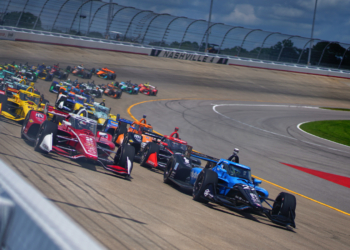
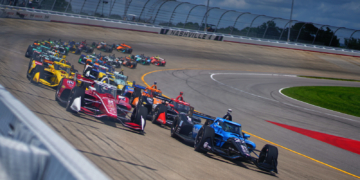
Per series rules, the pace car leaves the leader to pace the field for much of the lap leading to the restart. Often times that lead driver will push the field to a relatively high pace, in part due to the anticipation of getting back up to race speed.
This can lead to drivers in the back of the field not being able to form into a pack until very near to the start line, which creates large speed differences through the final corners before the restart line.
Bourdais did his best to allow the field to have a safe restart when he led the field to green on lap 64 at the recent Bommarito 500 from World Wide Technology Raceway, and feels that a better-defined procedure would help to have more clean restarts.

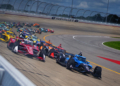
“I don’t know if anybody noticed what I tried to show at Gateway when I did lead the restart,” said Bourdais. “I pretty much did what I would very much like race control to kind of get on board with, but we seem to have a bit of a varying perspective on the whole thing.
“When I did that restart, I pretty much went to safety car speed right away at the line and for the entire lap until the restart, and that seemed to have just settled down a little bit, and not trickled as much accordion effect as we’ve seen in a lot of the starts and restarts.
“I mean, on the race control side, they tend to put a lot of responsibility on the leader to try and lead the field with the safety car just getting away before we even get it packed up, and therefore we barely ever get it packed up before starts or restarts.

“To me it’s a very risky move because you end up starting races with a field that has very, very large amounts of speed differential, and we’ve seen cars on top of each other many times.
“I very vehemently disagree with that approach, but I’m not the only one and I’m not race control, so everybody’s opinions just matter for themselves.”
Bourdais was caught up in an early race collision in Nashville, when the restart queue backed up unexpectedly and Marcus Ericsson ran into the back of his AJ Foyt ride.
The collision damaged the rear of the car and led to the Frenchman’s early retirement after only five laps, while Ericsson was able to repair his car and went on to claim an unexpected win.
Bourdais does not place the blame entirely on race control, however, and made sure to note that the competitiveness of the series has helped to create some of the clashes seen lately.
“When you have a monotype series for the most part with two engines that are very closely matched, and [the field is] very high density, you’re going to see very, very high aggression on starts and restarts,” continued the long-time veteran.
“Unfortunately, everybody knows that this is when things are happening, and if you are looking for positions, well, you’re not going to have that many chances.
“I wish we were kind of getting more involved with that [procedure], but for sure everybody needs to be on board, as well, and respect the gapping and how much throttle brake is applied and stuff like that.
“It takes a bit of everybody to fix the problem that we’ve had lately for sure.”
Other drivers, including the current points leader Pato O’Ward, have pointed to the chaotic restarts as an area that can be improved, whether by driving standards or through tighter control on the restart procedure.
There may be more chaos on the starts and restarts this upcoming weekend in Portland, which has a first-corner chicane that has been a hot spot for collisions in years past.




Discussion about this post