

Ex-Red Bull boss Christian Horner said Formula 1 should raise its budget cap from $215 million, claiming teams are spending $500 to $600 million.
2021 was the first year the cost cap was introduced, limiting F1 teams to $145 million a year. This was bumped up to $215 million for 2026 due to regulatory changes.
However, the budget cap doesn’t cover all aspects of team spending. Aspects like driver contracts, the salaries of the top three employees that aren’t the drivers, travel costs and marketing all aren’t included in the initial budget cap.
The sport also runs a separate budget cap for the power unit, with $190m allocated for teams.


Horner led Red Bull through most of its success. However, he also led the team when it received a fine and reduced wind tunnel time for breaching the cost cap in 2021.
He told Autosport that F1 should change the rules.
“In the early years, there was a bedding into those rules,” he said. “The things that we got charged with in that first year now would not be an issue, or even in the second year.
A more diverse cost-cap
“So I think they’ve tied up a lot of the regulations; what I see now is that you’ve got a budget cap of just over $200m, but teams are spending $500 or $600m.
“More needs to be included within the cap. I think the cap on the engine side, arguably, as an all-encompassing cap, is a good thing; it’s just, what is that level?
“Formula 1 teams will spend as much money as they have, and it’s like a balloon with not enough air in it; if you squeeze it one end, the air is going to go somewhere else.
“So you’ll now see driver retainers far healthier than they were pre-budget cap, and it’s finding that right balance, and I think all of these businesses now, they’re no longer liabilities.
“Even the smallest team on the grid has a multi-billion dollar valuation. Five, six, seven years ago, they would have been seen as liabilities.
“So it’s driven real value into these teams, or franchises, that a team like Haas or Williams has come up the rankings.”
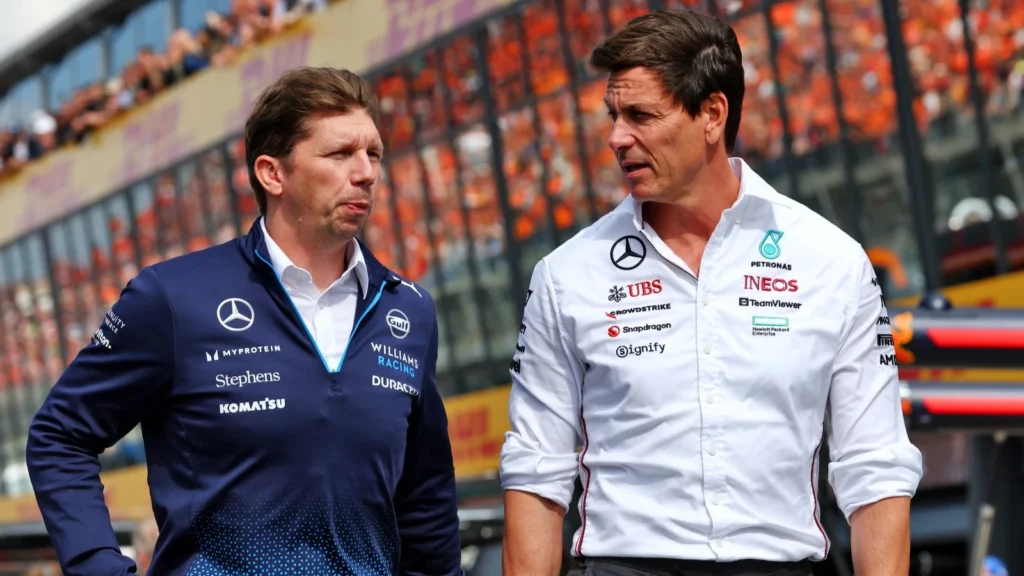
James Vowles, Williams team principal, has been open about wanting cost-cap changes, believing it still benefits the top teams. He wanted a sliding-scale cost cap limit that gives teams lower in the constructors’ standings more money than those at the top.
It comes off the back of the criticism that teams like Mercedes and Ferrari already had world-class win tunnels and facilities. Leaving their budget cap less focused on building a base and more on on-track investment. Whereas Haas are only just getting their simulator and other facilities up and running to the same level.
Change from the old days
Regardless, the cost cap has kept F1 teams stable and profitable.
“Prior to that, Formula 1 was like having a bucket full of money with a hole in the bottom,” added Horner.
“You’d run as far as you could with it until it ran out and spend a bit more than you actually had. We saw many teams come and go as a result, and now, with a budget cap, it’s driven efficiency.
“I remember pre-budget cap, the amount of unused stock that we would have at the end of the season, that had never seen a racing car, it’d be tens of millions of pounds.
“We’d have, because of the IP, you don’t want it to go anywhere; you’re not going to destroy it, and so they just sit in warehouses full of floors and wings and suspension parts – something like an Indiana Jones, Raiders of the Lost Ark scenario!
“Now, with a budget cap, you don’t have that luxury, so you’re much more selective in what you manufacture, how you spend your money, and the usage and consumption of those parts.
“It’s driven real efficiency into the businesses, so the accounts teams play as big a role as the design teams now in terms of winning Grands Prix.
“By the time I left, the accounting department was as big as the drawing office because the financial rules are as important as the sporting or technical rules.”
Vowles is pushing for changes ahead of 2030, which will mark the next big regualtion shift. However, Ferrari, Red Bull, and McLaren have opposed the change, leaving Vowles without the necessary votes.
Even Vowles’ pitch doesn’t change the cost cap structure, only the amounts each team is allowed.
READ MORE: Malaysia considering permanent F1 return after Bahrain GP success – reports








Discussion about this post