

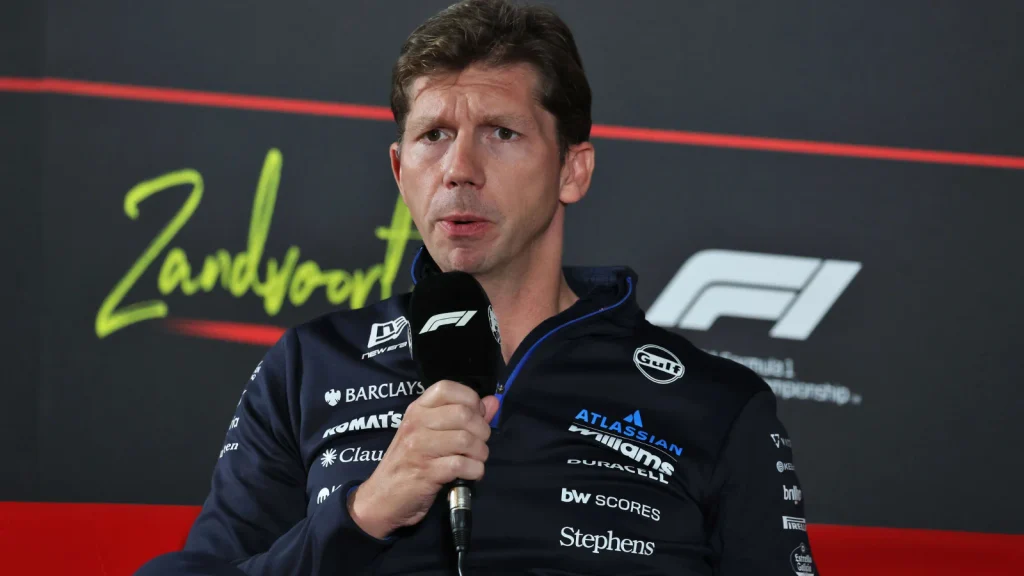
Toto Wolff has clarified his opposition to proposed changes to the Formula 1 cost cap by former Mercedes colleague and Williams Team Principal James Vowles.
Vowles has been open that he wants changes to the cost cap structure. Specifically, for teams further down the Constructors’ order. He suggested that lower teams have access to more funds than championship winners.
It’s a very similar principle to the one currently used to determine which teams get the most wind tunnel time: the lower down the order you go, the more time you have available for the upcoming season.
However, to push through a plan in the 2027 F1 Commission, Vowles would need six teams to vote for his motion. Allegedly, Alpine, Aston Martin, Audi, and Cadillac are currently in favour of the proposition, while McLaren, Red Bull, Ferrari, and Mercedes are against.


Vowles would need one more team on his side, with Haas and Racing Bulls undecided but having said they’d lean towards opposition. Zak Brown admitted he’d be open to a discussion.
The Williams boss hoped the proposal would be approved and implemented, ahead of the next big regulation shift, set for 2030 with the introduction of V8 engines.
A better balance
Toto Wolff had been adamant in his opposition, explaining that he understood the intention but that teams needed to strike a better ‘balance’.
“Where we stand, I’d love to have a little bit more room in the cost cap for lower salaries, a bracket, rather than buying new front wings, but give the possibility of paying a little bit more and being attractive as a sport,” he said.
“Obviously, it also depends on the size of the team. I think we agreed that is something we would like to do, but if you have the reality of the budget, a smaller team is not going to be happy about us having five million more in the cost cap to spend on PhDs. So that’s the second point.
“The third point is that what James is alluding to is the CapEx allowance or the CapEx possibilities. Now, how the regs were changed was that rather than having this CapEx budget, your CapEx would go into operational costs, into OpEx. So, the consequence is the teams that spent a lot in the past on CapEx, like us, for example, have a huge amount of costs that we need to depreciate in the cost cap.
“The ones that haven’t spent a lot obviously have much more possibility to spend on infrastructure or whatever you want to, what was CapEx before.
“So I think I have super sympathy with a team like Williams and with James, and he’s super clever, but we just need to find the right balance of not undoing something that we actually consciously changed a year or two ago. So, yeah, it’s just a forward-moving discussion.”
Wolff looks past the ‘red mist’
While he’s definitely open to changes in the regulations or how things work, he made it clear that making changes based on a balance of performance is like a ‘red mist’.
“Personally, I don’t like the concept of adjustment based on some positions. BoP for me is like a red mist. We’re having these tiny little adjustments on aero time, ATR, which is almost invisible to the spectator and hasn’t been a big thing because it’s really tiny.
“We have the catch-up mechanisms on the power units. If someone were to fall behind dramatically, then you get that opportunity, but it wasn’t a leapfrogging mechanism. So, the job that the FIA have done in that respect, I think, is very good.
“They haven’t allowed any politics to creep in, people making noises that they wanted to do or not. I think they handled that very well. So, do we really want another mechanism where you’re being allowed to have more CapEx, OpEx based on your championship position? I’m not sure.”
A call for caution
The Cost cap was introduced to level the playing field between teams by limiting how much money leading teams could spend, so every team theoretically has the same amount of money going in.
Some teams, like Haas, admitted they weren’t hitting the cost cap initially because they struggled financially. However, it’s had a side effect for the leading teams: they can’t offer key members higher-paid contracts, which has led to more turnover in key roles in recent years.
This is one area Wolff would like to see change. He also explained how Mercedes were disadvantaged in the opening phases of the cost cap.
“The reason the cost cap came in was in order to balance the performances between small teams and bigger teams. We had to actually quite dramatically restructure, whilst other teams were below the cap and they were able to hire,” he continued.
“So, I think that was the main idea. Now, where the cost cap has taken us is that obviously we have profitable entities, and that is, from a pure economic effect, nice. But it’s also suppressing salaries.”
Wolff believes one of the calling aspects of F1 was salaries and the job progression available. However, now you see more talent leaving the industry for higher-paid roles in other sectors.
“We were always an aspirational sport. We attracted the best talent from the best universities because of the possibilities you had in Formula 1.
“Now you can get someone into a Formula 1 team today on enthusiasm, but at a certain stage, after five, six or seven years and you have a PhD, your salaries are still depressed versus a tech company or a hedge fund or investment banking; that becomes a problem.”
READ MORE: Lewis Hamilton urged for ‘difficult’ conversation amid Ferrari ‘trust issues’










Discussion about this post