
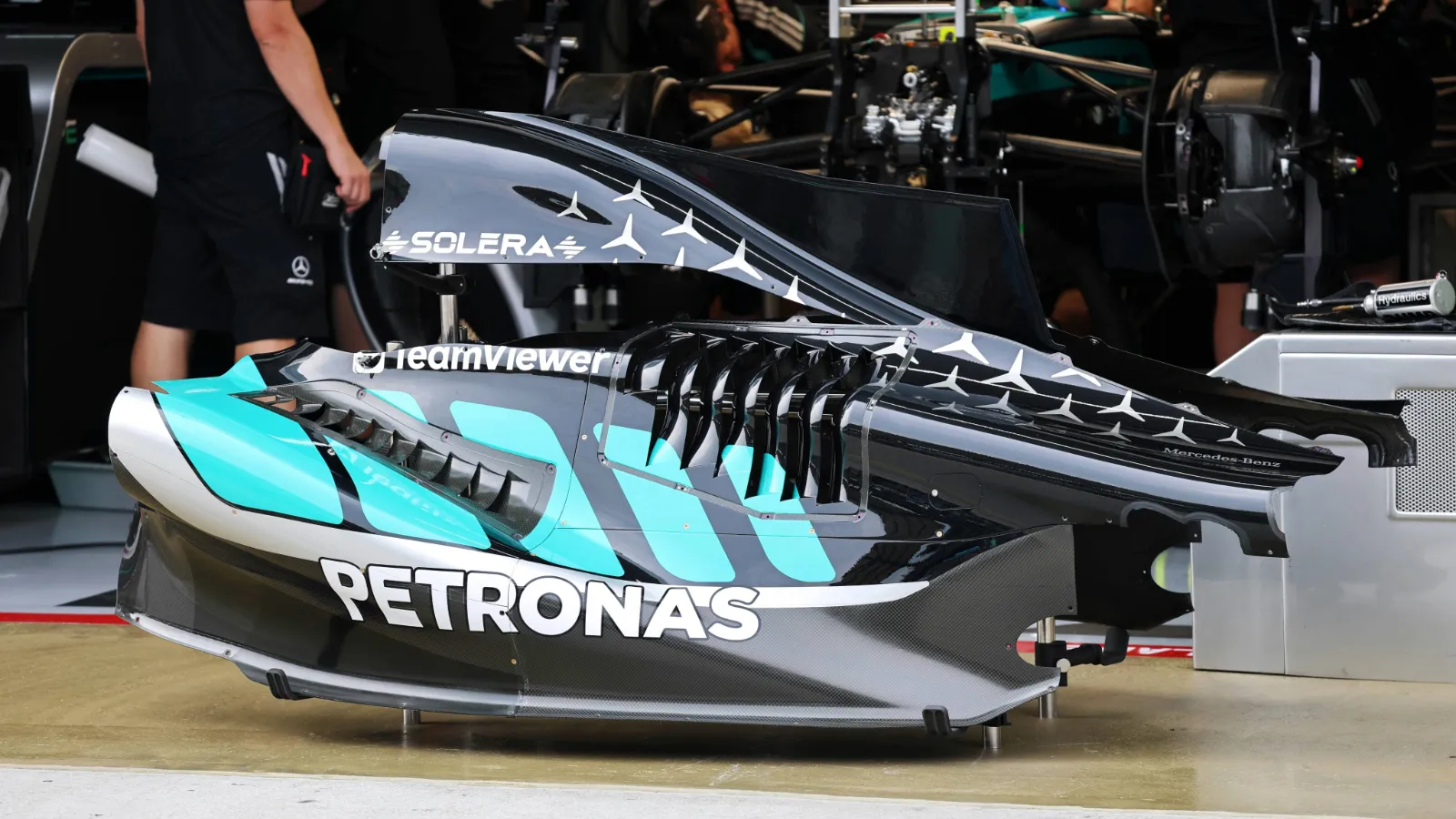
Mercedes has brought its first major aerodynamic upgrade for the W17 since May, for the Formula 1 Bahrain Grand Prix in Malaysia.
As the covers came off the 2026 Mercedes challenger at the Sepang International Circuit, it was hard to ignore a radical design choice opted for by the German marque for the weekend.
The W17 has been the benchmark of the field this year, but much of it has been down to the Brackley-based team’s stellar power unit programme for F1’s latest era, with the Mercedes PU winning 14 out of the 15 races run so far.
That said, the inherent aerodynamic concept of the chassis is something that the Mercedes engineers still want to perfect, given its relative weakness in slow-corner exits.


To combat this, the team has brought a radically revamped aerodynamic upgrade – its first substantial alteration to the W17 since the Canadian GP in May.
Much of the detail can be gleaned from the striking sidepod design. The idea is to allow concerted airflow towards the rear of the car, with an aggressive ramp angled towards the rear axle, without disturbing the inherent balance of the package.
What’s more, given the FIA has declared the race weekend at Sepang a Heat Hazard, work has also been done on the bodywork gills to accommodate the excruciating climate of Malaysia.
In addition to the sidepod bodywork changes, the team has also made extensive revisions to the floor of the W17.
These revisions, working in tandem with the updated airflow concept of the sidepods, will allow the German marque to improve its overall downforce across the car without incurring an uptick in drag.
It is being suggested that the downforce gains, on track, can be as high as four per cent.
The layout of Sepang, with its two long straights and fast-flowing corner complexes, would be the perfect venue for Mercedes to test out its latest innovation and stretch its legs further in both the drivers’ and constructors’ championships.
READ MORE – GALLERY: Mercedes reveals special livery for F1 Bahrain GP








Discussion about this post