
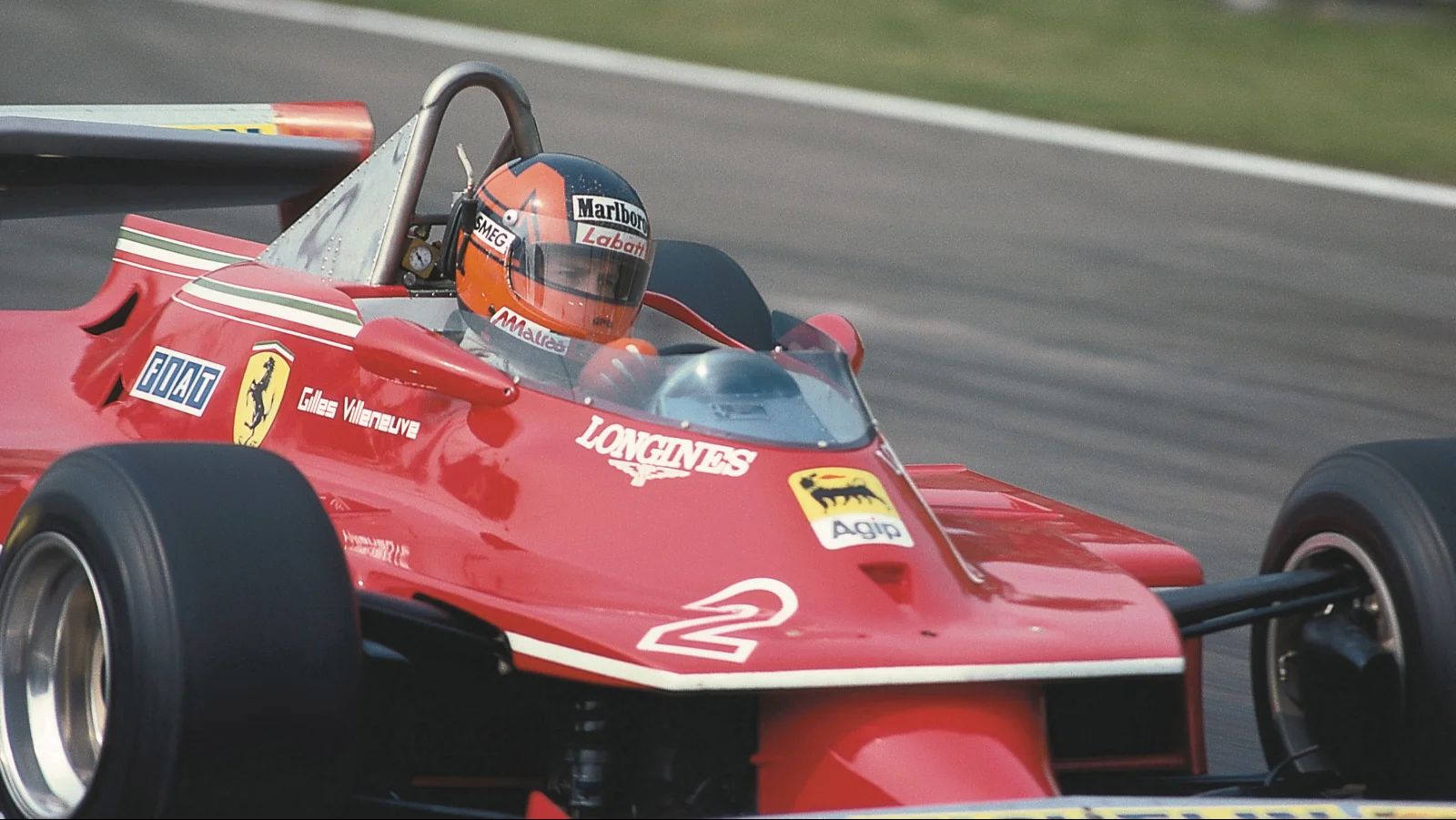
Jacques Villeneuve has opened up about the deep-seated influence of his father, Gilles Villeneuve, dispelling long-held media narratives as a new documentary prepares to shed light on the Canadian legend’s formative years.
The upcoming biopic, Villeneuve: Rise of a Legend, set for its world premiere at the Toronto International Film Festival on September 19, explores Gilles’ early career prior to his iconic Ferrari tenure.
The premiere coincides with Formula 1’s return to Madrid, where Gilles delivered his final Grand Prix victory at Jarama in 1981.
When Jacques entered Formula 1 in 1996, eventually capturing the World Championship the following season, media coverage frequently framed his career as a mission to complete his father’s unfinished story.

Gilles tragically died during qualifying for the 1982 Belgian Grand Prix at Zolder. However, the 1997 World Champion rejected those romanticized narratives from the outset.
“Talking about my dad was never an issue,” Jacques told media. “The issue was those people [journalists] were not interested in my answer. Or my way of thinking.”
“They could not care less. All they were wanting to hear is, ‘I’m carrying on the flame because of what my dad did not finish, and that’s why I’m doing it’. No, I’m racing because I love racing. Simple.”
“I loved my dad. I’m proud of him – he was amazing, what he achieved. But I’m doing my own thing. I’m not racing because I want to be the continuation of Gilles Villeneuve. That’s OK.”

A sign to stop talking about his dad
Frustrated by persistent attempts to turn his career into a Hollywood-style sequel, Jacques eventually chose silence over endless debate.
“And they were getting angry. So that’s when I said, ‘OK, I’m not even wanting to talk about him anymore because it’s pointless. There’s not a constructive discussion. You don’t actually care.’”
Jacques was just 11 years old when Gilles died, during a period when his parents’ marriage was under severe strain due to his father’s relentless focus on racing. The distance left him struggling to separate genuine childhood memories from family folklore.
“When he passed, I hadn’t seen him for a year or two, really,” Jacques said. “He wasn’t really living with us. It was really an odd situation.”
“So I never know if it’s a real memory, or a memory I was told growing up, mainly by my mother at the time. So that’s very confusing.”
The upcoming film offers the 1997 champion a rare chance to reconcile those early years with historical facts.
“So right now, it’s nice to be able to put some dots on the thing. And I think that the movie is quite accurate on those formative years.”
Villeneuve found the right reasons to race
Navigating F1 as the son of a motorsport icon presents intense scrutiny, forcing young drivers to develop a thick skin early in their careers to survive the pressure.
“If you’re doing this sport for the wrong reason, you’ll never achieve it,” Villeneuve said. “You have to really, personally, yourself, deep down, love it. Willing to take the punches because you get a lot of punches.”
“You get put back in place very easily on the clock. It’s very simple. How will you react to that?”
“Mostly in your formative years, when you start in Formula 3. That’s when you take the biggest beatings. So you need to build some kind of carapace around you.”
Shielding himself from external expectations allowed Jacques to carve out a distinct identity separate from the Villeneuve name.
“That’s why it happened like that. But then that gave me the freedom to just be me and not really carry it.”
While Jacques fought to forge his own path, he acknowledges absorbing his father’s uncompromising mindset and psychological drive to conquer challenges.
“I think that’s something I took a lot from my dad without knowing. Not because of who he was as a racer, but who he was when he was not in the race car – which was exactly the same guy. He was at home exactly the same way as he was at the racetrack in the race car.”
“Whatever he was doing was always very selfish in what he was wanting to do. He did love his family and so on, but he was very selfish in the fact that he’s the only one who wants to play on his pickup truck when he wants to climb a mountain. And that’s all that mattered.”
For a young boy, Gilles’ relentless, thrill-seeking lifestyle created unforgettable moments alongside the self-centered drive.
“And we could play with him if we did his things with him. That was it. As a boy that was super cool when I could go on his pickup truck with him at the same time, I was in paradise.”
“But then I could see his attitude towards risk, pushing the limit, but with respect. With respect to the opposition. And just always wanting to beat the next challenge.”
Gilles lived by a simple philosophy: proving his superiority through sheer audacity on and off the track.
“And often doing it just showed the other guys, ‘I can do it, you can’t’. Because that was his life story basically: ‘I can do this, you can’t’.”
“And even when he bought his chopper he was trying to do loop-the-loops because he’d been told it couldn’t do it. Stuff like that.”
That fearless mentality trickled down to Jacques, albeit tempered by a more calculated approach to danger.
“I took a lot from him on that aspect. But with a different education. So I think it allowed me to calculate the risk just a little bit better.”
“But I don’t have a lot of memory of him as a father. I don’t know if it’s because they don’t exist or because I’ve just put them away when he died. And that was my way of surviving.”
Remembering his father
In recent years, candid stories from Gilles’ former rivals have gradually reshaped how Jacques views his father’s legacy.
“What’s amazing is how over the last few years, people have opened up about their time with my dad.”
“Even [Alain] Prost, or other people that used to race with him, that never dared before, I guess. And the picture I’m getting is so different than the one I got from my mother.”
By separating the mythical Gilles Villeneuve from the real man, Jacques mapped out a career built on calculation rather than raw bravado—proving that inheriting a racing driver’s mindset does not require repeating their mistakes.
READ MORE – Williams unveils throwback livery for F1’s Madrid return





Discussion about this post