
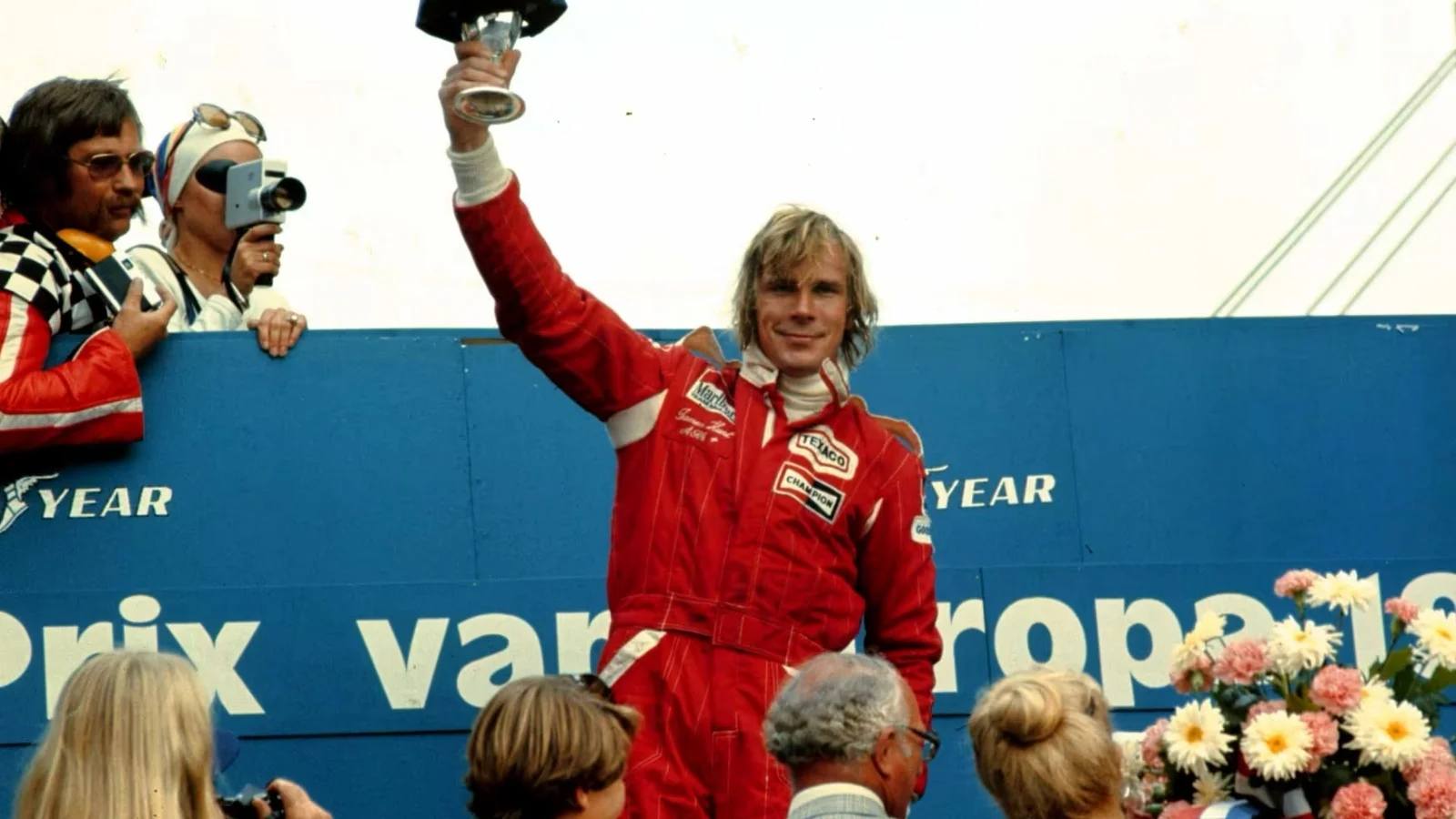
On this day in 1947, James Hunt was born. Motorsport Week takes a look at the man who was more than just a World Champion and one of Formula 1‘s perennial playboys.
James Hunt, to many of a fresher generation, is one of the main protagonists from the 2013 film Rush, which used an abundance of creative licence to retell the story of his epic 1976 title battle with Niki Lauda.
In reality, Hunt is portrayed primarily as a swashbuckling playboy who shared an intense dislike of his composed and almost-robotic Austrian counterpart. But in truth, there was more facets to Hunt, and to that said ‘rivalry’ with Lauda, than the film ever told.
After passing his driving test a week after his 17th birthday, Hunt got the taste for driving cars fast, and duly began racing Minis. Within four years, he was in Formula Ford, and a year later, in Formula 3. It was there where he first joined up with British peer, Lord Alexander Hesketh.
Together in Formula 3, they swiftly moved into Formula 2, having written off all the cars they had already races, helping Hunt earn the nickname ‘Hunt the Shunt’.
With costs not too dissimilar from entering Formula 1, Hesketh decided to throw in his lot and make a go of it, and with Hunt as his star driver, they bought a March 731 off the back of a successful Race of Champions event in which Hunt finished third. The adventure had now truly begun.
Hunt brought Hesketh its first point at Paul Ricard, followed by more at Silverstone, before a first podium at Zandvoort. The season ended with a further improvement of second place at Watkins Glen.
1974 saw a further three podiums, but it was the 1975 season that saw Hunt and Hesketh truly light up F1.
The lavish approach of Hesketh saw the team do things differently to that of the sport’s establishment. Pianos at the back of garages, celebrity guests and turning up in a Rolls Royce, Hesketh significantly shook the landscape, and did so formally at Zandvoort.
Hunt took a maiden win in a wet-dry race which saw him bravely defend Lauda, a man he’d come up against whilst on the career ladder in lower formulae. He was now firmly on the map.
Sadly for Hunt, however, without any sponsorship, Hesketh could not sustain its move towards the top, and withdrew from his own team. The team soldiered on, but Hunt had lofty ambitions, and when Emerson Fittipaldi vacated McLaren for Coprasucar, the chance of a big drive with a big team was his.
McLaren – the chance that made James Hunt a World Champion
It gave Hunt a chance to show his muscle against the awe-inspiring Lauda and Ferrari pairing, but did not get a win until Round 4 in Spain. It was inititally disqualified but was reinstated upon appealing, and was not the only controversial moment of the season.
At Brands Hatch, Hunt and Lauda collided, causing a red flag. Hunt won the race after a restart but was disqualified for attempting to race with the spare car. The decision was over a month later, by which time the title had taken a nasty turn.
At the Nurburgring, Lauda was infamously injured in a fiery accident that left him heavily burnt and, after inhaling toxic fumes, was left in hospital, having been given the Last Rites.
Whilst hauling one foot out of the grave, Hunt took victory in Zandvoort to add to the win at the Nurburgring. Hunt was now firmly in the title race, but just six weeks after Germany, Lauda was miraculously back.
His return was in Monza, and there, he earned ageless folklore by coming fourth, with Hunt spinning out. After officially losing his Brands Hatch victory, Hunt needed to be on a charge, and duly took a superb win in Mosport, and followed it up with victory at Watkins Glen.
The title would come down to the final race in Fuji.
On the morning of the race, Hunt, upon hearing some noises in the hotel room next to his, opened the interconnecting door to find Lauda marching around in his overalls, and greeted his adversary with the proclamation: “Morning, I’m going to be the World Champion today!”
But the heavy rainfall in Japan caused a discussion on whether the race should indeed go ahead. If it didn’t, Lauda would indeed be champion without having to set foot in his Ferrari. The race went ahead.
Lauda took the morally brave decision to retire the car after a handful of laps, leaving Hunt to an unchallenged quest for the title.
Hunt was set for the championship but a late puncture saw him tumble back down the order. But he worked his way up to third place, which was enough to see him take the title by one point.
From the cockpit to the commentary box
Incredulously, Hunt retired from F1 within three years of his title success. Having been unable to capture the form that took him to the top, a move to Wolf saw him opt to retire midway through the 1979 season. And with that, came a new calling.
The BBC, which had just begun showing Formula 1 consistently for the first time, hired Hunt to act as an expert analyst in the commentary box alongside Murray Walker, and the double act that it created was the stuff of legend.
Sharing one microphone, Walker and Hunt often clashed, contradicted each other and when grasping hold of it himself, Hunt was able to deliver a stream of honest and often blunt opinions on drivers, particularly those in backmarker positions. One famous incident was at the 1988 Monaco Grand Prix, when, after hearing Walker explain that Rene Arnoux had commented that non-turbo F1 cars did not suit his own driving style, riposted that the Frenchman had talked “bulls**t”.
In the background, Hunt endured some tumultuous times in his personal life. Twice divorced, Hunt suffered from financial troubles, and well-documented abuse of alcohol and drugs, but continued to commentate whilst recovering his losses.
Now in his mid-40s, the stability his commentating brought was accompanied by, for the first time, accompanying stability away from work. He found a new partner in art student Helen Dyson, and the pair were engaged in the days after he commentated on the 1993 Canadian Grand Prix from London with Walker, which set a tone in change of pace, having also ditched his excessive vices.
The next day, Hunt’s frivolous lifestyle ironically caught up with him, and passed away from a heart attack at his home, aged 45.
Tributes poured in from around the world of motor-racing, and Walker, who freely admitted was a polar opposite to Hunt – describing themselves as like “oil and water” – delivered an emotional euology on a subsequent TV programme compiled in the days afterwards.
But his character and personality, both within the car and in the commentary box, did ensure that he lived on as one of F1’s biggest personalities, aided by the Ron Howard-directed film. So much so that a fellow F1 World Champion, Kimi Raikkonen, entered a snowmobile race prior to a new season under the name James Hunt, showing the respect posthumously earned down to a new generation of drivers.
There were many other layers to Hunt, too. Through long-term McLaren sponsor Marlboro, Hunt became a mentor to an up-and-coming racing driver called Mika Hakkinen, who has fondly recalled his memories of him since. There were more mundane aspects to his persona, too, as he was also a champion in budgeriegar breeding, and was reputed to have found winning a rosette in a local competition as thrilling – or perhaps more – than winning a Grand Prix.
Through the help of his almost-identical son Freddie, Hunt’s legacy is still strong, with merchandise often sold bearing his helmet design and name. YouTube often plays a helpful part, also, as many examples of his iconic commentary is freely available to listen to.
Whilst there was a lot more to the man with the ‘Sex – Breakfast of Champions’ badge sewn into his overalls. But however you wish to view James Hunt, there is no doubt that the legend lives on.
And in today’s world of thoroughly media-trained and PR-sanitised Formula 1 drivers, always walking around in enough sponsor-laden team clothing to appear like a walking billboard, the image of Hunt, in barefoot, flared jeans and a t-shirt can still cut through in a way that will always raise a rye smile.
And thank goodness for that.
READ MORE – Lando Norris signs major McLaren deal to secure F1 future




Discussion about this post