
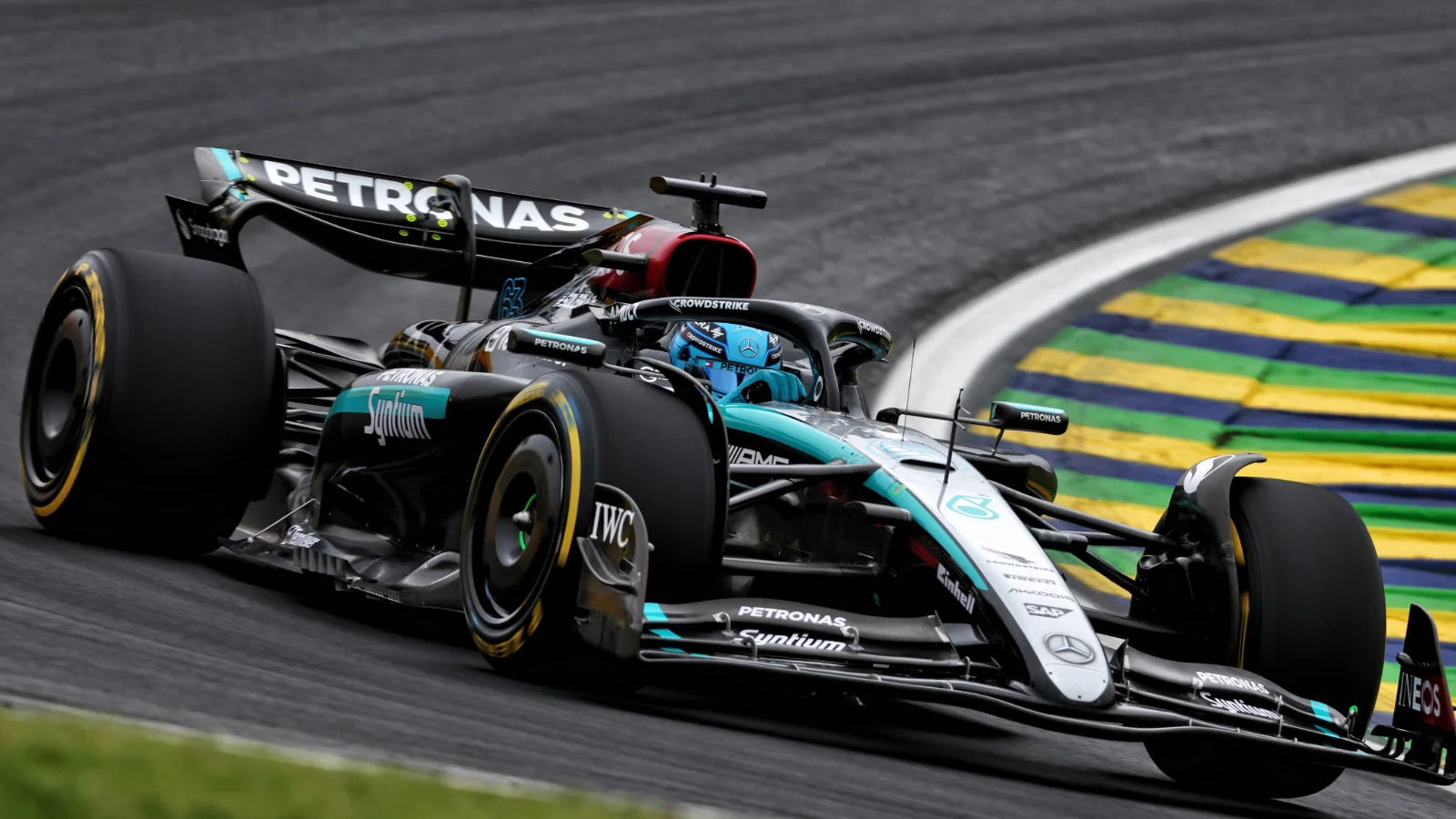
Mercedes will continue to experiment over the remaining races as it strives to ensure the W15’s slow-speed weakness is eliminated on the team’s 2025 Formula 1 car.
The German marque has endured a challenging run since the summer break as an update package in the United States has provided more unexpected complications.
However, Mercedes Trackside Engineering Director Andrew Shovlin has denied the new parts were intended to address the largest issue with the side’s 2024 package.
Shovlin has revealed that the biggest area Mercedes continues to spurn lap time to its immediate competitors is through sections which comprise low-speed corners.

But while addressing that shortcoming won’t transpire until next season, Shovlin has insisted there are learnings Mercedes can take from the W15 to aid that process.
“Where we tend to be weak, it is in the slow-speed corners, particularly the ones where you have got one corner following into another,” Shovlin said.
“There is a lot of turning of the car, and that is a weakness that we need to work on. We did not expect this update kit to improve that.
“All we expected was this to just lift the base performance of the car. In terms of what we have seen, we are confident it is doing what was expected.
“However, we are also confident there is some fundamentals that we have got to get to grips with this car in order to fix them on the W16.
“We are very busy with that right now, and hopefully making the right changes over the winter so that we are not struggling with these weaknesses next year.”
Mercedes to continue experiments
Mercedes’ slump in competitiveness since the summer break – which has delivered one podium in seven races – has the team resigned to ending the season in fourth.
But while that would mark the squad’s lowest placing since 2012, Shovlin has admitted Mercedes has been granted a chance to allocate an earlier emphasis on 2025.
“The main thing in terms of learning is that the corners that we are weak in are still the same ones,” he reiterated.
“It is the interconnected, slow corners. That is normally where we trip up.
“Going into this weekend, we certainly had sector two in Brazil, which has a lot of those corners on our radar as an area that we might struggle.
“The big focus in these remaining races for us is learning what we can. We are in a position in the championship where we cannot challenge in front of us.
“It is very unlikely we are going to see any challenge from behind.
“Our focus has very much shifted to learning what we need to this year to apply to next year in order to get on top of those issues.
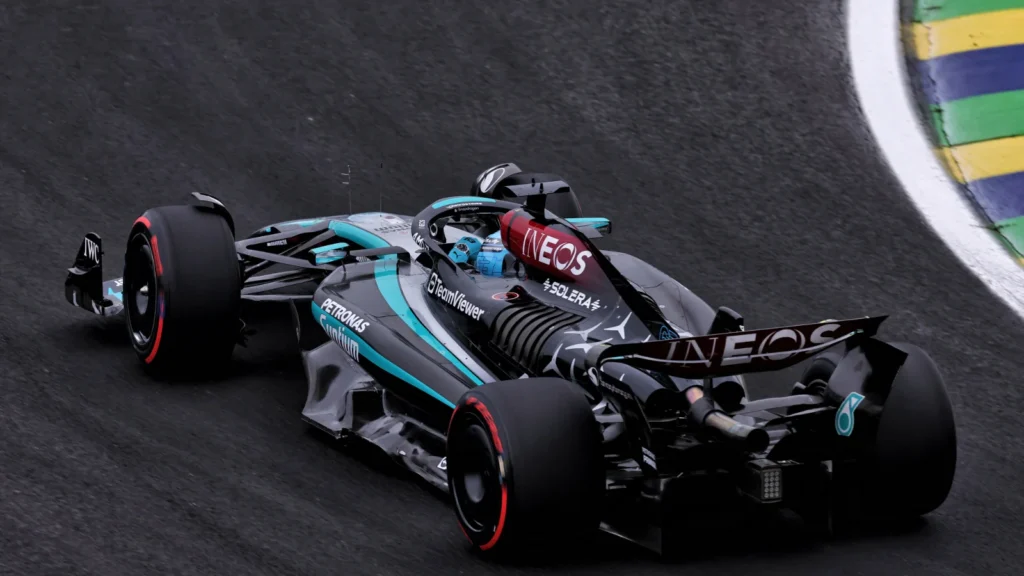
“In Brazil, it was useful having that wet running because you want to get a read on the car in the wet.
“There is always a few wet quali and race sessions over the year. It was reassuring to see that the pace in those conditions was decent.”
Mercedes expects remaining races to validate knowledge
Shovlin believes the contrasting characteristics across the three upcoming circuits will validate whether the winter tweaks Mercedes plans to make are the right ones.
“We are going to be looking at all the remaining tracks to assess performance and just confirm what we understand about this car and whether the changes we are hoping to make for next year are going to improve those areas,” he continued.
“Vegas has a lot of straight line and low-speed corners. Qatar is a faster track. And then, finishing in Abu Dhabi, which is a mix of everything, it will give us a good read on how we are performing and who is the benchmark.
“Sometimes it is Red Bull, sometimes McLaren, sometimes Ferrari, but it will allow us to establish the gap that we need to close down over those winter months.”
READ MORE – Lewis Hamilton ‘doing the best with what I’ve got’ amid ‘unacceptable’ Mercedes F1 woes




Discussion about this post