
Honda’s Trackside Chief Engineer Shintaro Orihara has explained how it was able to benefit from Formula 1’s enforced five-week break, to ensure it eradicated one of its biggest failings.
The Japanese giants have re-entered F1 under a cloud, due to the now well-documented issues it has suffered with the power unit produced for Aston Martin this season.
Aston has been therefore left from being a midfield challenger to outright backmarkers, alongside new team Cadillac, with Fernando Alonso’s point in Monaco the only respite so far.
One of the big talking points at the start of the season was the extreme vibration within the Adrian Newey-designed AMR26, caused by the batteries in the 50-50 hybrid power unit, which, according to Newey, put Alonso and teammate Lance Stroll at risk of “permanent nerve damage.”
However, the anomaly was largely eradicated by the time of Round 3 at Suzuka, with Alonso managing to finish the race, having retired the car at the previous round in Shanghai due to the vibrations.
However, it appeared that any possibility of further improvement was gone by the sport’s five-week break, caused by the cancellation of the Saudi Arabian and Bahrain Grands Prix due to the ongoing geopolitical situation in the Middle East.
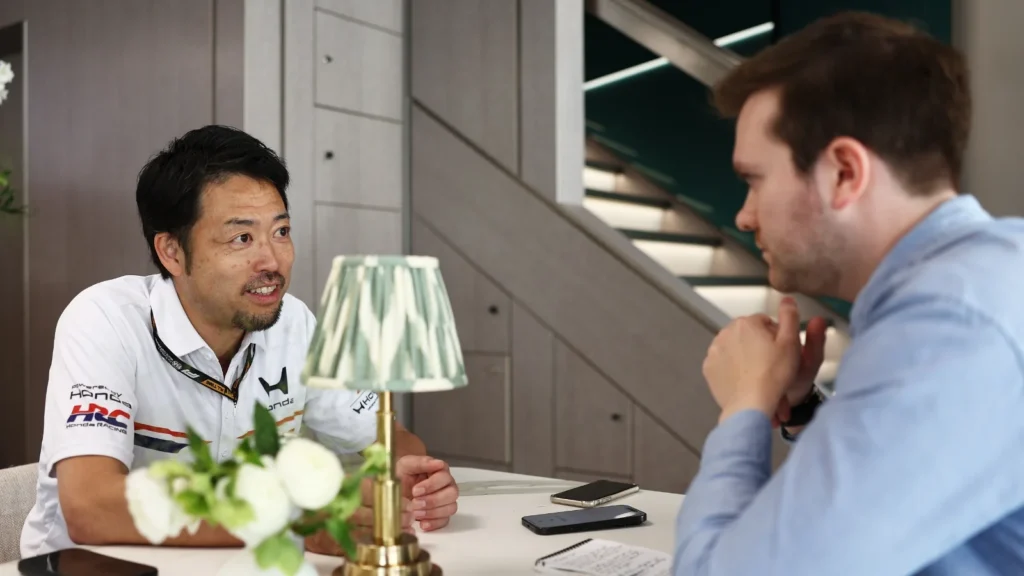
But, Orihara-san, speaking in an exclusive interview with Motorsport Week in Monaco, explained that, despite some downsides to the break, it gave his team a chance to rid the car of the vibration issues once and for all.
“There was a positive point and negative point to have those two races cancelled,” he said.
“Negative point: we lost that opportunity to learn something on energy management, water reliability. Always learning at trackside is very important.
“That was a negative point, but positive point, again, as I mentioned, after Suzuka, we brought Aston Martin’s race car to Sakura [its Japanese base].
“If we had these two races, probably it would have been too hard to bring the race car to Sakura.”
‘Correct direction’ after mid-break testing
Orihara-san explained that, with no races forthcoming to occupy some focus, Honda was able to work on his theory of how to fix the problem, which, thankfully, proved accurate.
“Still, already at that point, we had the idea to improve the vibration issue, but thanks to getting the car in the factory, we have performed testing with the idea and we got the data,” he continued.
“We felt the vibration level [lowering]. Myself and also some other engineers sat in the car on the test bench. And then we got a lot of data from the testing and that gave us confidence [that] our direction is correct.
“Then we could focus to prepare the new counter measure for Miami. [The] schedule was quite tight because we applied some big modifications.
Honda continues to work with Aston to provide further solutions, with the mouthwatering prospect of AMR26 upgrades, as well as that for Honda via its eligibility for the FIA’s ADUO scheme.
READ MORE –




Discussion about this post