
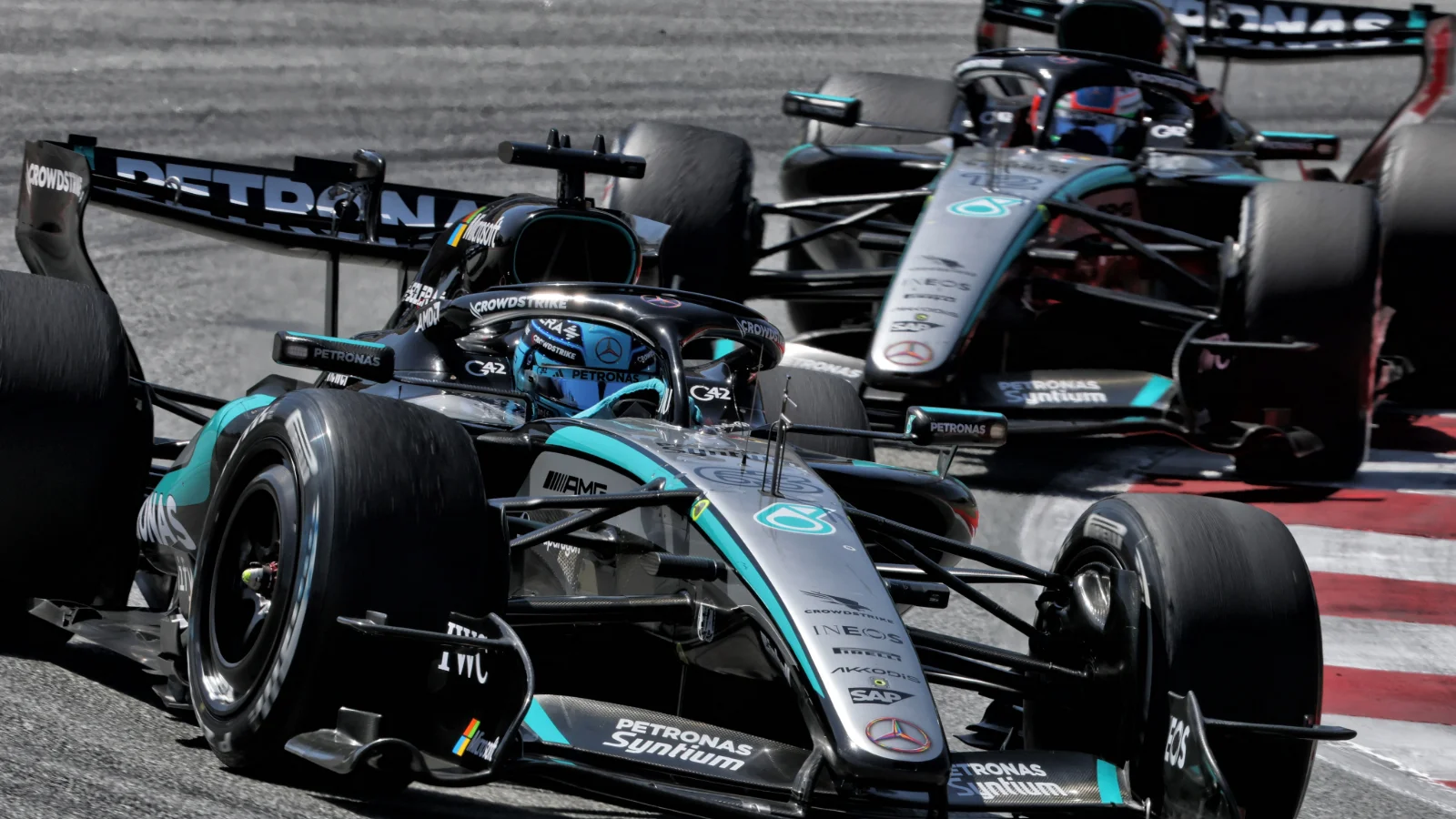
Every so often, there comes a time when the Formula 1 rulebook is pitted against a clever aerodynamicist or engineer in the paddock.
Adrian Newey – arguably the greatest car designer in the history of F1 – once bullishly declared: “There’s no such thing as the spirit of the regulations; it’s the black and white print of ‘you can’t do this, you can do that’. We [Red Bull] took the ‘can do’ bits right to the edge.”
Safe to say, then, that the laws of the sport have seldom seen eye-to-eye with the laws of physics in F1.
For the fans, watching this unfold is as much an intellectual stimulant – who doesn’t love debating over brake bias settings and mid-corner differentials over a Sunday pint, right? – as it is an ode to themaverick spirit.


Of course, this is only true when it’s your favourite team doing it; otherwise, it’s blasphemy!
The 2026 regulations reset gave teams a clean slate to work with. Too clean, perhaps, for Mercedes, as it turned out.
The German marque had dominated the erstwhile turbo-hybrid era, with eight consecutive Constructors’ titles between 2014 and 2021, off the back of a stellar power unit programme developed back at Brixworth.
And despite a fall from grace during the intervening ground-effect era, the team was billed to get the engine formula right again in 2026.
Five races into F1’s latest era, Mercedes has proven that to be the case, although with an important caveat.
Pre-season testing, this season, was rife with rumours about a clever exploit the Brackley-based team had found in the technical regulations. As we neared the season-opening race at the Albert Park Circuit in Melbourne, this was christened the ‘compression ratio trick’.
What ensued was relentless lobbying by rival teams such as Ferrari, Audi and Honda. Finally, the FIA decided to step in and ban this innovation – effective from the Monaco Grand Prix onwards.
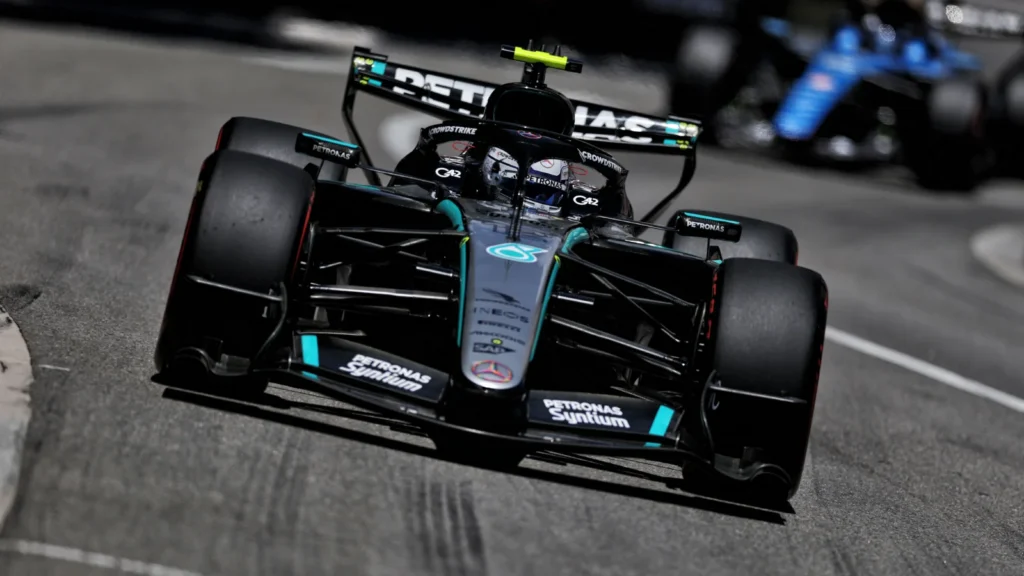
What was the Mercedes compression ratio trick?
The sum and substance of this controversy is to do with Article C5.4.3 of the 2026 Technical Regulations (TR). Under the current rule-set, the sport has retained the V6 architecture of its power units. However, none of those six cylinders can operate at a compression ratio higher than 16:1 (this is two steps below the 18:1 threshold under the erstwhile regulations).
In a nutshell, the higher the engine compression ratio, the higher the total power output will be. Mercedes had found a way to bypass this limit and run with a higher compression ratio when out on track and away from the prying eyes of the FIA technical delegate.
How? This is where the laws of physics pulled one over on the laws of F1. Article C5.4.3 described the procedure of such measurement to be “executed at ambient temperature”.
Mercedes [and reportedly Red Bull, too], however, took a refresher course on the laws of thermodynamics and realised that metal (the primary component of an F1 piston and the connecting rods) expands at the operating, on-track temperatures inside the power unit.
Naturally, such an expansion allows the piston to reach closer to the top of the cylinder, minimising the minimum volume inside the combustion chamber, which, while I’m no physicist but am reliably informed, means a theoretically higher achievable ratio of compression.
Therefore, while at ambient temperatures, these bespoke 3D printed pistons passed the FIA tests, on track, Mercedes was theoretically able to achieve a higher compression ratio than the mandated maximum as per the regulations.
The FIA verdict
After strong opposition from rival power unit manufacturers, the World Motor Sport Council (WMSC) ratified an amendment to Article C5.4.3 in February, essentially introducing a second hot-test.
Under the updated rule-set, the compression ratio will be measured at both ambient temperature and at 130 degrees C.
The amended Article was pushed forward and came into effect from the 1st of June, 2026, right before the Monaco GP, last weekend.
The older version of the regulatory text was completely scrapped and rewritten to avoid any other clever innovations Mercedes could have employed to sidestep this mandate.
The FIA’s swift intervention may have lent institutional credence to the pushback from rivals like Ferrari, Audi and Honda, but whether the German marque’s neat little compression trick was ever actually illegal is a different matter altogether.
The legality – or illegality – of the Mercedes loophole
As a lawyer, I can say with immense confidence that the old adage, “the devil is in the details,” is overwhelmingly true – especially in the case of the enforceability of regulations.
As it happens, the text of a regulatory provision may not always serve the overarching intent of the regulations. The FIA Technical Regulations aren’t a Constitutional edict and thus must always ensure that they leave out ambiguities.
When asked back in February by media including Motorsport Week, McLaren [a Mercedes customer outfit] CEO Zak Brown said: “The reality is the engine is completely compliant, passed all its tests, and I think HPP [Mercedes High Performance Powertrains] has done a good job.”

Brown, here, was spot on. On the face of it, the power unit was compliant with Article C5.4.3 and did in fact pass the test – a fact proven by the necessity of amending the Article rather than declaring the Mercedes power unit as outright illegal.
But to touch upon the legality/illegality of the compression ratio trick, I must make you understand what the regulations exactly said – not what they meant.
The mandate of Article C5.4.3 was clear; the cylinders must not operate at a compression ratio higher than 16:1, and this value would be measured at ambient temperatures through a procedure that “must be approved by the FIA Technical Department and included in the PU Manufacturer homologation dossier.”
The Mercedes power units on the grid in Australia, China, Japan, Miami and Canada did undisputedly go through the ambient temperature test and in a manner pre-approved by the FIA, and were hence, legal.
The updated Article C5.4.3, however, addresses this with one neat adjustment to its semantics.
Rather than “The procedure to measure this value [compression ratio] will be detailed by each PU Manufacturer”, the FIA amended the Article to mandate that “The procedure which will be used to assess compliance with this article must be defined by each PU Manufacturer.”
Now, the compression ratio is no longer just a binary value determined in stagnant conditions but a prescribed limit to be adhered to in letter and in spirit – sorry, Adrian.
Of course, this has been supplemented with a blanket ban on any “component, assembly, mechanism, or integrated arrangement of components” that can increase the compression ratio beyond 16:1.
The performance edge Mercedes had over its rivals was clear – whether it was directly related to the compression ratio trick or not is a different conversation. And for any team to replicate this innovation was never practically feasible.
Engine integration, in terms of layout to accommodate the expanding pistons and fabrication, could have been disastrous for its rivals, the research and development demands could have overshot the life-span of the current regulations, and most importantly, the cost-cap would never have allowed such an endeavour.
Therefore, the compression ratio trick being banned was not a product of its inherent illegality but more to do with the ground realities of F1.
F1 isn’t called the Piranha Club for nothing. At the end of the day, one of its biggest fish ended up on the wrong end of the political corridors.
But then, as ABBA once said, Rules must be obeyed.
READ MORE – Fernando Alonso urged to remain in F1 by Domenicali: ‘We need heroes’








Discussion about this post