
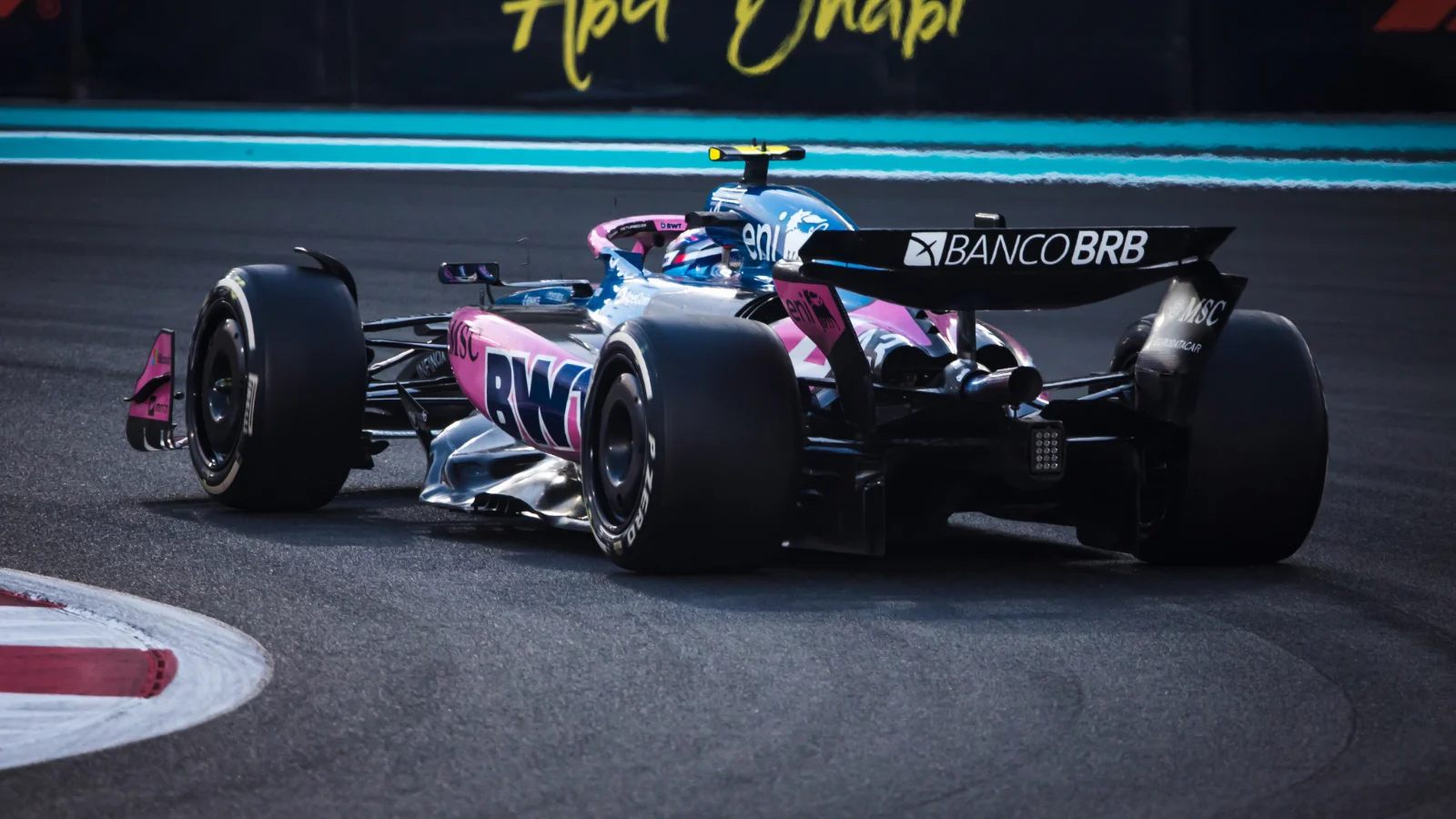
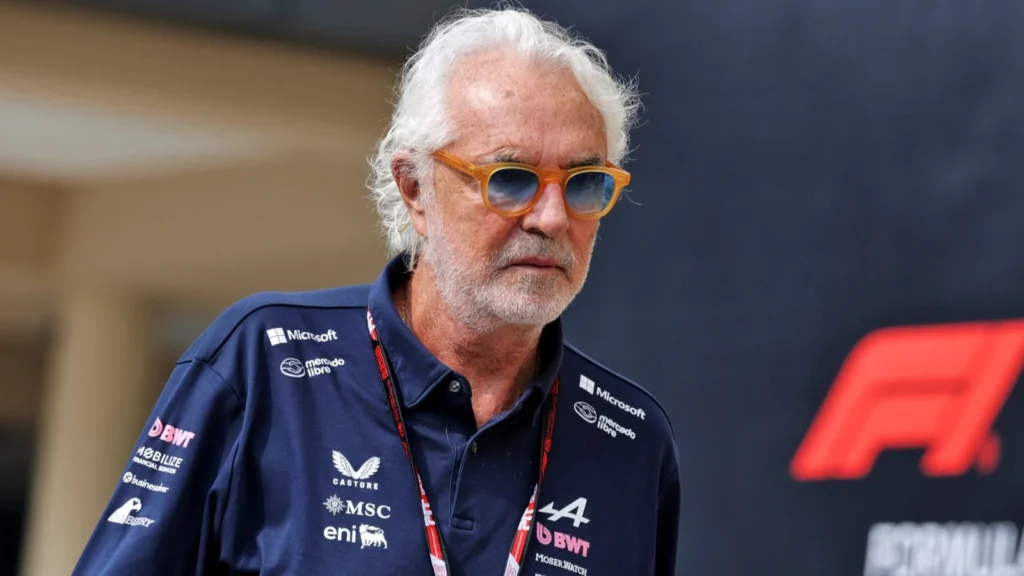
Alpine Executive Advisor Flavio Briatore has pinpointed the beginning of Formula 1‘s turbo-hybrid era as the moment the team’s decline truly began.
The Enstone-based squad slumped to last place in the Constructors’ Championship in 2025, as its limited in-season development became exposed.
The scale of the struggles marked a low point for the Renault-owned side. For Briatore, the wait for the 2026 regulations couldn’t come soon enough.
“We are here for winning,” he told The Race. “We are not to be a tourist to go around the world.
“It’s very hard, this situation for us. I’m not used to it. I was used to it 20 years ago, but now every Sunday is torture.
“You have no chance. You arrive in places and you see the mechanics put the garage together, working very hard.
“Then you watch all these people doing the best effort as possible, and you don’t have the possibility to enjoy the race, to go back home with the points.
“It’s very frustrating. I hope next year we pay everything back double!”
Why Alpine gave up on 2025 prospects so soon
On paper, Alpine’s weak 2025 campaign had a straightforward explanation.
The team chose to halt development of the car early to focus entirely on the all-new regulations coming in 2026, when it will also switch to Mercedes powertrains.
History offers examples where such an approach has paid off, but Briatore admits the risk has been costly in the present.
From his perspective, Alpine lacked the capacity to run parallel programmes.
“We don’t have the capacity to develop the 2025 car and a 2026 car,” he said, believing even a fully developed A525 would only have lifted the team to the fringes of the midfield.
“That was our belief when we made the decision, but it was a bit of an underestimation because everybody has done a better job than us.
“In the beginning our car was P6/P5. After that, everybody improved the car a lot, and we are not where we expected. So that is why we took the risk to put all the effort into the 2026 car.”
Briatore insists the car alone did not explain Alpine’s predicament. Long-standing management instability has cast a shadow over the team for years, and it was one of the concerns he raised with former Renault CEO Luca de Meo before agreeing to return in mid-2024.
He believes the lack of consistent, hands-on leadership at Enstone has hurt Alpine’s ability to operate effectively.
“I knew Luca much before F1, and at one point to see the team Renault like that was really difficult, because it was my team,” he said.
“You know, I’m back in Enstone in the same office as 20 years ago. I’ve been three times in this team!
“We discussed, and I said to Luca that if you need some help, I will help you because I’m disappointed.
“The team was managed by people from France, from Paris. F1 is already difficult to manage day by day in the office, in Enstone. So managing F1 from Paris is impossible.”
The most sensitive issue remained the engine. Renault never established a clear benchmark during the turbo-hybrid era, and Briatore believes the consequences of that failure are still being felt today.
He does not blame the current staff at Viry-Chatillon. Instead, he points to decisions made more than a decade ago, when Renault chose not to match the investment levels of its rivals as the hybrid regulations were introduced.
“With the new rules for the engine, maybe at the time, Renault was not taking seriously to match the cost of making an engine like the Federation wanted,” he said.
“Everybody else was investing a lot of money. You’re talking about Mercedes, Honda and Ferrari. Renault was like stay like it was OK.
“I am not pointing the blame at somebody, I think it just happened like that. At the time the president was Carlos Ghosn, and maybe the management had no balls to tell Carlos about being serious to do F1. Now we have the result.
“In the meantime, I think, Renault did the best that was possible. But if you don’t have a resource, then it’s very difficult to be competitive. Viry did the best as possible. [Bruno] Famin was here, he did the best as possible.”
For Briatore, the switch to Mercedes power is not an emotional decision but a practical one. If Alpine wants to compete, he believes it must use the best available tools, just as he has done in the past.
“I remember I was fighting like crazy to have the engine of Renault in ’95 because Williams blocked me to have the engine,” he said.
“So at the time, Renault had the best engine in F1. To have a Renault engine, I bought Ligier myself. I take away the engine from Ligier, I give it to Benetton, and then I give to Ligier the Honda [Mugen] engine.
“For me, Renault was representing the best engine in the world. In ’95, we won 80% of the races with the Renault engine.
“So I know for Renault, it was a difficult choice. But if you want to be competitive, you need to have the same weapon everybody has.”
With Mercedes power arriving, Briatore believes Alpine can reset its ambitions. He is not predicting an instant title challenge, but he does expect a meaningful step forward.
“I want us to be in the first six,” he said. “When you’re sixth/seventh, you start the race, and you smell the podium already.
“When you are 14th/15th, forget it. My dream, if you want, is to be competitive, to be at this kind of level.”
Doubts remain about how quickly Alpine can recover from its current position. Briatore, however, has built a career on embracing scepticism.
“It’s a big, big, big, big challenge. But I’ve never had a small challenge,” he said.
“With Benetton, the people were laughing because we were a T-shirt maker. I remember Ron Dennis, he told me that I don’t have motorsport in my stomach.
“Then, in the meantime, we were winning the races with no motorsport in the stomach.”
READ MORE – FIA admits to missing key flaw during ground-effect F1 era




Discussion about this post