
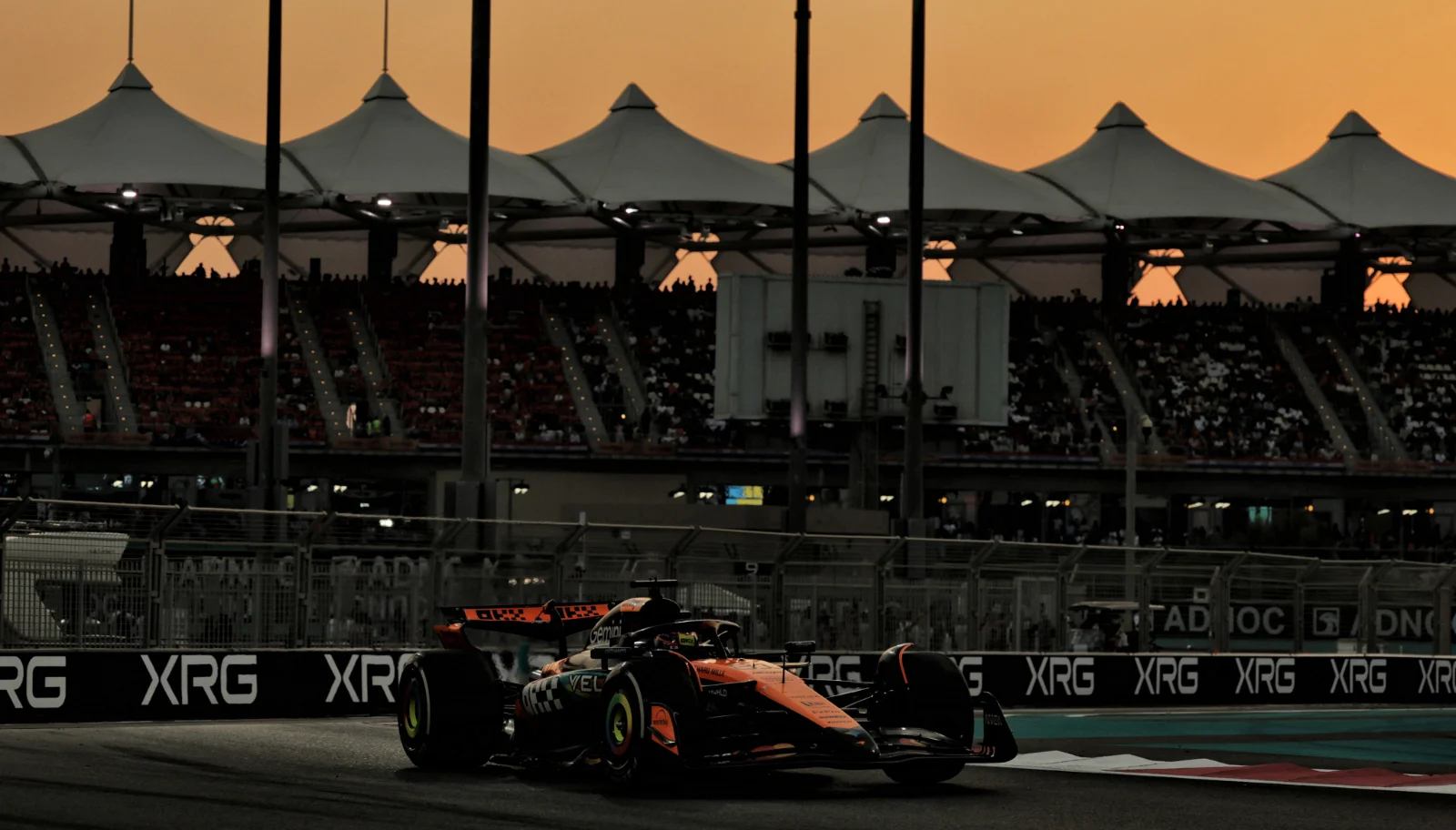
Whilst the 2025 Formula 1 season has ended, teams will now embark on crucial post-season testing in Abu Dhabi.
F1 will bid farewell to the current regulations, as the sport prepares for the new hybrid era. Thus, end-of-season testing at the Yas Marina Circuit will be important in understanding how the sport’s radically different cars will behave next year.
Throughout Tuesday’s test, all 10 teams will field two cars. One 2025 chassis, used for the Young Drivers test, and the other will be a ‘mule car’, adapted specifically to simulate key characteristics of the 2026 machinery.
A mule car is a modified chassis used exclusively for test running, designed to provide teams and drivers with data before the new regulations come into effect.
Rather than a prototype of the 2026 car, teams will run an adapted 2025-spec chassis.
To help achieve this, the mule cars will run Monza-spec front and rear wings, thus, creating a lower drag profile similar to what is expected under the 2026 ruleset.
Tyres will also be significantly narrower, reflecting the dimensions Pirelli will homologate for next season.
But most importantly, drivers will have a speed limit of 300 km/h to simulate next year’s active aerodynamics.
Pirelli have suggested that this speed limit will help balance the front-rear loads, giving teams better tyre data. In 2026, teams will be able to deploy active aerodynamics on both the front and rear wing elements, allowing the car to shed drag evenly and maintain stability at high speed.
To further simulate next year’s aerodynamic philosophy, the mule cars will also use DRS far more frequently.
In addition to the usual activation zones, drivers will open DRS along the start–finish straight and from the exit of Turn 2 to the Turn 5 hairpin.
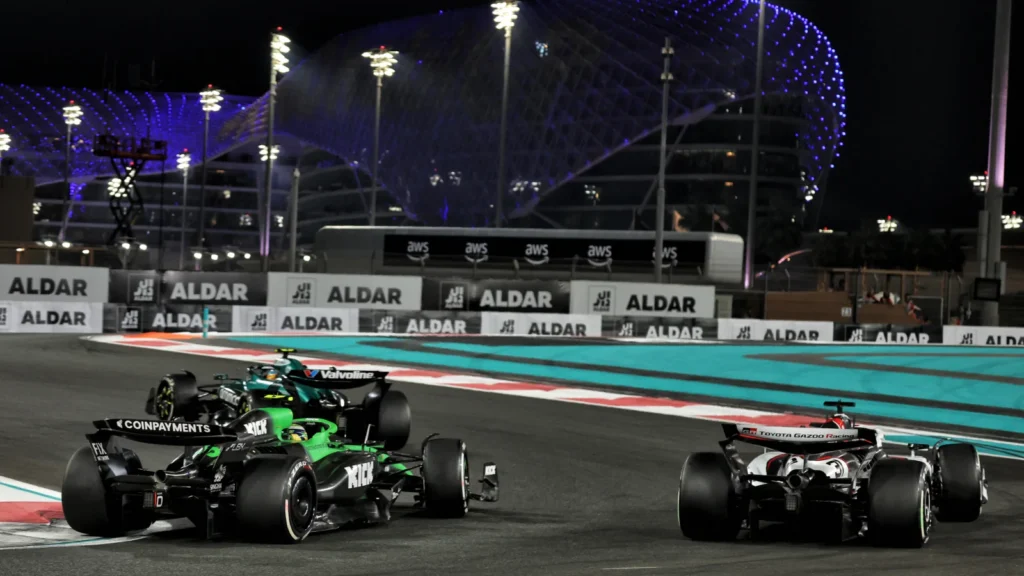
Who will be driving in Abu Dhabi?
Each team will divide their testing time amongst several drivers. For many teams, their 2026 race drivers will test the ‘mule car’ whilst rookies will partake in the young drivers’ test.
However, there are some drivers who will not feature in the post-season test in Abu Dhabi. Red Bull and Aston Martin’s driver pairings will not be present for testing, as Isack Hadjar and Stoffel Vandoorne take the reins. Meanwhile, George Russell and Franco Colapinto will also not be present on Tuesday, handing the testing time to their 2026 teammates.
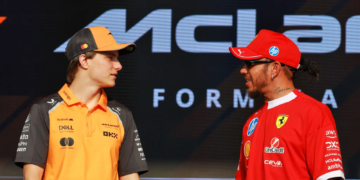
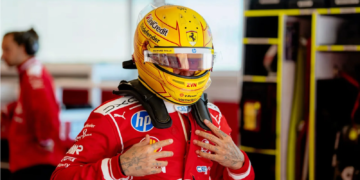
McLaren, Ferrari, Williams, Haas and Sauber will have both Race Drivers present for Tuesday’s test. Whilst Lawson will test for Racing Bulls, alone.
Looking at the Young Drivers’ test, many teams will field drivers who were present during Friday’s FP1 session in Abu Dhabi. Ferrari gives another opportunity to Dino Beganovic, Williams call on Luke Browning, Alpine will utilise Kush Maini as Sauber will continue to develop Paul Aron, all of whom impressed across their Formula 2 seasons.
Haas will hand running to Ryo Hirakawa, who doubles as a Toyota WEC driver, while McLaren brings back long-time IndyCar favourite Pato O’Ward.
Meanwhile, Racing Bulls’ 2026 recruit, Arvid Lindblad, will get his first official test ahead of his full-time graduation to the grid next year.
Whilst Post-season testing in Abu Dhabi will not deliver lap records, it will be crucial as teams prepare for 2026. Teams hope that the data collected from the test will help them understand this new era of F1
READ MORE – Valtteri Bottas makes first Cadillac F1 appearance in social media post




Discussion about this post