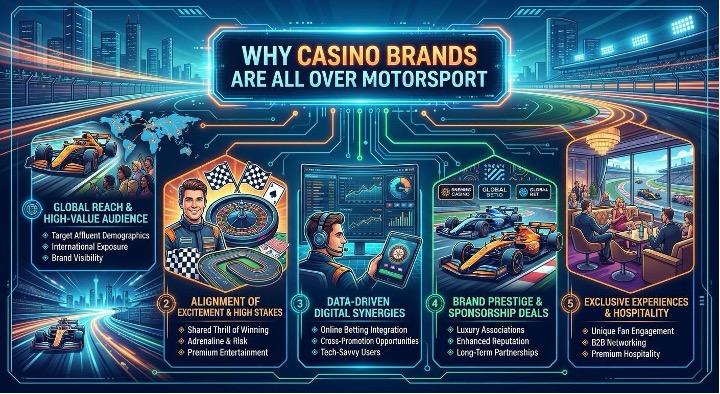
If you’re a motorsport fan, you’ve probably noticed something over the past few seasons. Casino logos are everywhere: on car liveries, driver suits, pit walls and all over digital streams.
Brands from the iGaming world have poured money into Formula 1, MotoGP, NASCAR and virtually every racing series with a sizeable audience. But what does that actually mean for you as a fan? Should you care about online casino games beyond the flashy sponsorship decals? And more importantly, what should you understand before you ever consider clicking on one of those branded links?
This guide breaks it all down, from the legal landscape to responsible play, so you can make informed decisions rather than getting swept up by marketing alone.
Why casino brands are all over motorsport
The sponsorship explosion
The relationship between gambling companies and motorsport isn’t exactly new, but it has deepened dramatically. Casino operators see racing audiences as a perfect demographic: tech-savvy, thrill-seeking and comfortable with risk. That combination makes motorsport fans a prime target for iGaming marketing.


When you watch a race broadcast or scroll through a team’s social media, you’re being exposed to carefully crafted brand visibility. The logos on a car travelling at 200mph aren’t just decorative. They represent multi-million-dollar sponsorship agreements designed to build familiarity and trust with potential customers. For many fans, this exposure becomes the first touchpoint with an online casino brand they might never have encountered otherwise.
However, brand visibility does not equal legal availability. Just because you see a casino sponsor on your favourite team’s car doesn’t mean that operator is licensed, or even legally accessible, where you live. This is a critical distinction that too many fans overlook. A casino brand might sponsor a globally broadcast race while only holding licences in a handful of jurisdictions.
Platforms like AutomatenspieleX illustrate how region-specific the online casino landscape truly is, with offerings tailored to particular markets and regulatory frameworks rather than operating as one-size-fits-all global products. The gap between marketing reach and regulatory authorisation is enormous, and understanding it can save you from legal headaches or, worse, losing money on an unregulated platform.
What fans actually encounter
Beyond the liveries, motorsport fans encounter casino promotions in several direct ways. Teams run co-branded social media campaigns. Drivers appear in promotional content. Race-day apps feature integrated betting or casino offers. Streaming platforms carry targeted ads based on your viewing habits.
The sheer volume of these touchpoints can create the impression that online casino play is universally available and straightforward. It isn’t. Every promotion, app or sign-up offer you encounter through motorsport channels should be checked against your local or state law before you take part. This isn’t paranoia, it’s basic consumer protection.
The legal reality of online casino gaming in 2026
Where you can actually play in the United States
Here’s where things get concrete. As of November 2026, real-money online casino gambling is legal and operational in only seven US states: Connecticut, Delaware, Michigan, New Jersey, Pennsylvania, Rhode Island and West Virginia. There is no federal framework authorising nationwide play. Access is governed state by state, and each jurisdiction has its own licensing requirements, tax structures and consumer protections. If you live outside these seven states, you cannot legally play real-money online casino games through a regulated US operator.
Maine passed legislation (LD 1164) in January 2026 creating a tribal-exclusive online casino model, but as of October 2026 no operator had launched because implementing rules were still being drafted. Meanwhile, Washington, DC introduced a bill proposing legalised online casinos with a 25% gross gaming revenue tax rate and a 21-plus age requirement, though that bill had not been enacted by November 2026. New York took a different approach, banning sweepstakes-style dual-currency online casino games while full iGaming legislation remained stalled. The pattern is clear: legislative progress is slow, uneven and far from guaranteed.
Here are seven key facts every motorsport fan should know about the current landscape:
- Only seven US states currently offer regulated real-money online casino gambling.
- New Jersey’s internet gaming win hit $271.0 million in June 2026, a 17.5% year-over-year increase according to the NJ Office of the Attorney General.
- Pennsylvania generated $249.3 million in online casino revenue in September 2026 alone, up 6.82% year-over-year per the Observer-Reporter.
- The combined iGaming revenue across all seven legal states reached $10.73 billion for full-year 2025, according to the American Gaming Association’s 2026 report.
- Nevada, despite its gambling reputation, remains limited to regulated online poker only, with no full-spectrum online casino gaming.
- Sweden introduced real-time monitoring and geolocation requirements in 2026, reflecting a global push toward tighter oversight.
- Multiple jurisdictions, including New York and Pennsylvania, are actively cracking down on sweepstakes and grey-market casino products through new legislation and court rulings.
The sweepstakes crackdown
One trend motorsport fans should pay particular attention to is the accelerating crackdown on sweepstakes-style casino platforms. These dual-currency products have operated in a legal grey area for years, allowing players to use virtual currencies that can sometimes be redeemed for real prizes. They’ve been heavily advertised, including through sports and racing channels.
But 2026 has been a turning point. New York outright banned these products. Washington, DC’s proposed online casino bill specifically includes a sweepstakes ban. Pennsylvania’s state Supreme Court ruled video skill game machines illegal in June 2026, with enforcement beginning in October. The writing is on the wall: if you’ve been using sweepstakes casino platforms, the regulatory environment is shifting rapidly against them.
How online casino games actually work
Understanding the basics
For motorsport fans who have never explored online casino games beyond seeing a logo on a car, here’s a quick primer. Online casinos offer digital versions of classic games: slots, blackjack, roulette, poker and more. These games run on random number generators (RNGs) that determine outcomes, and licensed operators must have these systems regularly audited for fairness.
The house always has a mathematical edge, which is how the business model works. Some games offer better odds than others. Blackjack and certain video poker variants tend to have lower house edges than most slot games. Knowing this matters because it directly affects your expected return over time.
What makes the experience different from visiting a physical casino is convenience and pace. You can play from your phone, at any hour, with no travel required. That convenience is a double-edged sword. The speed at which you can place wagers online far exceeds what you’d experience sitting at a table in Las Vegas or Monte Carlo, so your bankroll can evaporate faster if you’re not paying attention. Any regulated platform will offer responsible gaming tools such as deposit limits, session timers and self-exclusion options. Use them. They exist for a reason.
Comparing popular game types
To help you understand the differences between common online casino game categories, here’s a comparison:
| Game type | Typical house edge | Skill involved | Pace of play | Best for |
|---|---|---|---|---|
| Online slots | 2%–10% | None (pure chance) | Very fast | Casual entertainment |
| Blackjack | 0.5%–2% | Moderate (strategy helps) | Medium | Players who enjoy decision-making |
| Roulette | 2.7%–5.3% | None (pure chance) | Medium | Fans of classic casino atmosphere |
| Video poker | 0.5%–5% | Moderate to high | Medium | Strategy-oriented players |
| Live dealer games | Varies by game | Varies | Slower | Social experience seekers |
The house edge percentages above represent what the casino expects to retain from each dollar wagered over the long run. A lower house edge means better theoretical returns for the player. If you’re coming from the motorsport world, think of it like tyre degradation: the longer you run, the more the inherent disadvantage compounds. Managing your session length and bet sizes is essentially your pit strategy.
Responsible play and what to watch out for
Compliance requirements that protect you
In regulated markets, operators must meet strict compliance requirements that exist specifically to protect players. These include state licensing, geolocation verification ensuring you’re physically within state borders when you play, age verification (21-plus in most states) and mandatory responsible gaming tools such as self-exclusion programmes and deposit limits. When you play on a licensed platform in one of the seven legal states, you benefit from consumer protection standards that simply don’t exist on offshore or grey-market sites.
Sweden’s 2026 regulations are worth mentioning here because they illustrate a global trend. The country introduced real-time monitoring and geolocation mandates for online platforms, requirements that echo what US regulated states already demand. According to BNL Data’s regulatory analysis, this kind of convergence suggests an emerging international standard. For motorsport fans who follow globally branded casino sponsors, this means the regulatory bar is rising everywhere, not just in the United States.
Red flags for fans
So what should you watch out for? First, any casino platform that doesn’t require geolocation or age verification is operating outside regulated frameworks. Second, offshore operators that target US players often lack the consumer protections and dispute resolution mechanisms that licensed platforms provide. Third, and this is specific to motorsport audiences, don’t assume a sponsorship deal validates an operator’s legitimacy in your jurisdiction. A brand can sponsor a Formula 1 team while being completely unlicensed in your state or country. Many of the biggest iGaming sponsors hold licences only in select European or Asian markets. Always verify independently.
The increasing scrutiny of advertising is also something to keep an eye on. As more jurisdictions tighten rules around casino-style products, motorsport series and teams may face evolving advertising restrictions. This is particularly relevant in markets where iGaming isn’t legal but audiences still see branded content through streaming and social media. The regulatory asymmetry between where ads are shown and where play is legal creates genuine confusion for fans, which is exactly why articles like this one exist.
What this means for the future
Market growth and expansion outlook
The revenue numbers tell a compelling story about where online casino gaming is headed. New Jersey’s 17.5% year-over-year growth and Pennsylvania’s steady climb suggest that mature markets still have room to expand. The $10.73 billion in combined iGaming revenue across all seven legal states for 2025 (as reported by the American Gaming Association in 2026) represented a 27.6% jump from 2024. Even accounting for the fact that expansion to new states has been slow, the existing markets are generating increasingly significant revenue. For motorsport fans, this means the casino-sponsorship pipeline isn’t drying up anytime soon. If anything, expect more brands competing for visibility on your favourite teams.
Expansion to additional states remains a slow burn. Maine’s experience, enacting legislation but not launching operations because rulemaking takes time, is a recurring pattern. Don’t expect a sudden flood of new legal markets. But the trajectory is clearly toward broader availability, not contraction. For fans outside the current seven states, patience and vigilance are your best tools. Play only where it’s legal, and keep an eye on your state’s legislative calendar.
The evolving relationship between racing and iGaming
Motorsport and casino gaming share more DNA than you might think at first glance. Both involve calculated risk, strategic decision-making and the thrill of uncertain outcomes. That’s why the marketing synergy works so well. But as a fan, your job is to enjoy the racing and, if you choose to explore casino games, do so with clear eyes and full awareness of the rules. The industry is growing, regulations are tightening, and the grey areas that once made it easy to play anywhere are shrinking fast.
Ultimately, what motorsport fans should know about online casino games comes down to a few simple principles. Verify legality in your jurisdiction before you play. Use only licensed, regulated platforms. Take advantage of responsible gaming tools. And never let a sponsorship logo on a race car substitute for your own due diligence. The chequered flag might signal the end of a race, but your financial decisions shouldn’t be a gamble.