
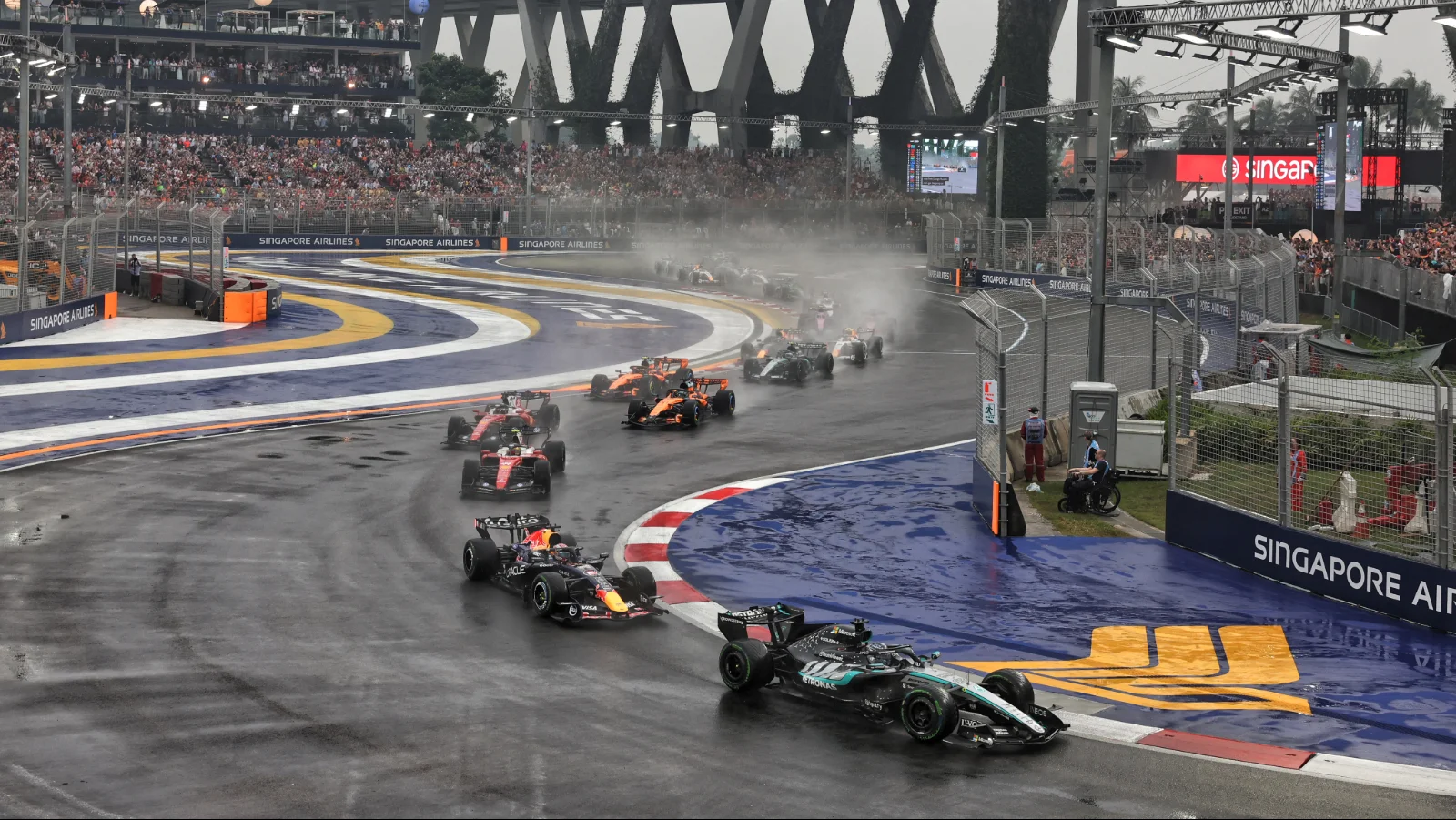
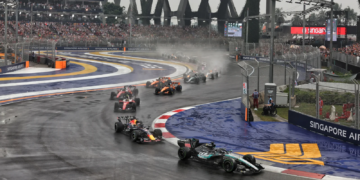
Wet weather and Formula 1 have not enjoyed a good relationship of late. The last two weekends in Malaysia and Singapore, respectively, have shown how far F1 has fallen when operating in wet-weather conditions.
The irony of the situation is that when it used to rain in F1, the race provided a guaranteed cracker of a race. Today, it’s more of a damp squib, and it really does not have to be this way.
We don’t have to look far back in F1’s grand treasure trove of historic races to find examples of cars running in the wet. Let’s take Silverstone 2008 to start. Starting out dry, a near monsoon fell onto the circuit. Drivers were forced to think on their feet and navigate tricky conditions where aquaplaning was a real possibility, with no margin for error. Darwinism at its finest, only the best survived that day.
Then of course, there’s Brazil 2003. Multiple Safety Cars, and cars running wide into what became the world’s most expensive car park. Card aquaplaned off and hit the barriers, with not even reigning world champion Michael Schumacher spared; his first retirement since Germany two years prior. It required skill and guile, and although the race start was delayed, the wait proved more than worth it once underway.


Of course, the most iconic wet-weather race remains Canada 2011. Setting the all-time record for the longest race in history at 4 hours, 4 minutes, and 39 seconds, it was interrupted by a two-hour-long red flag. More than justified, the conditions were appalling, but the track still held water at the restart, leading to Jenson Button’s now-legendary win after multiple drive-through penalties and pitstops.
Where did it all go wrong?
The common denominator in all of these races is that, despite the wet weather, they still went ahead and shone because of it. Sadly, in modern-day F1, this is becoming rarer and rarer with each passing year, risking F1 becoming known for being overly cautious if droplets of rain fall onto the circuit. An over-exaggeration, yes, but let us explain.
So, where did it all go wrong? In the last couple of years, F1 has slowly regressed into throwing Safety Cars or throwing yellow flags for the slightest risk. Times change and safety improves, of course, but looking at the modern-day version of the sport, neither of us can foresee a race like Brazil 2003 or Silverstone 2008 being allowed to go ahead today. The race would be red-flagged long before cars aquaplaned.
Looking at where the catalyst may lie for this sea change in attitude, there is one obvious elephant in the room: Spa 2021. The now-infamous race, which completed only two laps over multiple hours, arguably changed how races are run in the wet. This race was an extreme scenario, one that is unlikely to be repeated. Yet, its impact on F1’s attitude to rain cannot be underestimated.
Of course, another flashpoint is an event which came about exactly 12 years ago last week.
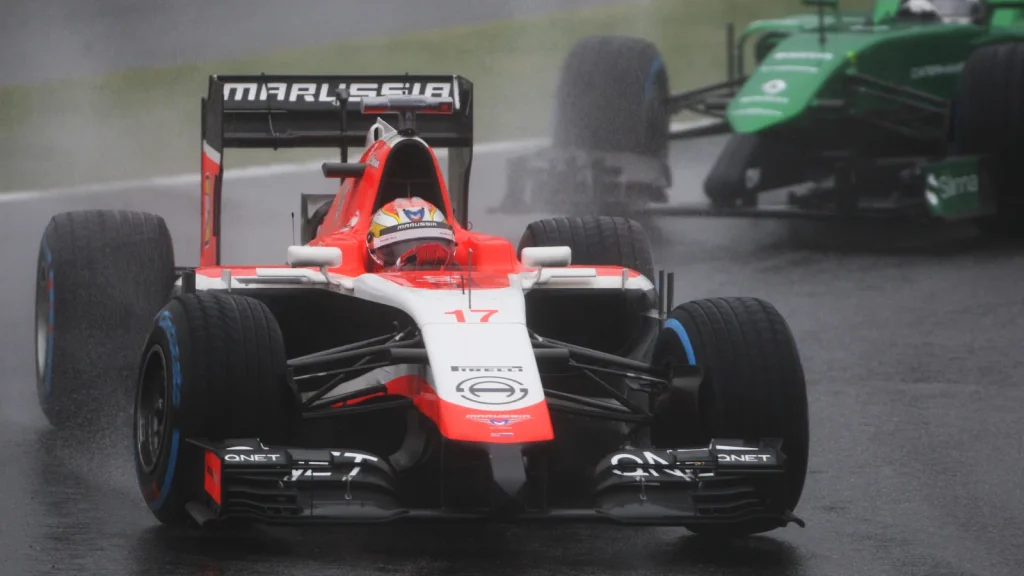
At the 2014 Japanese Grand Prix, the promising and burgeoning talent of Jules Bianchi was snuffed out in the typically treacherous Suzuka rain. Hitting a recovery vehicle, the Frenchman sustained head injuries, to which he succumbed the next summer.
Like all seismic accidents, both fatal and non-fatal, the positive that comes from them has always been the implementation of a new safety measure that mitigates the chances of repetition. In Bianchi’s case, it triggered the Virtual Safety Car, which slows down the pack to a safer level without the need to bring out the real Safety Car.
Is F1 becoming too cautious?
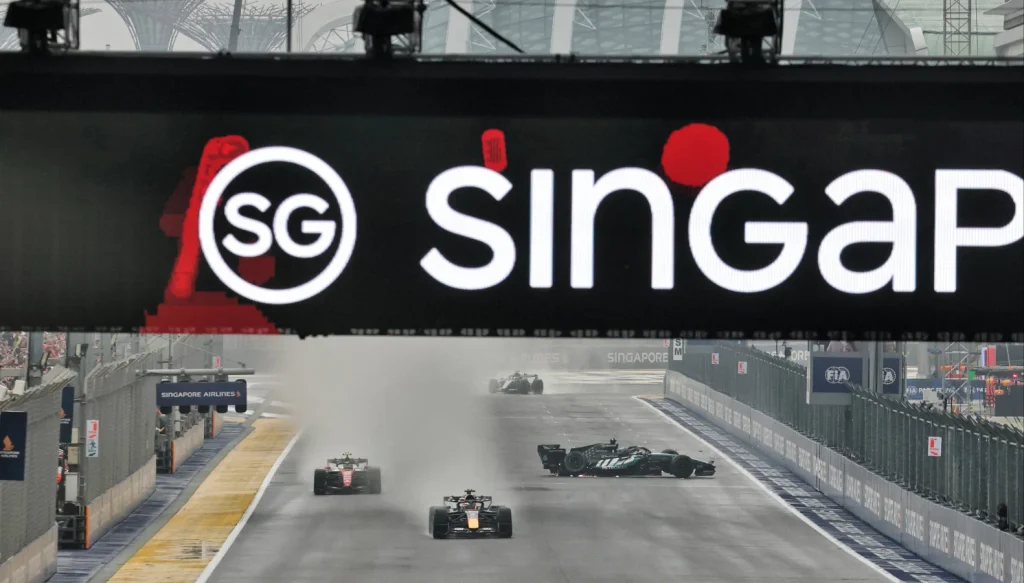
Whilst this may well have kept a plethora of drivers safe from huge accidents since then, it does feel like, without wishing to sound callous, that the cautious approach has, on occasion, gone too far. And if we take Suzuka as another example, it is fair to say that, once in a while, we could always find a compromise.
In 1994, the Japanese Grand Prix saw horrific rain tarnish the early stages, with several drivers having sizeable ‘offs’. The final straw was that of now-F1 commentator Martin Brundle, who crashed heavily just a matter of yards from where Bianchi crashed. Brundle’s McLaren clouted the barrier, as well as a marshal, breaking his leg. The red flag was eventually, and swiftly, brought out, and the race did not restart until the elements had somewhat subsided.
Whilst there would be supposed reservations about the race recommencing, the remainder of the race was run on aggregate timing, and without further big incidents. In fact, aside from Damon Hill’s victory over Michael Schumacher, the second half of the truncated race is fondly remembered for a delightfully relentless battle for position between Jean Alesi and Nigel Mansell, the French-Sicillian frantically withstanding the Williams’ desperate attempts to overtake. Mansell famously overtook the Ferrari around the outside of the final chicane on the final lap.
Malaysia, like last week and several other times before, has been fraught with monsoon weather sporadically throughout races in its history on the F1 calendar. 2001 was one example, with a flurry of cars pirouetting like graceful ballet dancers at the Bolshoi on the slippery track. The race continued, and as the track continued to be wet, we were treated to some spectacular driving performances.
The moral of this? Whilst it might be churlish to consider putting the lives of drivers in further danger than motor-racing already exposes them to purely to save face to the individuals in the grandstands, there is the bullish case to be made that drivers are paid an exorbitant amount of money to do what they do; the fans, by contrast, earn a tiny fraction of what they earn, and wanted to see cars out on track. And these drivers are professionals. Like Alesi and Mansell, a shared sense of trust that one won’t do something stupid to the detriment of safety must be sacrosanct and, to the most part, expected.
Fans are also not stupid. They know when it’s too wet for a car to go out on track, logically and sensibly. They appreciate the risks, many of them will remember every horrific incident that sets the precedent to be more careful next time around. Each time draws a new line which must not be crossed, and that’s fair enough.
But perhaps those lines have now been blurred just that little bit too much. It says something that just lately, Formula E has had more wet races than Formula 1 has, and whilst it might be a hollow brag for them, it tells me that F1’s extreme measures of caution are becoming a little bit like putting on a belt when a pair of braces are already holding up your trousers.
Now, Formula 1 feels closer to IndyCar when it comes to its approach to rain. It begs the question why rain tyres exist when there’s such a hesitation to use them.
One can only hope that, as we start to prepare for the inevitable return to fully combustion engines, the rule-makers can look at a way to ensure cars will be amply equipped to deal with the rain, from both a grip level point of view, as well as that of minimising the spray to the cars behind them.
We hope that they will reach a sensible, safe and ultimately fulfilling conclusion. Maybe they’ll see clearly now the rain is gone.








Discussion about this post