
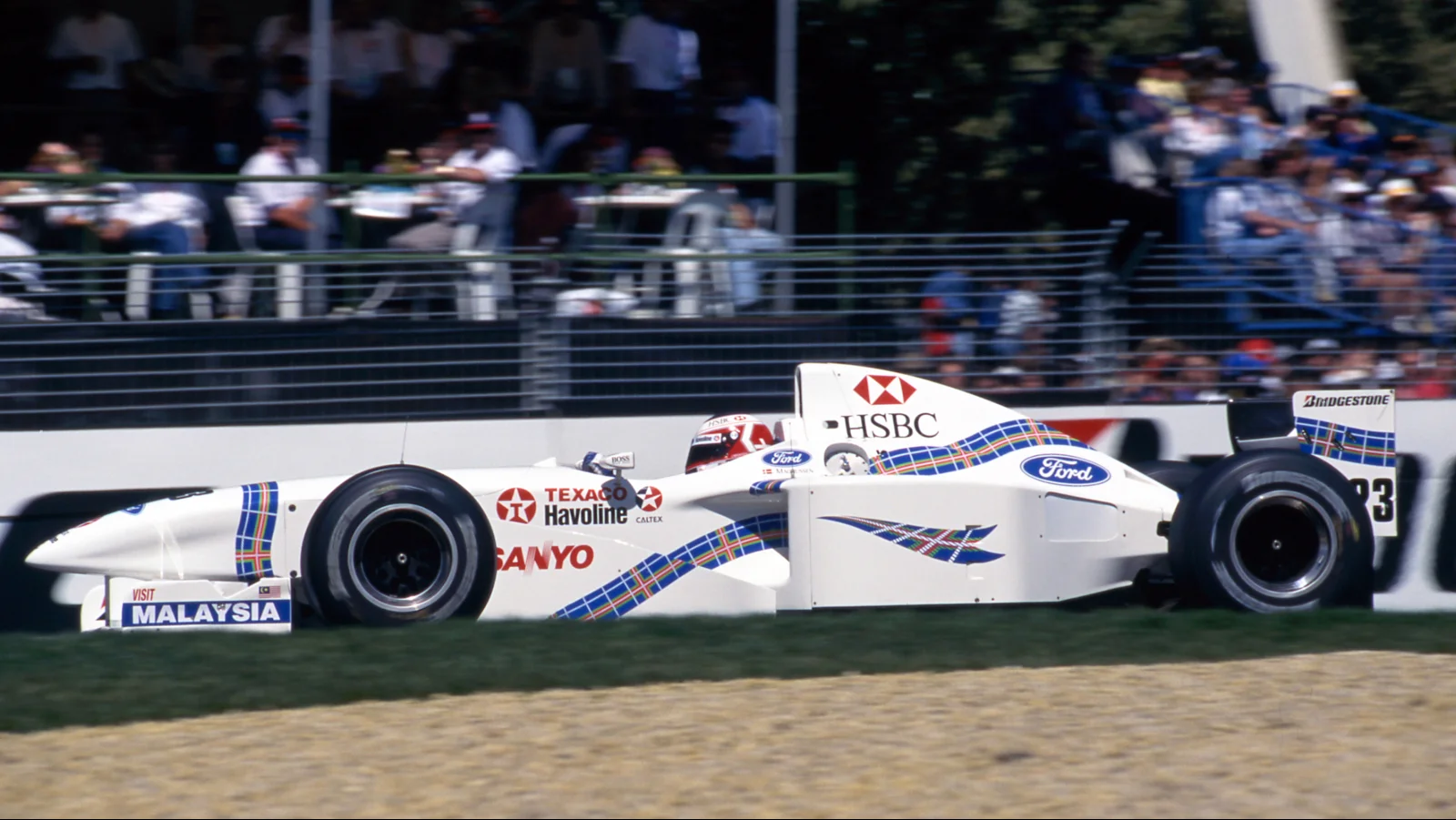
Sir Jackie Stewart secured a glittering and unique legacy in Formula 1 by the time of his retirement at the age of 34.
He won three World Championships, held the record for most Grand Prix wins for almost a quarter of a century, and above all, campaigned fervently and unabashedly for improving safety in the sport. The legacy those achievements earned him was as timeless and seamless as the way he wore – and still wears – his shirts and Rolex watches.
But many might forget that, almost another quarter of a century after hanging up his helmet, he took a risk on all that to put his name to what was his own eponymous Grand Prix team.
The story of Stewart Grand Prix begins in the late 1980s, and not through Sir Jackie himself, but rather his son, Paul. Initially opposing the ‘monkey see, monkey do’ attitude of Paul wanting to go racing himself, Stewart decided to support Paul’s ambition, and with that, formed Paul Stewart Racing, that eventually competed in Formula 3000, British Formula 3 and Formula Ford 2000.
Paul continued to run the team after abandoning his own racing ambitions, and with some success following, naturally, the topic of entering an F1 team was floated, but initially rejected. Across a six-year period, beginning in 1989, no fewer than 17 teams came about and folded, but a link to Sir Jackie’s own success behind the wheel changed the landscape.
All three of Stewart’s Drivers’ titles were won in cars powered by Ford, the success forming a close bond between the American marque and Ken Tyrrell. Ford gave Stewart a five-year deal to help make the team a factory one, and thus, the seeds were sewn.
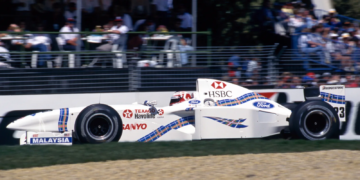
With a plain white colour scheme, interwoven with the Stewart family’s own tartan pattern, the unique identity for the team was now in place, and with additional funding from the Malaysian government in the form of sponsorship for the country, the only question now was who would drive the two cars for its 1997 debut season.
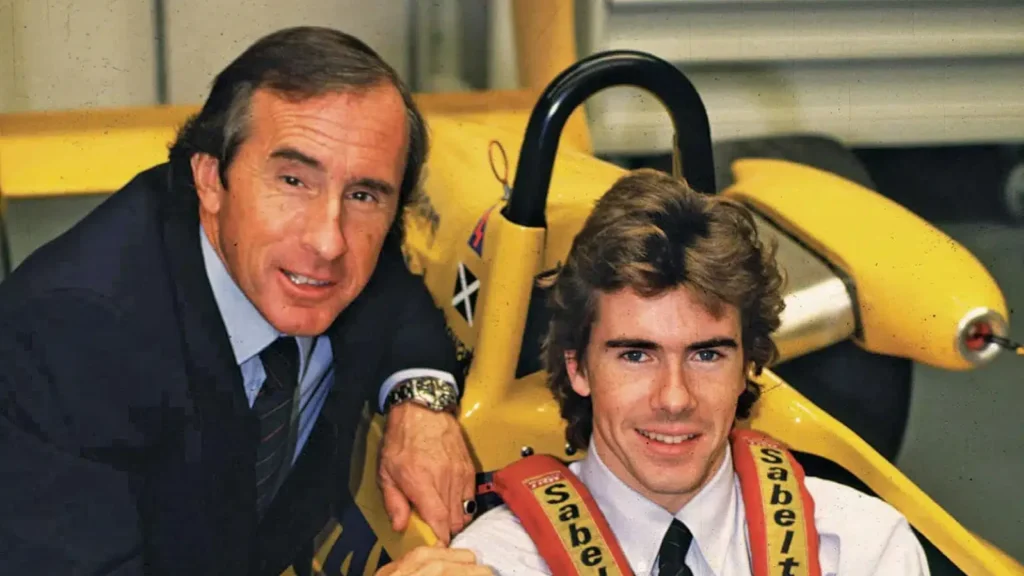
Stewart chooses its first F1 line-up
Jan Magnussen was signed, the Dane having already gained one race of Grand Prix experience as a stand-in for Mika Hakkinen at McLaren in 1995. But a more experienced wheelsmith was also required.
One bold move was to try and convince the soon-to-be World Champion Damon Hill to join, having been informed by Williams that he would not be retained for ‘97. Sir Jackie had been teammates with Damon’s two-time champion father Graham at BRM, ensuring a sentimental but logical reason to sign. But Hill felt that Arrows was less of a risk, having already been an established team for some years, and therefore declined the opportunity.
Stewart Jr drew up a shortlist that contained Jos Verstappen and Martin Brundle, who had been let go by Jordan, but he also opted out, choosing instead to take his first steps into commentary and punditry, a medium in which he has now become television royalty. The third option, however, wasn’t half bad.
It was, ironically, Brundle’s ‘96 teammate, Rubens Barrichello, who was chosen, and the Brazilian signed on the dotted line. Barrichello could already boast four seasons of Grand Prix experience with Jordan, and still only 24, it was a no-brainer of a choice. The pieces of the Stewart puzzle were now firmly in place. It would be one of three new teams for 1997, joining Alain Prost’s own squad [the man who broke Stewart’s all-time win record] and Mastercard Lola, the subject of last week’s tale
For the opening round in Melbourne, Barrichello was three seconds off pole position, but remember: this was the 1990s – the gap between the top and the midfield was a little wider. The reality was that Stewart was comfortably the second-highest of three in qualifying. Barrichello’s time was within three tenths off Oliver Panis’ ninth-placed time in the Prost, and that was, in all fairness, an oven-ready team given its previousidentity as Ligier. Barrichello was two tenths off a top-10 grid slot.
He repeated the feat at the next round in Brazil, and in Argentina, went even better by planting the SF01 fifth on the grid. Magnussen was classified 10th and last, but a true and proper sighting of the chequered flag still eluded the team.
That was until the Monaco Grand Prix, Round 5.
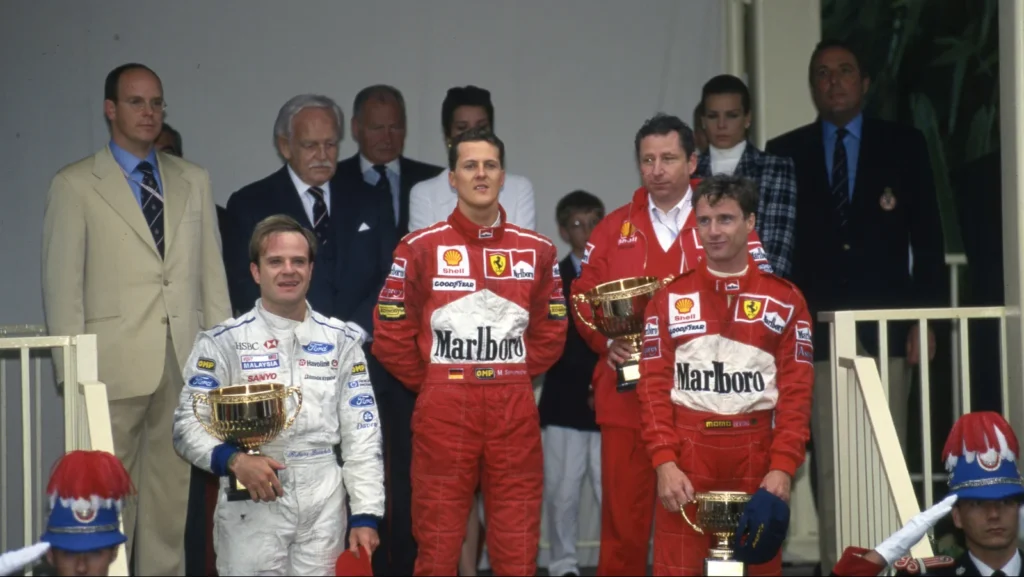
Rubinho scores tear-jerking Monaco podium
The Principality was famously the location of Weekend of a Champion, the documentary made by Roman Polanski that followed Stewart around the weekend of its 1971 Grand Prix, memorably detailing how to tackle the circuit by drawing on a tablecloth. Stewart won the race that weekend, and did so a total of three times. 26 years after that Hollywood-enamled weekend, it was the scene of a new, and more personal, triumph for the Stewart family.
Qualifying 10th, Barrichello navigated his way through the chaos brought by the rain that fell on race day to take second place, with Magnussen seventh from 19th on the grid. Not only was it the first real race finishes, but a seismic podium result to boot. Stewart, a man who stoically maintained a stiff upper lip amid the deaths of friends and colleagues during his own racing days, shed tears of joy on the pit wall.
Reliability was the only genuine issue of 1997, as those six points accrued by Barrichello in Monaco were the only ones it garnered that year, securing ninth-place in the Constructors’ Championship.
1998 would have obviously been seen as, with a season’s worth of experience to be imbedded in the sport, a chance to kick on and progress further, but sadly, Stewart GP would not be afforded with such fortune.
Alan Jenkins, the designer of the SF01, was tasked with penning its successor, but lateness in its development ensured a lack of competitiveness. With reliability the main factor in a lack of points in its first campaign, performance replaced it the next, with one less point than its 1997 total, albeit across two races. Barrichello earned two fifth-place finishes in Spain and Canada respectively, the latter seeing Magnussen ensuring its first double-points finish with sixth. But his overall performances saw him lose his drive after the race, and was replaced by one of Stewart Jr’s original choices to be his teammate – Verstappen.
Getting closer
The off-season saw some drastic changes which would ultimately prove to be beneficial. Ford’s acquisition of Cosworth saw a bold but ultimately wise risk to build an entirely new engine, and the car – the SF03 – was designed by former Jordan technical director Gary Anderson, who replaced Jenkins.
Verstappen was not retained, and so alongside Barrichello came Stewart’s first and only proven Grand Prix-winner in Johnny Herbert. Round 1 in Melbourne showed significant promise with its highest-ever grid position – fourth via Barrichello. But as the 22 cars lined up on the grid for the start, incredulously, both Barrichello and Herbert’s cars began to smoke. Herbert’s SF03 could not be fixed, but Barrichello recovered and finished fifth.
The next round brought no points but, as consolation, a significant milestone for the team. Barrichello qualified third and go ahead of Michael Schumacher into second, and, to the euphoria of the partisan crowd at Interlagos, took the lead on Lap 4 as Mika Hakkinen suffered from a temporary transmission problem – the first time a Stewart car led a Grand Prix.
Barrichello led for 23 laps until the first round of pit stops, but worked his way back into the podium positions with an overtake on Eddie Irvine. However, as often was the case for Barrichello, the so-called curse that afflicted him in Sao Paulo saw him retire on Lap 42.
Disappointment would not linger, however, as he would take the team’s second podium at the next round in Imola. Herbert would score his first points Canada, which was followed by another milestone in Magny-Cours, as Barrichello took the team’s first and only pole position, amid changing wet weather conditions. The rain repeated itself on race day, and despite the chaos it brought, Barrichello scored third place.
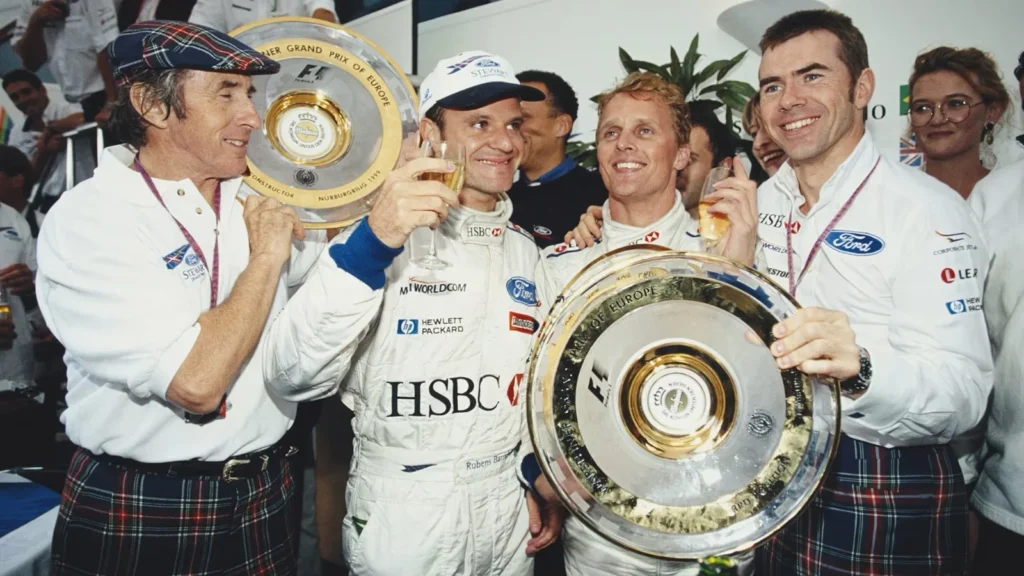
A fitting result as Stewart sped into the sunset
The team would go through a dry spell until Hungary, where Barrichello finished fifth, followed by fourth at Monza. Herbert failed to build on his Canada result, but made up for it at the European Grand Prix at the Nurburgring.
Starting 14th and 15th respectively, Barrichello and Herbert didn’t look like much of a betting man’s tip for a result, but the ensuing rain caused seismic drama in the Eifel Mountains.
The rain caught out most teams, and the chief title contenders – Hakkinen and Irvine – were undone by it. David Coulthard spun out from the lead, with Ralf Schumacher taking the lead. Giancarlo Fisichella took the place, but he too spun out. This, then, gave Schumacher a near-certain lead, but a puncture saw his chances obliterated.
Amidst all this, Herbert, who had pitted for wet tyres at the right time, was now in the lead, and held off the Prost of Jarno Trulli to take his third and final Grand Prix victory, and the first and only win for Stewart Grand Prix. Celebrations were doubled as Barrichello made it a 1-3, giving Sir Jackie and Paul a moment in the sun, which reappeared by the time Herbert stood aloft on the rostrum.
The maiden Malaysian Grand Prix saw the Sepang Circuit suit the SF03, giving Herbert and Barrichello fifth and sixth on the grid. They would finish fourth and fifth.
There was now only one Grand Prix left. Not just for the season, but for the team, as, in June, it had been sold outright to Ford, who entered it under the Jaguar brand. There would be no happy ending, as both Barrichello and Herbert narrowly missed out on points in Suzuka.
Both Stewart Sr and Jr stayed on in new roles. Sir Jackie was made Chairman and CEO, but quit two months before the 2000 season started. Paul would remain as COO, but stepped down midway through the season after being diagnosed with colon cancer, from which he thankfully made a fully recovery.
Jaguar failed to capture the magic of Stewart GP, and scored just two podiums in a five-season spell, before Ford sold the team – and its Milton Keynes hub – to energy drinks brand Red Bull.
Red Bull? Running a Formula 1 team? It’ll never catch on.
But for Stewart GP, the three-season run was filled with strife and turmoil, but was packed full of memories upon which both Sir Jackie and Paul can now look back on with pride, as one of the most recognisable and successful names in Formula 1 history became one of the underdogs, and like all dogs, on one drizzly day in Nurburg, had its day.
READ MORE – F1 Rewind: Stewart’s heir perishes; Mansell and Prost share Brands Hatch glory




Discussion about this post