
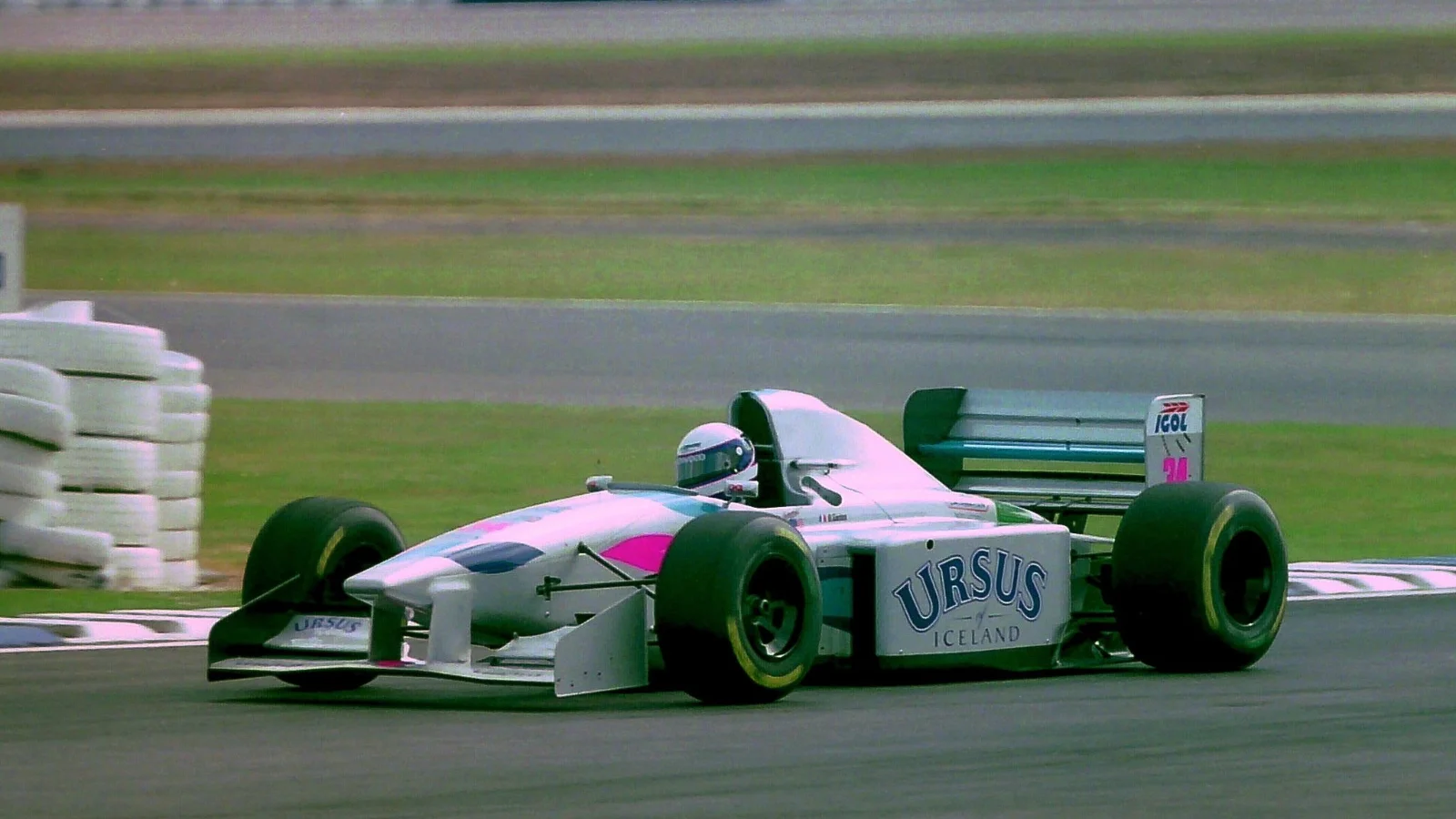
Pacific Grand Prix are a relic from simpler times in Formula 1, but their story is anything but that.
I will admit to being a bit of an old soul before my time. I long for simpler days when we weren’t glued to phones, staying out late at night and feeling perfectly safe in a dark area, and for when common sense-backed finality ruled sport: Either do well, or disappear.
Basically, be ambitious and not rubbish, and do not expect a helping hand from someone to get you out of a mess entirely of your own making. F1 may be cutthroat now, but that is nothing compared to the sport in the 1980s and 1990s, when you either survived or sank without a trace. So for this week’s look down F1’s memory lane, I wanted to look at the final teams that not just failed in F1, but destroyed its own reputation in the process.
Pacific Grand Prix is an enigma as, on paper, it had the pedigree to be successful. To give a modern-day comparison, it would be like if Prema stepped up from its vast junior formula ventures. Pacific had entries in British Formula 4, British Formula 3, and in Formula 3000, the then stepping stone to F1 [today’s F2 equivalent]. But presence means nothing without success, and Pacific delivered, winning in every category it entered.
By the early 1990s, its accolades left it with only one more series to conquer: F1. But saying “we can win in F1” off the tongue with ease is about as reliable as a mid-2000s Peugeot, and just as problematic. The team needed serious momentum and power to survive and thrive in F1, but it got almost every major decision wrong. The hard product it ended up with made the metaphorical Peugeot I just mentioned look like a dream car that people would queue up for hours.

A compromised [and doomed] car origin
Even in the 1990s, a massive infrastructure was needed to run an F1 team. Design offices, workshops, and wind tunnels galore made the multi-million-dollar machine go round, and without them, a team was hindered before it even turned a wheel. Pacific, despite its junior-category success, fell into this trap.
It lacked the infrastructure to design a car – a pretty important part of an organisation planning to go motor racing. So, founder Keith Wiggins employed car designer company Reynard to build them one, a smart decision considering its pedigree for designing winning machinery. Instead, the PR01 endured a painful birth more akin to that infamous scene from Alien, though there would be no hiding the after-effects of this nightmare.
The car was based on a shelved F1 entry project by Reynard originally created for the 1992 season. Names like Rory Byrne and Pat Symonds were key names for the project before they departed to Benetton, taking their up-to-date designs with them. The impact on Benetton’s cars speaks for itself: multiple race wins in 1992 and 1993, as well as Michael Schumacher’s 1994 driver’s title win.
But the original mothballed designs for the Reynard car lay gathering dust. Sensing an opportunity, Wiggins pounced and secured the rights to the designs. Pacific now had a car it could adapt, but as anyone will tell you, using year-old car designs as the basis of an up-to-date car equates to near-competitive suicide. Wiggins would not discover this until later. Instead, he hired designer Paul Brown to adapt the car to the 1993 regulations. Brown had a somewhat underwhelming career, having worked at F1 backmarker Zakspeed before a stint in Sportscars.
Brown set to work, adapting the monocoque to the crash safety tests to create the PR01, with the next step being equally as important: the engine. Wiggins secured a deal with Ilmor for its 3.5-litre V10, prioritising durability and reliability. But this engine was already a year out of date, competitiveness-wise, and its power deficit would only get bigger. Xtrac developed the gearbox, with no issues reported.
So, Wiggins had a car, engine and gearbox, and was ready to race except for one tiny thing – money. Sponsorship dried up, and Pacific would stay in F3000 for another year, setting the team back another 12 months. Instead, the team would turn up in Brazil in 1994 eager and ready to race. A necessary decision, but nonetheless a highly costly one, as Pacific needed commercial backing to see the season out.
A disastrous five-race maiden season
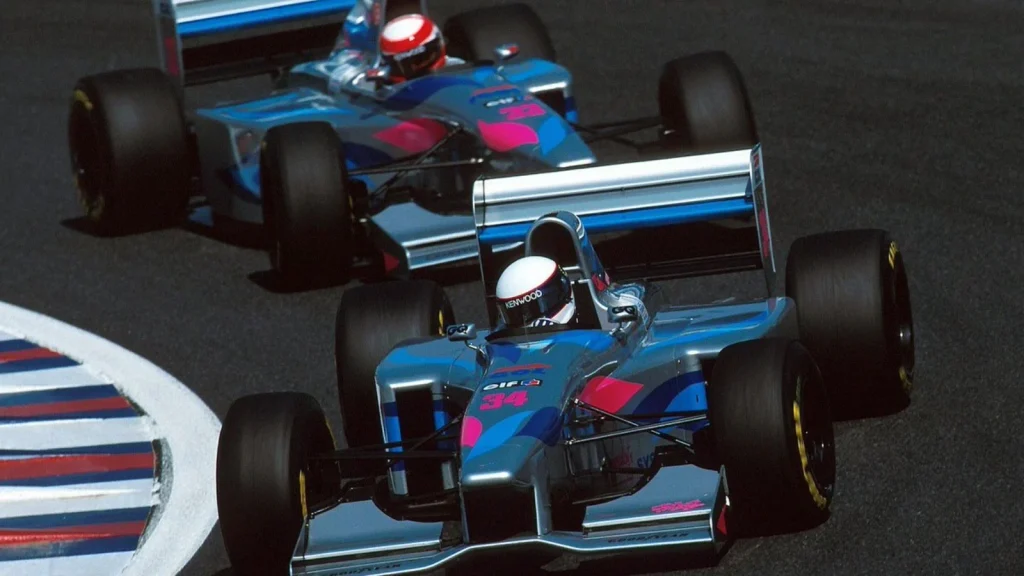
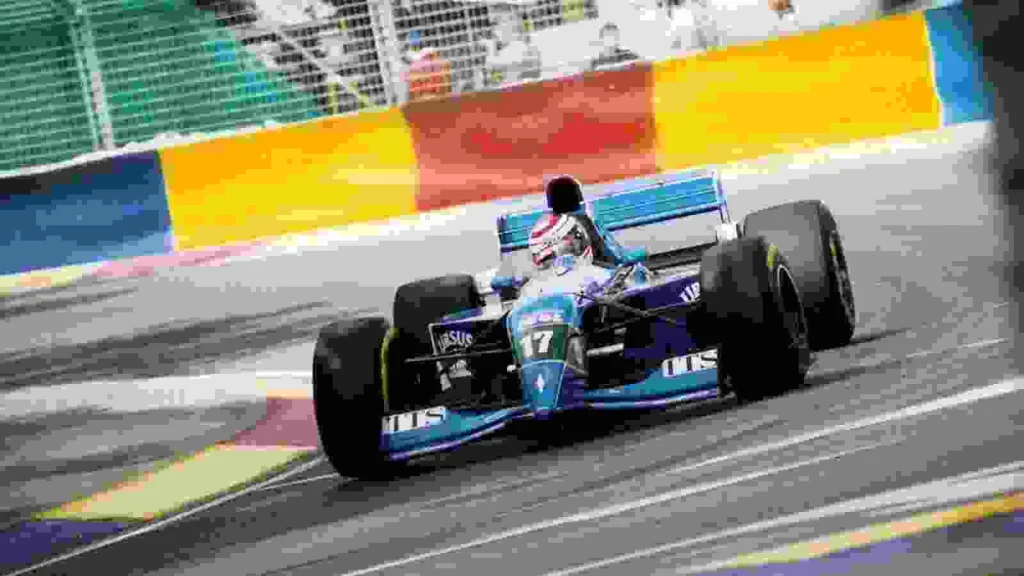
The results of a year of delays and compromised designs came home to roost when F1 rocked up in Interlagos for the 1994 season opener. Drivers Jean-Paul Belmondo and Bertrand Gachot [also a shareholder in the team] were stuck driving cars based on a four-year-old design, with engines at least two years out of date. To compound their woes, the car had broken down with such frequency during pre-season testing that car setup proved impossible.
The only saving grace was that Gachot made the grid, qualifying on the penultimate row of the grid, while Belmondo failed to qualify. But this beacon of hope lay extinguished after just one lap, when Gachot found himself involved in a first-corner collision. He pulled into the garage after just one lap, registering Pacific’s first DNF of its maiden campaign. This weekend set the tone for the team in 1994.
The next race, held in Aida and dubbed the Pacific Grand Prix, proved to be a disappointment, as both cars failed to take to the grid. The tragic events in Imola at the next race offered Belmondo a chance to start the race, given that Rubens Barrichello was out after his crash on Friday, and Roland Ratzenberger had succumbed to his horrifying crash on Saturday. In a gesture of true sportsmanship, Belmondo declined, stating that he had not earned the position. One cannot imagine the horror of that weekend, let alone being offered a deceased competitor’s spot on the grid. Gachot retired after 23 laps after starting on the back row when his gearbox gave out.
Williams ran only one car in Monaco in tribute to the late Ayrton Senna, while Sauber withdrew after Karl Wendlinger crashed at Nouvelle, allowing both Pacific cars to start. Neither would finish, though both made it well past the halfway point of the race. Gachot retired on Lap 49 after gearbox failure, while Belmondo was forced to give in to exhaustion on Lap 53. Four rounds into the season, Pacific had yet to finish a race.
With the grid still fluctuating as teams fielded one car or had injuries, Spain and Canada allowed Pacific to race, albeit with only one car in Montreal. Once again neither finished, and with the grid stabilising, Pacific’s lifeline was cut off faster than a 1990s teenager being caught on the phone with their boyfriend and racking up a massive bill. The team failed to qualify for the rest of the year, as the outdated design and underpowered engine bit hard. Gachot declared his delight at season’s end for never having to drive the PR01 again.
A cringeworthy launch
Wiggins understood that a massive overhaul was needed to secure Pacific’s future after a torrid maiden season that only Life Racing Engines could truly understand. With the decline of the iconic Lotus brand, Wiggins sensed another opportunity and made a deal with David Hunt [the brother of James Hunt] to add the name of the famous team to his cars. As a result, the team was rebadged as Pacific Team Lotus, with the iconic green colour scheme subtly added to the paintwork of the new PR02. This deal, although offering prestige, delivered very little in the way of sponsorship or technical advancement. On paper, it made little sense at all other than to plaster the name of a fallen giant onto the side of a minnow team staring F1 death in the face.
The PR02 would not make the mistakes of its predecessor and was a completely new design, penned by Frank Coppuck. Coppuck had an extensive history at Team Lotus, and a stint at CART. His efforts marked a clear improvement over the PR01. To put into context the leap forward the cleanly designed PR02 was over the utterly useless PR01, we need look no further than the gap to the midfield. In 1994, Pacific ranged from eight to ten seconds off the pace, a chasm in F1 terms, even for the 1990s. The PR02 shortened this gap to four to five seconds. A Ford V10 was chosen over the hapless Illmor offering, although a tad more expensive.
Similarly, with the withdrawal of Lotus and Larousse, the grid now consisted of 26 cars, which guaranteed its qualification for races. Things, it seemed, were on the up for Pacific at last. But money, that small thing that makes F1 tick, proved to be in short supply once again, with more needed to pay Ford on top of the freight costs. This would badly compromise the team later in the season. Gachot remained in the cockpit, joined initially by Andrea Montermini.
All that remained now was to launch the PR02, including its “alliance” with Team Lotus. The venue chosen to mark what Wiggins called “the first true Pacific car” was the Aldwych Theatre in London’s West End. But this launch proved more of a Greek tragedy than a triumphant stage debut. The reason? A bottle of Moët champagne. These can sometimes prove a challenge to open, but this particular bottle took things to a whole new level. Imagine a conversation so brutal you can’t look away, yet it makes you cringe to your very core. That feeling must have permeated the auditorium as the media were forced to watch for 25 agonisingly long minutes as Wiggins tried to spray the champagne to commemorate the launch [the only time he would in 1995]. He succeeded, but all dignity had long gone; the applause in the auditorium was likely out of pity.
Reliability and pay drivers kill off Pacific
The season began in earnest, with Pacific now a regular team on the grid. But reliability continued to elude the team as the costs mounted. The situation became so dire that Gachot vacated his seat mid-year to allow drivers Giovanni Lavagi and Jean-Denis Delatraz a shot at the cockpit.
These two drivers were utterly hopeless in terms of pace, but brought with them much-needed funds to keep the team alive. But when you have the legendary commentator Murray Walker shouting “What is Delatraz doing?!” when watching him weave his car from side to side at the Nürburgring, it’s clear that this is a desperate move from a team in its death throes. Gachot returned to the cockpit once Deletraz’s funds dried up.
Two eighth-place finishes were the highlights, but they brought no points or prize money. Out of funds, Wiggins withdrew at the end of 1995 and returned to Formula 3000, as the threat of the 107% rule and increased crash tests made racing in F1 in 1996 impossible. With that, Pacific died, taking the Lotus name with it. An ambitious but ill-thought-out project, no one came to the rescue, and the team is one of the forgotten outfits of F1’s glorious past. There is no escaping the fact that Pacific did everything wrong. Outdated car designs and engines, pay drivers that are spoken about in hushed tones and deals that brought no money to the table.
Yet, to me, it is a symbol of a simpler time. A team operating on a tiny budget, coming into F1, trying its best and disappearing after exhausting all avenues. Ambitious but rubbish? Yes. Gritty, and full of determination that today’s version of F1 severely lacks? Very much yes.
Call me an anarchist, but I’d far rather see a grid with the likes of Pacific on it [minus the pay drivers] that show a little more spunk than today’s ultra-corporate outfits with billion-dollar valuations. Teams like Pacific represent a time when racing was simpler, the politics of getting to the grid manageable, and passion outranked cash. The time of plucky teams, at least for now, is over. F1 is a worse place for it, in my view.




Discussion about this post