
Beauty is in the eye of the beholder, and most of the time it can be found, even in the most questionable of places. Sadly, this was not the case with McLaren in Formula 1 in 1995. From a car design perspective, 1995 acted as an interim year, as cars underwent a safety transformation.
Cockpits now covered the drivers fully once again, fans no longer seeing the driver’s shoulders, and their hands working the wheel. Crucially, however, the risk of the driver being struck by debris had been reduced, even though these still did not fully encase the driver in the cockpit.
Front wings had also been overhauled; the swooping noses of 1994 were now out, replaced with higher front wings. Simple reasoning guided this decision: cars could no longer launch over the front of another, or bed heavily into the gravel. Rear wings were reduced by 100 millimetres, while a stepped floor was introduced to stop the cars generating 1994 downforce levels.
Adapted late in 1994, the cars were a step down in aesthetics. While 1994 was a great year for truly beautiful cars, some truly awful cars were raced in 1995. Ranging from aerodynamically absent designs to downright weird, 1995 included cars that today would send social media into a Gen Z-enforced “crashing out”.

This created somewhat of a quandary when compiling a list of beautiful cars for the 1995 season. So, instead, this week we look at the worst of the worst. And in doing so, we examine a piece of F1 history that killed a world champion’s career and McLaren’s reputation for over a year. A car from a team that should really have known better.
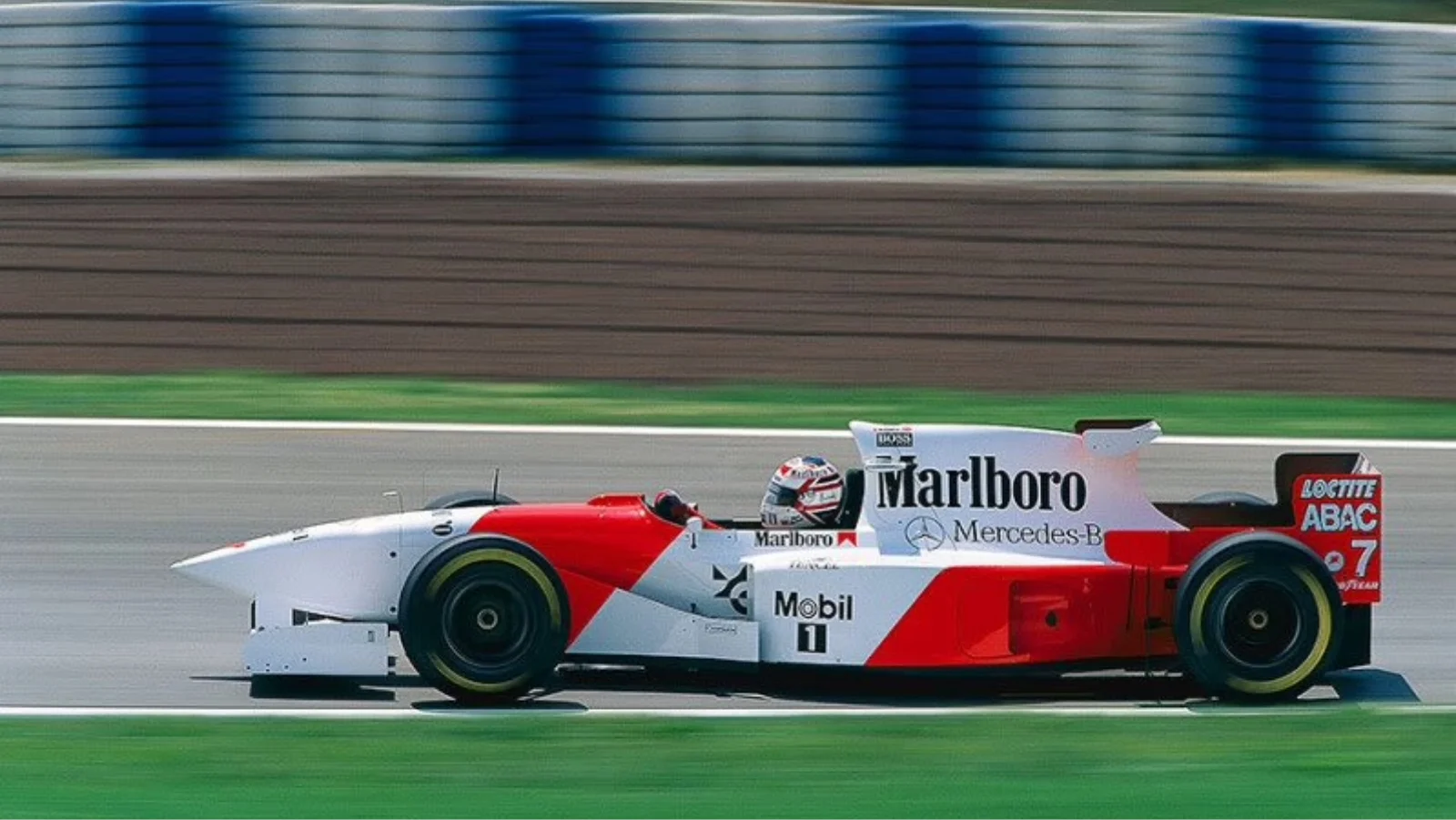
The car chosen to be gifted this unfortunate mantle is the McLaren MP4/10. An eyesore in every sense of the word, it was the kind of car fans would likely emigrate to avoid these days if seen on a race track.
An ‘ugly duckling’ start to an alliance that transcends history
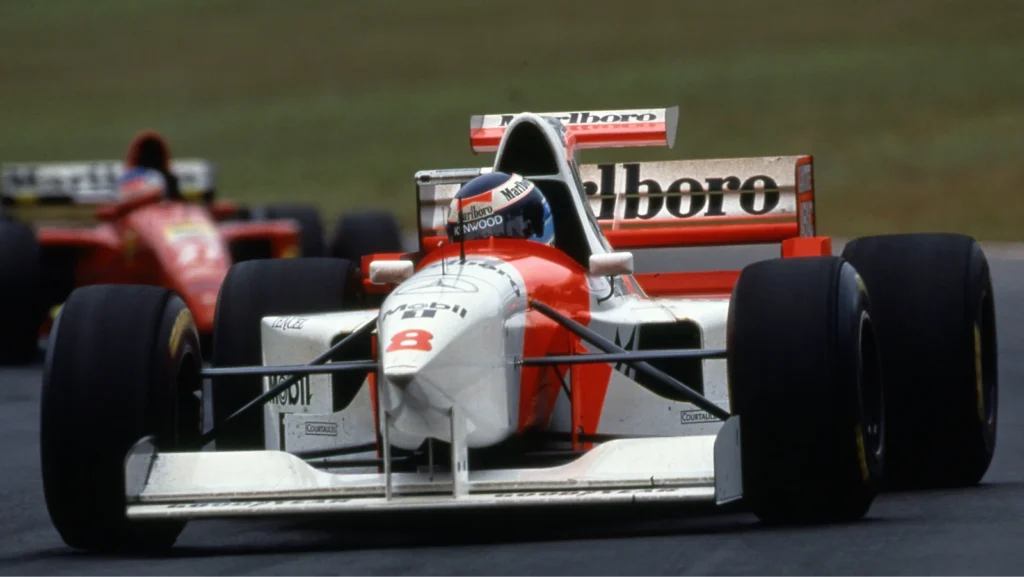
Dear oh dear, where do we begin with this car’s flaws? Everything about the MP4/10 screamed a team in crisis. Following the disaster of Peugeot power in 1994, McLaren snapped up Mercedes engines for 1995, which would become [and still is] an iconic partnership. But all legends have humble beginnings, and McLaren in 1995 was a team reaching the lowest point in its decline.
On paper, this should have been a recovery year and a potential return to the good old days of the famous white and red cars taking to the podium after a lean period. Making a statement of intent, the Woking marque convinced Nigel Mansell to postpone his retirement after winning the final race of 1994 to partner Mika Hakkinen. Known as “the worst-kept secret in the paddock”, Mansell had bold goals.
But here is when the first snag befell the partnership: The 1992 world champion didn’t actually fit in the car at launch. After just one test, Mansell was badly bruised and could not drive the car without suffering considerable pain. A new monocoque would be needed, far from an overnight fix. A new driver was needed for the first two races of the season, leading free agent Mark Blundell to make a shock debut for McLaren following his release from Tyrrell.
But a driver change was far from the only thing wrong with the MP4/10. This car is without question one of McLaren’s biggest design missteps. The Science Museum hosted its glitzy launch, with veteran broadcaster Steve Ryder on hosting duties.
Alarm bells started ringing as the cover came off, Ryder labelling the MP4/10 as “radical progression, this by McLaren”. Replacing “radical” with “misguided” would be a more accurate statement. If a car looks quick, it usually is. If it looks madcap or too radical, it’s usually an ugly duckling: only its mother can love it.
Terrible design concepts
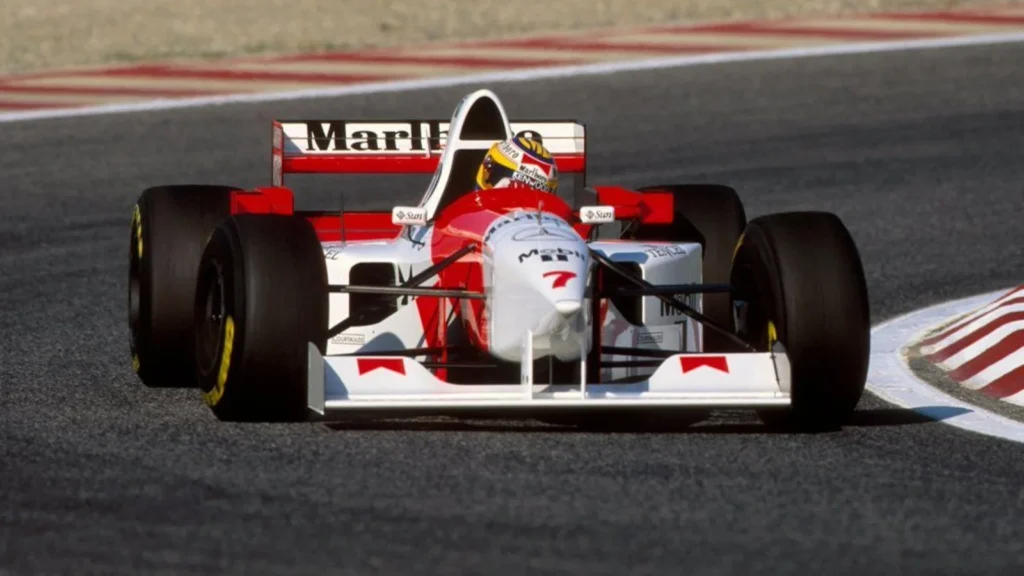
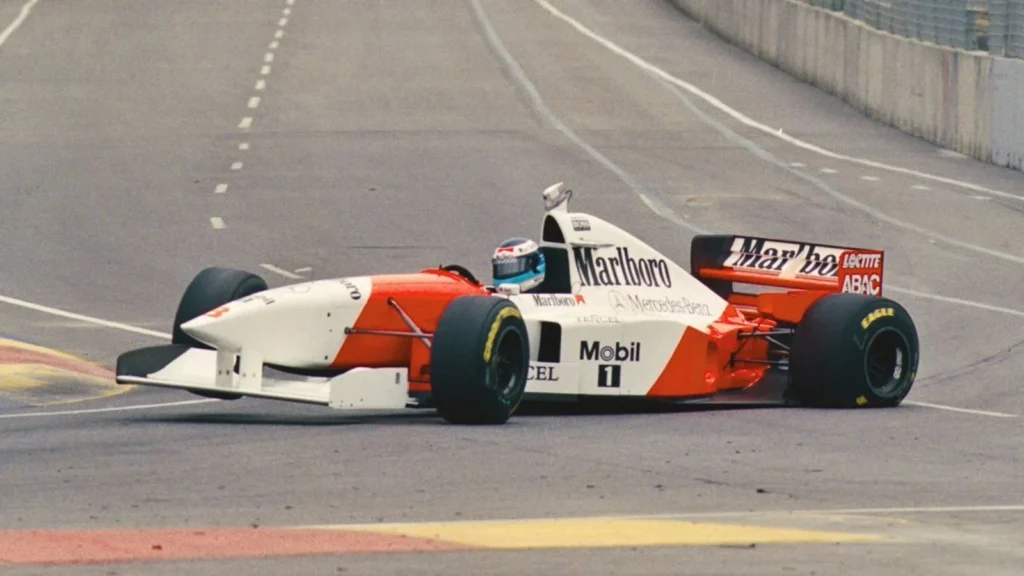
The car featured a high, pointed front nose with aerodynamic traits similar to those of a Morris Marina, resulting in a bulky-looking front end. The front wing endplates were located under the round tip, giving the optical illusion of them being attached to the chassis by invisible gaffer tape, an ugly sight indeed.
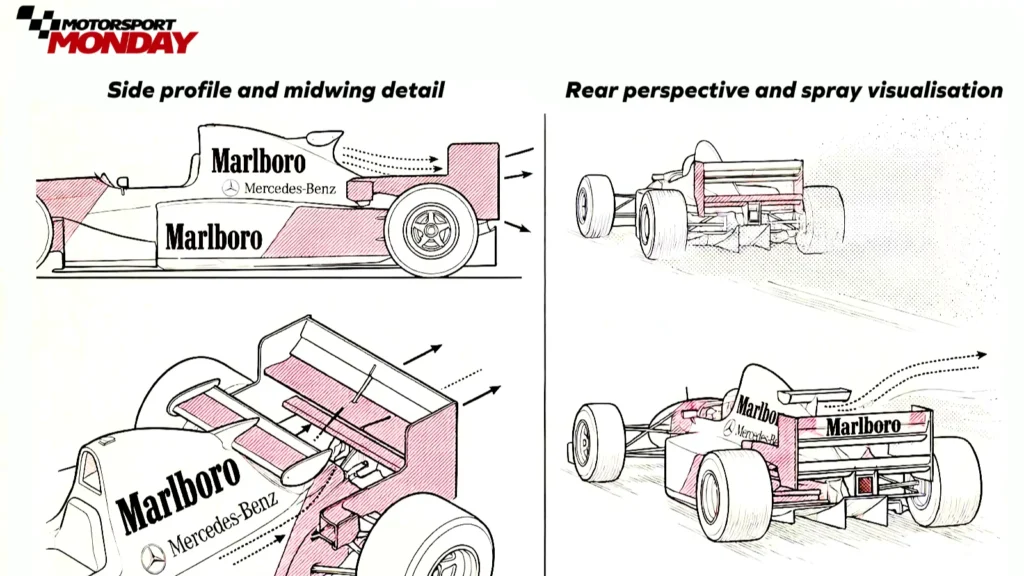
But the king-sized elephant in the room [which could not be missed by anyone with even the remotest sense of spatial awareness] was the engine cover. Sharkfin concepts are commonplace in F1 today, but McLaren took this a step further, with the introduction of a “midwing” on the engine cover. This led to a dramatic swooping down of the engine cover itself into the chassis, before the sensitive rear wing supports.
In theory, the midwing would channel airflow over it, cleaning the air towards the main rear wing and aiding efficiency, regaining a portion of the downforce lost by the new rules that slow the cars. The reality and result of this aggressive design saw results similar to giving fine bone china to a horde of drunken elephants at a tea party at Buckingham Palace.
First, there was the weight of the midwing. It added somewhere in the region of three to five kilos to the engine cover and, critically, the car’s centre of gravity. A real-world comparison would be adding a 250g weight to the roof of your family car and attempting to take a corner on a country road. The moment you arrive at the bend, the car will roll, become unpredictable, and you will have no confidence. This is the feedback that Hakkinen and Blundell gave throughout 1995 regarding the MP4/10: sluggish and prone to rolling, with a pendulum-effect anomaly that would occur without warning.
This is not the only consequence of placing a wing slap bang in the middle of an F1 car. That supposed clean air that should have been a benefit? It didn’t exist, at least not when it counted. Instead, what it actually generated was aerodynamic turbulence and instability, adding further complications to an already impossible situation. When a driver of the calibre of Nigel Mansell tells you your car is difficult to drive due to the consistencies of the aerodynamic package, you know you are in major trouble.
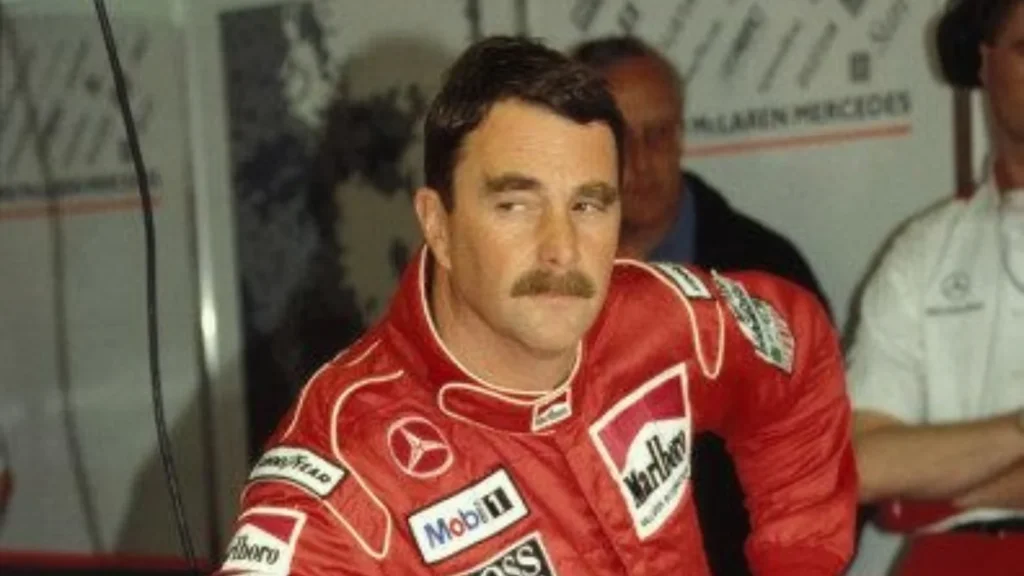
Mansell forced to wait for debut amid disastrous opening races for McLaren
The opening races for McLaren had showcased just how badly the team had gone down the wrong avenue for designing the MP4/10. The Mercedes-Benz FO 110 engine had pace but was let down by the chassis. Brazil masked the car’s shortcomings, Hakkinen taking fourth and Blundell sixth. To the casual viewer, this marked a positive start to the season, but upon further examination, the results unravel.
Hakkinen and Blundell were over two seconds shy of polesitter Damon Hill in qualifying, the car behaving like an intoxicated student feeling their way down a pitch-black corridor at 1 am to find their dormitory: it lacked grip, poise and acted completely unpredictably, running the risk of hitting a wall.
The true, ugly picture became horribly clear at the next round in Argentina. While the rain mixed up the grid, allowing Hakkinen to start in fifth, the dry conditions on race day extinguished all hopes of a result. The Finn was involved in a first corner collision with Eddie Irvine’s Jordan, causing a puncture, spinning Hakkinen into the gravel. Blundell retired on Lap 9 with an oil leak in a car that looked like a nightmare to handle.
Then, having waited two races to get into the MP4/10, a disconsolate Mansell made his McLaren debut at the San Marino Grand Prix. His expectations were low, the Briton unable to confirm if he could finish in the points. Media hype, however, over the debut of two icons in F1 history was off the scale.
But with so little time in the car, as well as the MP4/10’s terrible handling, Mansell qualified in ninth, 1.2 seconds away from his younger teammate in sixth. The race proved equally as horrific, as Mansell wrestled the car around, though running in the points in fifth. But Irvine, fresh from wrecking Hakkinen’s race in Argentina, collided with Mansell at Tosa, forcing him into the pits to finish a lowly tenth. Hakkinen, meanwhile, took fifth.
The inevitable messy divorce of McLaren and Mansell
By the next race in Spain, the tense atmosphere inside McLaren threatened to boil over. Mansell’s constant [but not unjust] criticism of the MP4/10 deepened a growing rift between him and Ron Dennis, while also hating driving the car. The perfect storm would lead to one of McLaren’s worst weekends in the sport, but the start of a recovery to F1 greatness.
Qualifying proved a much closer affair than in San Marino, Mansell just a tenth of a second away from Hakkinen, lining up ninth and tenth. Both, however, were 2.4 seconds away from the pole time of Michael Schumacher. Neither would finish the race. Following a run through the gravel, Mansell entered the pits and parked his car, citing handling issues. Hakkinen stayed out only to retire from fifth with a fuel pressure problem.
But a double DNF would not be the major story for McLaren in Spain. Instead, a far worse story transpired: Mansell had quit, leaving F1 behind for good. A partnership that promised so much blockbuster performance had ended on a whimper. Lacking confidence in the car and not wanting to work with McLaren to fix the issues.
The MP4/10 played a major role in his departure. Concerned about having a major accident if he continued to drive it, he was unable to speak the same language as the 1992 world champion. Mansell loved to thrash cars around, taking them to the limit of adhesion, a trait he could not do with the MP4/10.
Away from the MP4/10’s shortcomings, the alliance between Mansell and McLaren made no sense. It was a bit like giving an elderly person a task to create a social media post for a Gen Z audience, using their slang. It could be done, but it would be a monumental disaster, as neither would speak the same language.
Mansell needed to be the centre point of the team to rally around, using emotion to get results. Dennis, on the other hand, was controlling, wanting to project McLaren in his own image. The relationship was doomed to fail from the start. Had he stayed, he would have seen results from late 1996, but required quicker results and a car on his wavelength. The gap between the MP4/10 and the front of the field was simply too far. It is the car that truly killed a world champion’s career.
McLaren endures slog before *that crash* in Adelaide
Blundell was now a full-time race driver, and McLaren had work to do to salvage its season, which proved to be a near-impossible task. The glimmer of hope it had came in the form of Blundell, who grasped his opportunity by the horns. Although the car was a dog, he was still driving a McLaren.
Results were few and far between; the team developed several versions of the MP4/10 throughout the year, with the tide not turning until the second half of the season. Hakkinen took two podiums in the closing races, finishing second in Italy and Japan. While Blundell failed to match his younger teammate, he did bring home points on four occasions, salvaging fourth in the constructors’ championship by season’s end.
But the MP4/10 and 1995 had one final gift for McLaren. Mansell said one of the reasons he walked away was his fear of a major accident. This came at the final race of the year in Adelaide, Hakkinen becoming the unfortunate victim of prophecy during Friday qualifying.
Suffering a deflated tyre at Brewey Corner, his car launched into the air before landing and skidding across the track into the barriers at high speed. Given that cockpits were still relatively low in 1995, his head was thrown forward, hitting the front of the cockpit backwards and side to side within two seconds. Suffering a fractured skull, he required an emergency tracheotomy to save his life, the Finn turning blue in his cockpit from being knocked out, and his jaw was clamped shut. He made a full recovery and raced again at the 1996 season opener.
Blundell, now the sole McLaren in Adelaide, qualified a lowly tenth but secured fourth in a race full of mistakes by the frontrunners and those around him. It was a positive end to a year of disappointment.
The MP4/10 may not have been the worst-performing car of 1995, but it was most definitely an example of rushed decision-making, a laissez-faire approach to innovation before frantically back-tracking.
Perhaps its most memorable legacy is its arguable sense of self-awareness. The MP4/10 knew it was so bad that it didn’t want a driver of the calibre of Nigel Mansell to drive it out of embarrassing itself further. Consigned to the pages of history, it does not feature in the boulevard at the McLaren Technology Centre. Some cars are best left to be forgotten. This is one of them.




Discussion about this post