
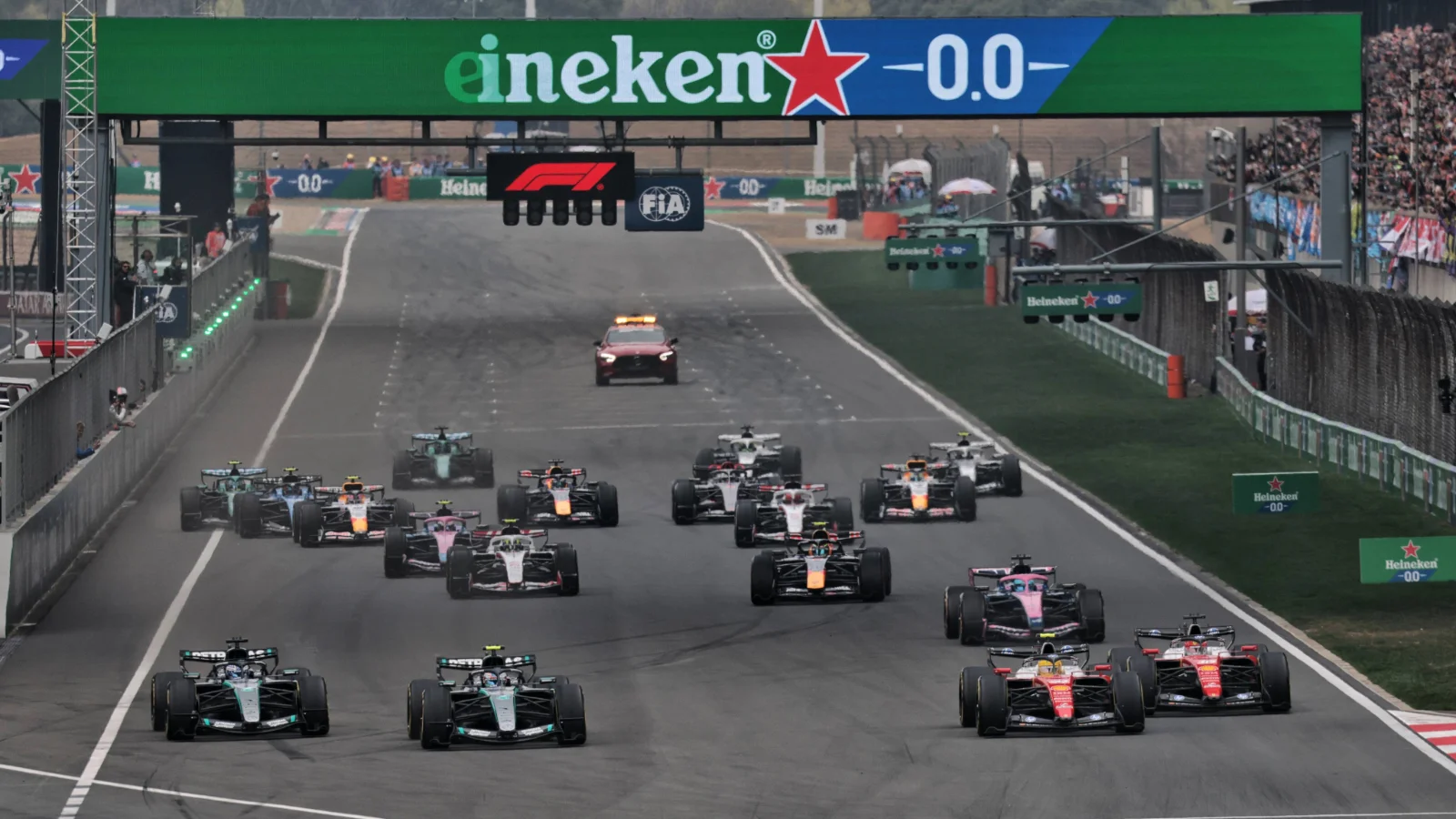
Race, charge battery, overtake is the new mantra in Formula 1 at present. Likened to Mario Kart by Max Verstappen and Charles Leclerc, readers will now have the image in their minds of playing the game in an arcade, but instead of Marios’s kart they’re now driving a Ferrari using a power-up to blast a Mercedes out of the way…
All well too, but there is another game from history that has become the perfect analogy to describe today’s Formula 1 – “Crash Team Racing”. Known to some, it involves upgrading your kart, racing on increasingly challenging circuits, and eliminating competitors with unique power-ups and boosts to get ahead; a bit like F1 these days?
And here is the problem with these games… they are a distraction! Of course, you can play them for hours when you are young, but even that has its limit. The reason is simple, and rather obvious: repetition.
It’s the same tracks, the same style of racing, and without any form of deviation. Not much work was put into the long-term playability of these games, and why would it be? They were designed to kill an afternoon, not become a long-term solution for gamers.


Like any current in-craze fad, its popularity dies down over time, and the game quietly and quietly became part of history and legend. Moreover, most of the bad parts were forgotten and only a few highlights were ever remembered; much like the last two grands prix in Australia and China…
Formula 1’s new rules attracted the ire of drivers long before they turned a wheel in anger. Yet, the regulations have been forced through, with driver feedback seemingly ignored. They were created in a different era, and the sport has been left behind, even more than BlackBerry after the birth of the iPhone.
The popularity of global en masse electrification (if you can call it that) of anything on four and two wheels has long since died down and major automative players are trying their best to spin their way out of this earlier electric-frenzy.
Rules from a world that time forgot
Formula 1’s attempted split at an equal 50:50 split of internal combustion and electrical power was made at a time when the switch to electrification was “cool” in the eyes of car companies.
The future was suddenly electric and Formula 1 needed to embrace this bold new “Carbon Zero” vision. But like Mario Kart, and Crash Team Racing, its appeal has quickly faded as reality and repetition kicked in.
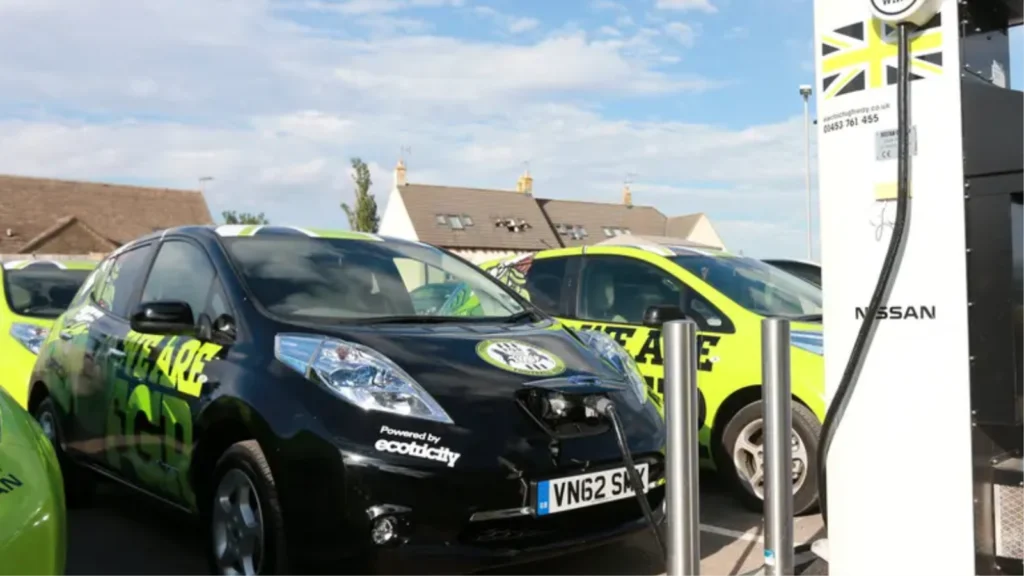
Car companies are now trying to frantically roll back their switch to all-electric cars due to low (and in some cases, zero) uptake and costs. Public interest, while undeniable, does not match en masse consumer behaviour. And it’s for good reason too, the basic charging infrastructure to support electric cars does not exist yet and, quite possibly, can never be built with current limited supply.
In Britain, for example, we have a serious problem with electric car charging outside London. Trips must be planned to the last detail to prevent being stranded, and don’t get me started on what your options are if you live in the far-flung corners of the country like Cornwall.
This means exciting cars like the soon-to-be-launched Peugeot E-208 GTI remain a pipedream car for most of the population because of a very simple question: where would you charge it if you live in a terraced house or the tenth-floor apartment in a rented building?
Consumers are not interested in products that make their lives more complex. In 2026, the word is chaotic enough without the unpredictable. Daily life is designed to squeeze every possible bit of money out of you. Petrol prices, while expensive, guarantee that a car will be filled up, and will run, short of a freak mechanical failure. Electric cars in today’s world, do not share this trait.
A somewhat fundamental problem, it is perhaps why electric car sales, while rising, still lack real-world consumer confidence. It’s almost as if having an unrealistic, expensive idea forced on the general public doesn’t work – who would have thought it?
This is exactly the trap Formula 1 has fallen into. Its lost touch with its more technical fanbase, in favour of being politically “cool”, by championing enhanced electrification. It has ignored that fans do not care about how batteries are deployed. They want to see great racing, loud noise and simple cars.
So, instead of the universal praise it expected for its new rules, the sport is now crashing harder than a hungover university student in a quantum physics lecture that got drunk the night before, and cannot remember the person they woke up next to the next day.
Our beloved sport t is being memed and ridiculed daily by other forms of Motorsport – not a good look. It has, by its actions, made itself comparable to Formula E with Max Verstappen calling the cars “Formula E on steroids”.
Formula 1 is now entering into a full-blown identity crisis that not even a late middle-aged man has experienced.
Hope over reality for Formula 1?
To understand how Formula 1 has arrived at this terrible place, we need to understand the political landscape at the time these regulations were created, not just in F1, but in the wider automotive world.
Governments were pushing for no new petrol-powered cars to be on sale as early as 2030. Sales of electric vehicles were on an upward trajectory. Formula 1 needed to think carefully about it stayed “relevant” in this brave new world and acted in the best way it deemed it could.
Taking the plunge, it settled on a 50:50 split between internal combustion and electric power. Battery charging and deployment would be built on the foundations of the previous generation of car, executed with more finesse based on lessons learnt.
DRS would officially cease to exist, with different modes of active aerodynamics now making the front wing move too. Battery deployment, however, would take centre stage. To governments and wider environmentalists of the day, this looked like a hot fudge sundae on a warm summer’s day. A 50:50 split in power is a short, snappy statement that the automotive community can get behind.
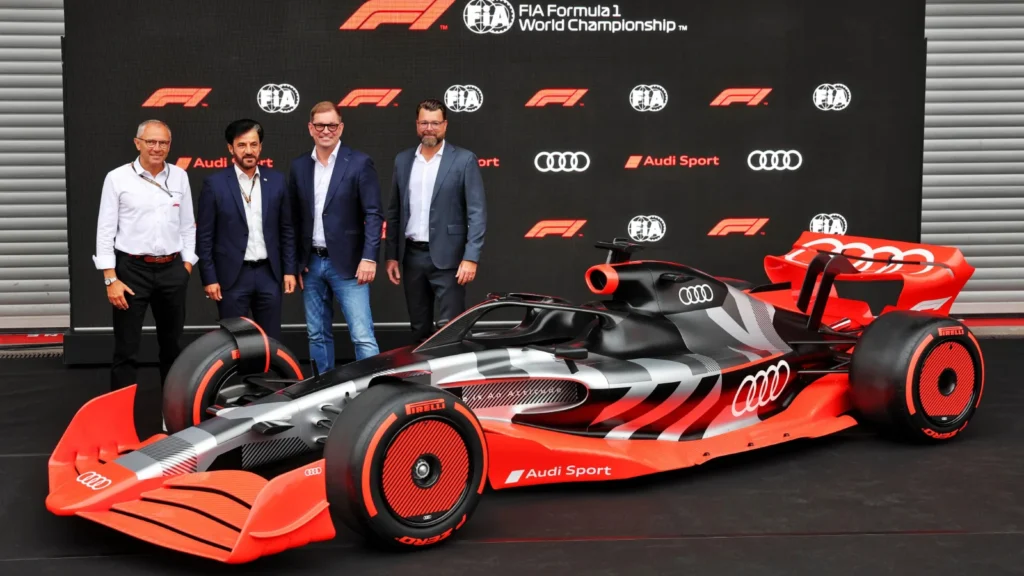
The results were immediate: Audi were attracted to Formula 1 for the first time in the sport’s history, quickly signing on the dotted line. Honda returned (again), General Motors was on the way, and even Porsche came close before opting to walk away. It seemed that a new dawn for F1 was at hand.
But behind the scenes, the designers and drivers were discovering multiple major flaws in simulators: the cars are never truly 50:50. The battery and internal combustion engine take over at different points, with battery management taking over the racing, while the active aero had drivers spinning out on the straights.
Drivers immediately raised their concerns, but these were quickly dismissed. The new era would come, regardless, and these issues could “just” be worked around.
Then, with a year or so to go, electric cars suddenly fell out of favour with car companies. Production continued, of course, but all electric lineups were abandoned, and governments pushed back the date of new petrol-powered cars to be off the road.
And the sport? Well, that was now locked into regulations that were created in a world, by a world, that no longer even existed, if it did to start with.
How to fix a surge of negativity
But this wouldn’t matter if the racing was good, a hark back to the good old days of the 1990s. Instead, what fans and the automotive sector has been given, are cars that defy Formula 1’s progress.
Labelled the “battery championship” by Fernando Alonso, cars super-clipping down the straights is not what fans pay significant sums of money to watch in a grandstand or general admission. Formula 1 machinery has no business slowing down on a straight in any way, shape or form, unless it is a swap of position between teammates, or a blue flag scenario.
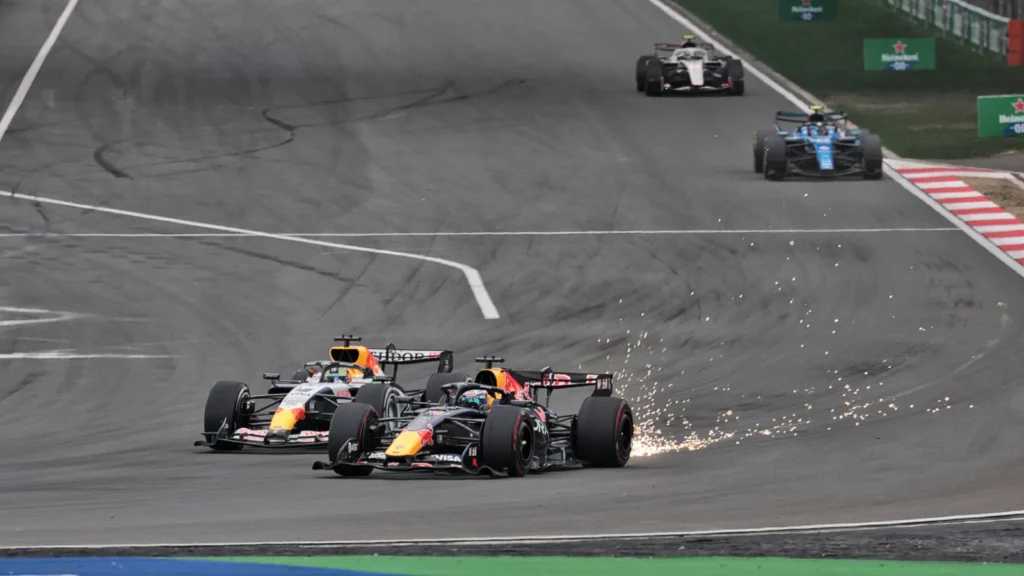
Overtaking is now, if possible, even more artificial than DRS. Gone are the days where drivers performed overtakes using skill, lining up a rival and using surprise to power past. Now, a driver simply has to wait for their rival’s battery to run out. The results resemble a child racing an adult in a 100-meter sprint.
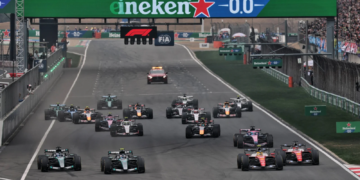
The start of races so far has been fast and frenetic, the highlight of a weekend by a long way. Ferrari have become a nuisance to Mercedes, able to dice with the Silver Arrows before falling away after a few laps into the race.
After that, battery management kicks in, and the midfield take over the action, demonstrating “who has the biggest batteries?”. It is, to the many, the antithesis of what modern day Formula 1 should be.
To be clear, not everyone is vehemently against the rules. Some have praised the racing and believe it has injected chaos into the sport. But it must be said these voices are few and far between. Fan engagement is shifting to laugh at Formula 1, and eventually, like the racing games that occupied fans for a few months, interest from Formula 1’s casual fan audience will wane, then diminish entirely.
Fixing this surge of negativity is not an easy task. The FIA has, apparently got a Plan B, which is under consideration for after Suzuka. It plans to collate the data from the first three races and then form an idea, such as limiting the battery management. But, in the meantime, we are forced to endure another weekend of artificial racing powered by battery management.
This electrification saga has played out a bit like Disney’s Snow White reboot. In trying to make regulations that offend no one and include everyone (yes, Audi and Mercedes we are looking at you), they have managed the same impossible feat as that disastrous film, offending just about everyone!
Just like the original successful movie, the sequel is ill-advised…
READ MORE: Alpine F1 stake saga takes new twist as new bidder throws hat into the ring








Discussion about this post