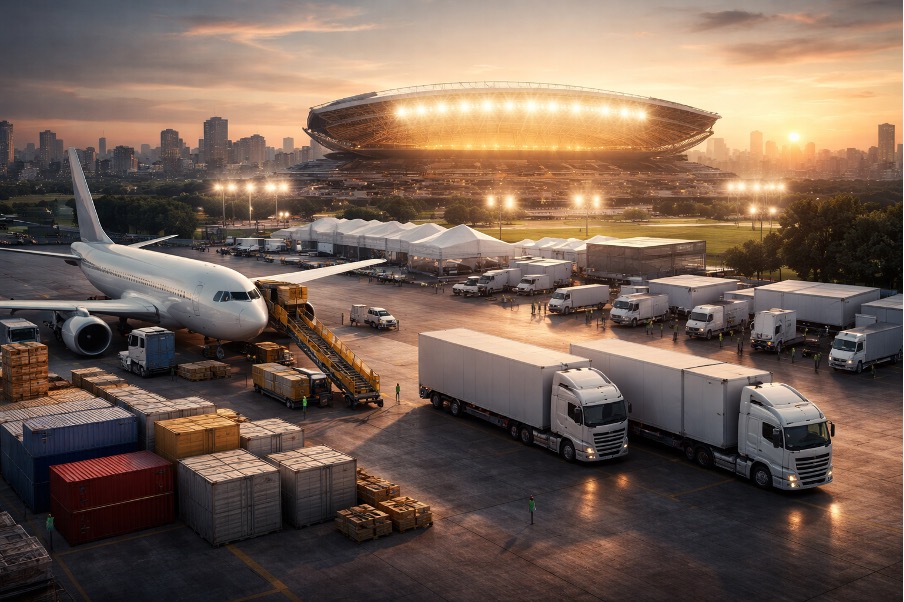
A major motorsport or sporting event looks settled only after months of contracting, routing, and staffing have already taken shape.
In February LA28 said more than 5 million fans from 194 countries had registered for its first Olympic ticket draw; in January, FIFA said the World Cup had generated more than 500 million ticket requests in 33 days.
Meanwhile DHL says that a Formula 1 season can involve moving up to 1,200 tonnes of freight across 24 races on five continents. Money arrives first. By the time the lights come on, the business model has usually been running for a year or more.
The rights stack comes first
The first build is commercial, not physical. The IOC’s own marketing overview says the Olympic movement is privately funded through broadcast partnerships, the TOP programme, and host-country ticketing, sponsorship, and licensing.

LA28 said in that same February media release that it had already passed $2 billion in sponsorship revenue during 2025. That tells you what hosts sell before they stage anything: exclusivity, inventory, and access to their audience. The event starts as a rights business and only later becomes a transport problem.
The venue map is a budget sheet
Venue plans are often presented as a fan story, but the hard part lies in cost control and travel time. LA28’s June 2024 venue revision shifted more Olympic sports into existing stadiums and fewer temporary sites, with an estimated $156 million in combined savings and revenue gains.
LA28’d November 2025 competition media release described the Olympic programme as 51 sports across 49 competition venues in 18 zones. One small operational clue sits in the football calendar: LA28 said this month that the tournament will start on 10 July 2028, four days before the Opening Ceremony on 14 July, because the approved format gives each team two extra rest days. That is not pageantry; it is scheduling discipline.
Freight sets the pace
Motorsport makes the logistics visible because the cargo is heavy, fragile, and public. DHL says each Formula 1 season moves up to 1,200 tonnes of cars, engines, fuel, broadcast gear and hospitality material.
Plus, Formula 1’s 2025 sustainability update says new freight containers were introduced to enable more efficient Boeing 777 use, biofuel trucks were expanded across the European leg, and around 140 personnel now work remotely on race weekends from the Media & Technology Centre in the UK.
Freight decides and the calendar changes for 2026, with Canada moving to May and Monaco to June, were not cosmetic; Formula 1 said that the shift removes an extra transatlantic crossing for essential freight and equipment.
Borders, beds, and staffing charts
The biggest tournaments are also immigration exercises. FIFA says the 2026 World Cup will run from 11 June to 19 July, with 48 teams, 104 matches, and 16 host cities. Its volunteer programme alone will involve around 65,000 people working across more than 20 functional areas at stadiums, training sites, airports, and hotels.
That scale turns small failures into visible ones: a thin airport desk at 06h00, a slow accreditation handoff at team check-in, or a bus loop that clogs after a late kick-off can damage a host day before the match report even starts. Good hosts usually look calm because the staffing chart has already absorbed the panic.
The data room now feeds betting markets
The operations room no longer serves only broadcasters. When Formula 1 appointed ALT Sports Data in February 2025 and FIFA selected Stats Perform in January 2026, both competitions acknowledged that official timing and event data now flow smoothly.
This information now flows directly into media products, trading systems, and online betting (French: paris en ligne) markets that price the same lap time, lineup bulletin, or disciplinary note within seconds.
A late stewards’ document or a corrected team sheet now hits several businesses at once, not just a press box. That changes how tightly hosts manage every verified update.
After race week, the asset still has to earn
Ticketing now doubles as crowd management and post-event revenue planning. LA28’s current ticket process uses timed drops. Its March update says buyers who do not reach the 12-ticket maximum in an early window roll into later draws.
Meanwhile On Location is already taking deposits for hospitality ahead of broader sales; in Formula 1, the Las Vegas model now leans on Grand Prix Plaza as a year-round business, with the official site calling it the largest Formula 1 attraction in North America.
Formula 1’s January reopening notice stating that it will close again in the fall to prepare for the 19-21 November 2026 race weekend. Another small observation sits there: the venue spends most of the year selling access, then disappears back into race operations when the circuit needs it.
That is how modern hosts justify the spend between bids, calendars, and race weekends.