
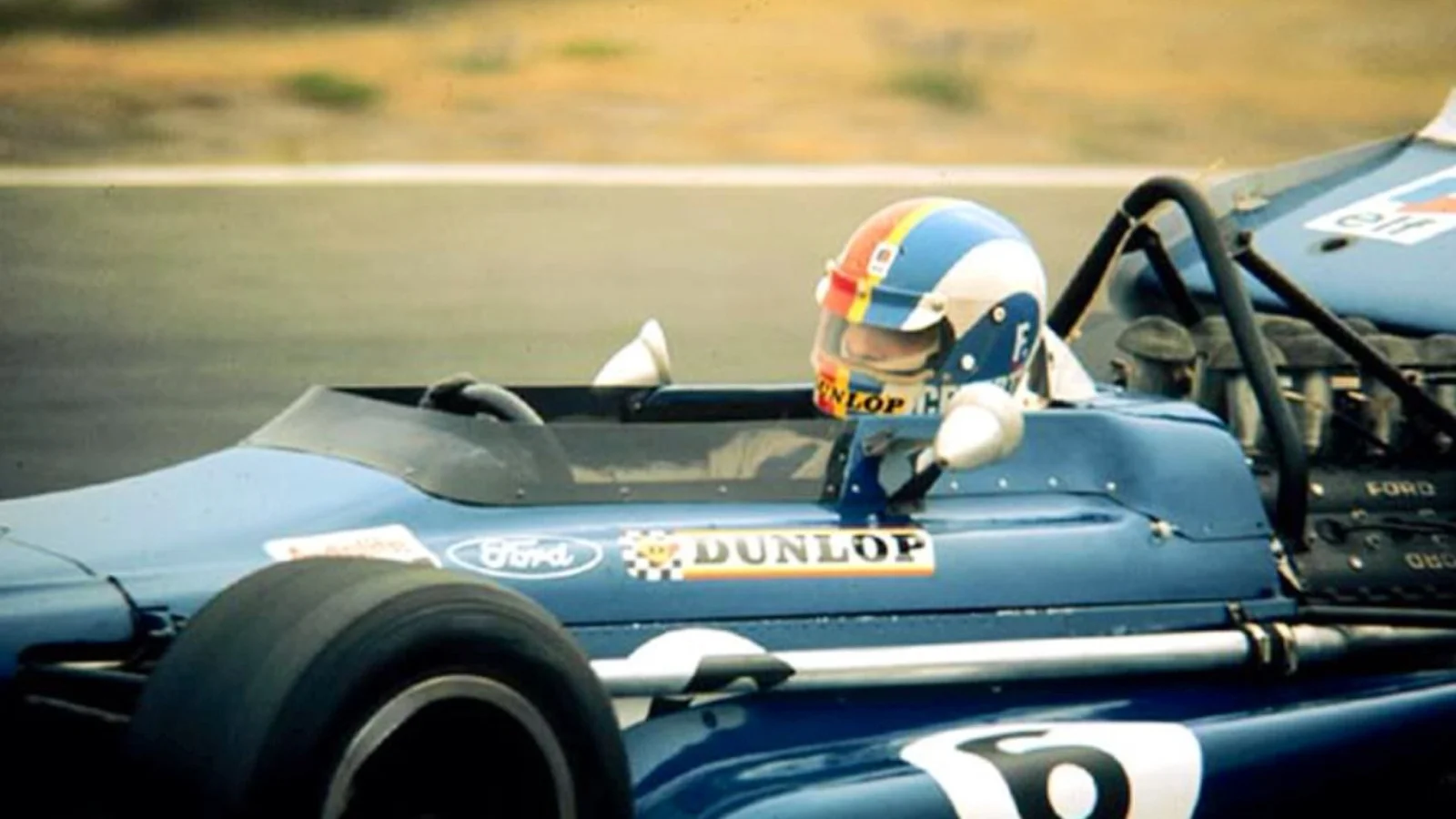
Motorsport Week looks back on the career and life of Francois Cevert, the protgege of Jackie Stewart who was killed before reaching his prime in Formula 1.
Born in Nazi-occupied Paris on February 25th 1944, Francois Cevert ventured into motor racing as soon as he completed National Service, and after a successful stint at the Winfield Racing School, he was handed a scholarship, which was a Formula 3 seat.
After an initially difficult period, Cevert switched from racing an Alpine to joining the Bologna-based Tecno team, which carried him through all the way to an F1 debut at the 1969 German Grand Prix.
Earlier that year, Stewart, on his way to the first of three Drivers’ titles, competed – as was common in those days – in a Formula 2 race at Crystal Palace, and when he found it exceedingly hard to overtake Cevert, the Scotsman noted the name.
After Stewart’s F1 team-mate at Tyrrell, Johnny Servoz-Gavin, retired after just three races at the start of 1970, Ken Tyrrell had remembered Stewart’s tip off about Cevert, and duly gave him a call.
Driving the team’s second car, a March chassis, Cevert scored his first point at Monza, and was rewarded with a 1971 seat in its own chassis, alongside Stewart.
His first podium fittingly came at his home Grand Prix at Paul Ricard, and after a further two at the Nurburgring and Monza, Cevert scored a maiden win at Watkins Glen, the final round of the championship, taking him to third place overall, with Stewart winning a second title.
1972 yielded a little less success, with sixth place in the Championship standings, taking two podiums at Nivelles and Watkins Glen, but did finish second in the Le Mans 24 Hours for Matra, its other car winning, courtesy of Graham Hill.
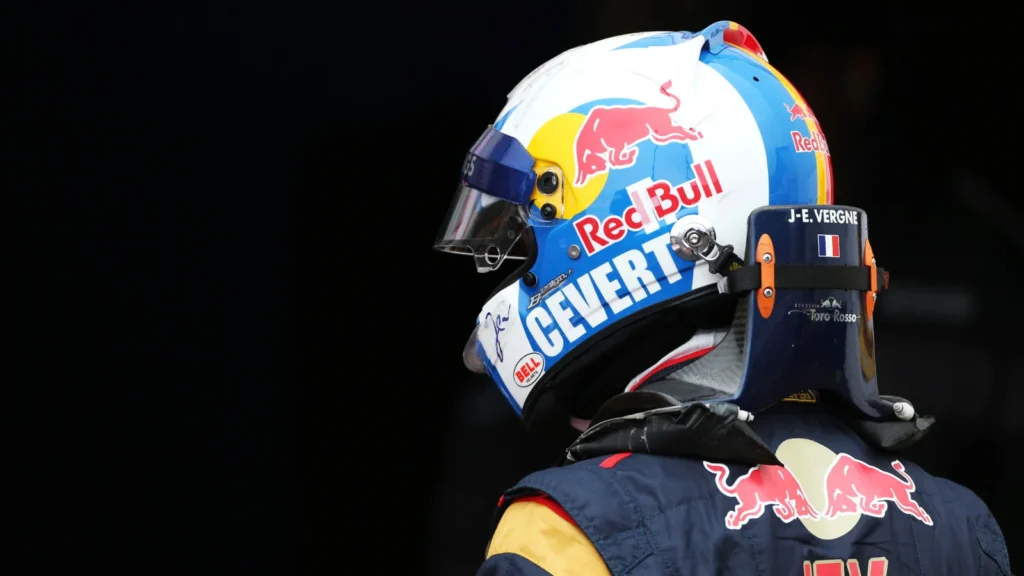
The chance to take Stewart’s F1 mantle snuffed out at The Glen
Cevert hit the ground running in 1973, taking second in Argentina, and then in Spain and at Zolder. A further three second-places in France, Holland and Germany followed, to add to the third place scored in Sweden.
Now as close to Stewart as ever, Cevert looked set to finally take that next step on a more consistent basis, and with Stewart secretly plotting his retirement at the end of the season, Cevert was all set to be the number one driver for Tyrrell in 1974.
At the scene of his greatest moment to date, Watkins Glen, Stewart was readying himself for what would be his final Grand Prix, and his 100th.
On Saturday morning, Cevert was battling with his close friend, Swede Ronnie Peterson, for pole position, and went out to claim top spot.
During a fast lap, Cevert approaches ‘The Esses’ complex, and after a hitting a bump, touched a kerb, sending him into one barrier, launching him into the other on the opposite side.
Cevert was killed instantly.
“Cevert had crashed violently in the uphill Esses heading onto the back of the circuit,” Stewart recounted. “Fighting the car as he went up the hill, he brushed the curb on the left, whipped across the track and hit the guardrail on the right.
“The car began to spin, and he swerved back across the track at 150 mph and hit the outside guardrail almost head-on.”
Stewart concluded: “They [marshals] had left him [in the car], because he was so clearly dead.”
Tyrrell admitted that he subsequently considered quitting Grand Prix racing afterwards. The decision was taken to withdraw Stewart’s car from the race.
Cevert, just 29, was denied the chance of emulating his mentor Stewart, by the very dangers he had fought to improve throughout much of his Grand Prix career.
Whilst never a World Champion and whilst perishing at such a young age, a legacy formed through his ever-improving race craft, his friendship and nurturing from Stewart, and for the Gallic charm so many people attributed to his character.
The image of his white, red and blue helmet, and his piercing blue eyes gazing with focus out of it, has transcended through the decades, to ensure that he is remembered as one of F1’s biggest ‘what ifs’.
READ MORE – F1 driver who inspired Brad Pitt movie to ‘complete’ unfinished season




Discussion about this post