
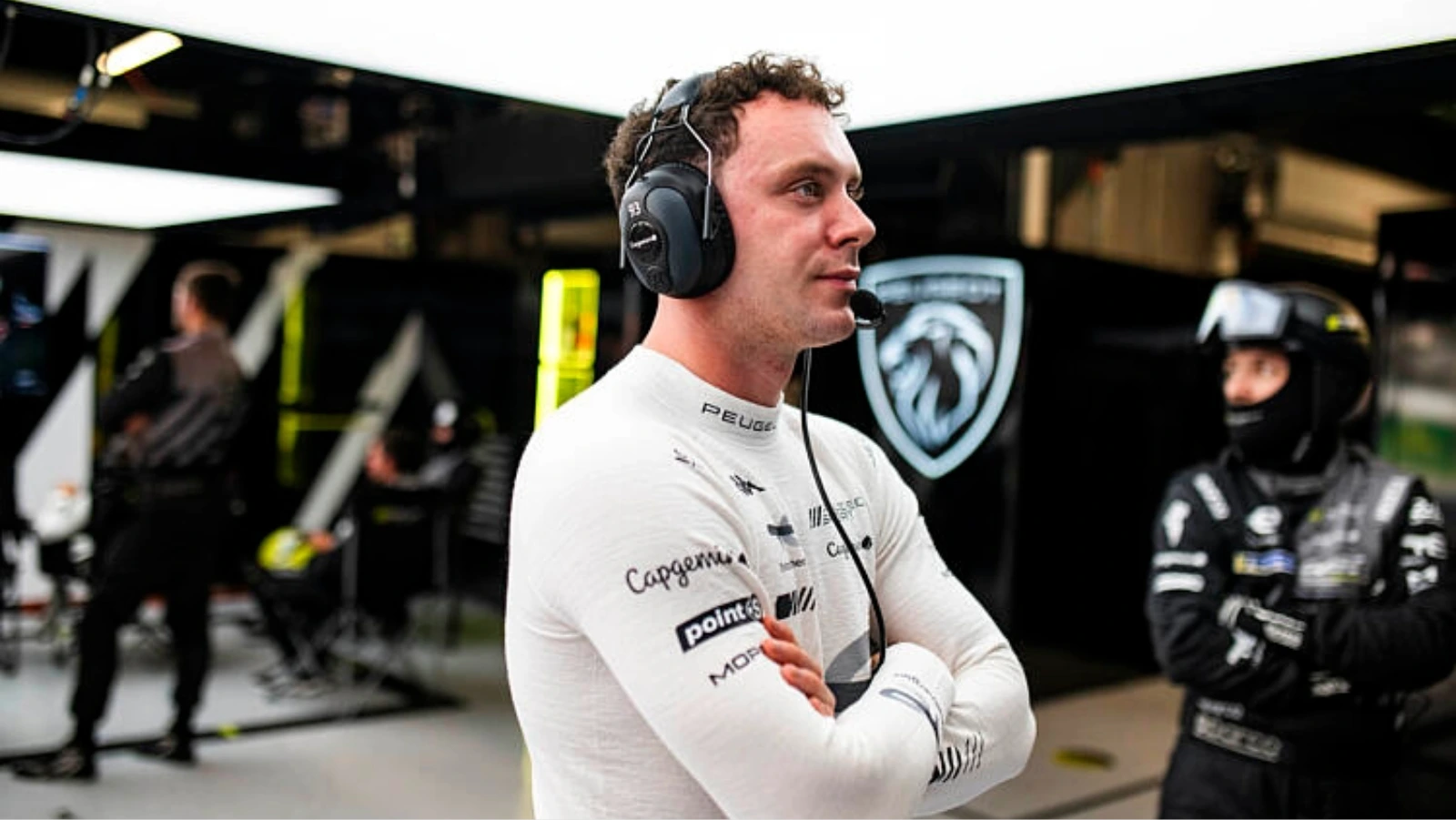
Alex Quinn’s progression with Team Peugeot TotalEnergies made the next step at the 6 Hours of Barcelona, where Alex made his Hypercar debut. Following his first outing at Barcelona, he reflected on the transition to Hypercar racing when speaking to Motorsport Week at the 6 Hours of Monza.
Alex Quinn was originally expected to make his full-time FIA World Endurance Championship debut in 2027. However, his promotion to Team Peugeot TotalEnergies’ race line-up came earlier than planned, giving the British driver the opportunity to step into the team’s #93 Peugeot 9X8 for the final two rounds of the 2026 season.
The 25-year-old replaced Stoffel Vandoorne following the Fuji round, joining Nick Cassidy and Paul Di Resta for the races at Barcelona and Monza. It was a significant opportunity for Quinn, who had spent the season working with Peugeot as a test and development driver while continuing to establish himself in endurance racing. His 2026 campaign had already delivered considerable success, including the IMSA LMP2 title and class victories at both the 24 Hours of Le Mans and the Rolex 24 at Daytona.
For Quinn, the opportunity to move into the Hypercar category represented an important step in his career. Having already spent time working with the team and familiarising himself with the 9X8, he was able to approach his first race with a degree of preparation. Nevertheless, nothing could entirely replicate the experience of competing in the championship.
Looking back on his Barcelona debut, Quinn described the weekend as a particularly important moment. “It was a really special weekend,” he explained. “It’s been nice looking back on my career and then finally having that first weekend come around.”
The transition into the team proved smoother than he had anticipated, largely thanks to the support of those around him. Despite joining the line-up relatively late in the season, Quinn said he never felt overwhelmed by the demands of the new environment.
“Everyone in the team was amazing, helping me get settled in. It never once felt too much for me, so that was nice,” he said. “It felt like it was quite seamless.”
The result itself was not quite what the team had hoped for, with the #93 missing out on a points finish. However, Quinn was more encouraged by the progress made throughout the event and the opportunity to gain valuable experience in the car.
“We didn’t quite make the points, but I feel like throughout the weekend we made massive progress. In my stint, I enjoyed it and, looking back on it, I have no regrets. I feel like it was a really fun weekend.”
Although his previous testing experience with Peugeot had provided a useful foundation, the race weekend presented a different set of challenges. One of the biggest differences was managing traffic, particularly when sharing the circuit with the LMGT3 field. It was an aspect of Hypercar racing that Quinn acknowledged could not be fully replicated outside competition.
“There are obviously some things you can’t fully prepare for. You can’t put yourself in that race situation until you’re actually in it. I’ve driven the car before in tests, and obviously I was a development driver this year, so I was prepared in that aspect.
“There are a few things, like being in GT traffic in this car, that you can’t really prepare for. But at the end of the day, I feel like we handled it well.”
With his first race behind him, the experience also provided a clearer idea of what to expect heading into Monza. The initial nerves had begun to settle, allowing Quinn to concentrate more fully on the demands of the weekend rather than the significance of making his debut.
“I feel like I’m less nervous, for sure. I didn’t admit it at the time, but I probably was quite nervous,” he admitted. Having now experienced the championship environment first-hand, he felt more comfortable and better prepared for his next outing. “I definitely feel more comfortable and ready to get on track.”
Monza also offered a familiar setting. Quinn had last competed at the Italian circuit in 2020, when he secured pole position, although changes to the surface and circuit characteristics meant that some adaptation would still be necessary.
“It’s a track I enjoy. I was on pole here last time I was here, so I enjoy it, and I think the racing should be fun as well,” he said.
He was particularly interested in experiencing the circuit through the demands of multi-class endurance racing. While he already knew the track, racing there in a Hypercar alongside the LMGT3 field would present a different challenge.
“It’s a track that’s probably good for racing, good for overtaking and multi-class racing. It will be the first time I’ve done that here, so I’m interested and excited for the weekend,” he added.
Beyond adapting to the circuit and the car, integrating into an established driver line-up has been another important part of Quinn’s introduction to the championship. The experience of working alongside more experienced teammates has provided him with an opportunity to understand the technical aspects of the 9X8 in greater depth.
He was particularly keen to acknowledge Nick Cassidy’s assistance, highlighting the importance of understanding the systems and adjustments involved in running the car over a race weekend.
“They’ve been amazing, to be honest,” Quinn said of his teammates. “They’ve been really good, really fun to work with and really helpful.” He singled out Cassidy for his support, explaining that the process of learning the car goes considerably further than simply driving it quickly.
“I feel like I have to give Nick a special mention. He’s been very good with me, helping me with all the systems in the car.”
While Quinn had already completed development work and prepared himself for the opportunity, the demands of a race weekend brought another level of complexity. Understanding how to adapt the car, work with its systems and make adjustments requires a more detailed knowledge of the engineering behind it.
“When you’re actually in a race weekend and having to adapt and adjust the car, the systems and everything like that, he’s been really good at giving me the theory behind it so I fully understand it,” he explained.
It is a learning process that will continue beyond the final rounds of 2026. With a full-time race programme ahead, the additional track time at Barcelona and Monza provides Quinn with an important opportunity to build familiarity with the championship before the next season begins.
“That’ll keep going this weekend, and I’m sure next year as well,” he said. “So, definitely learning a huge amount.”
However, Quinn is also conscious that the technical learning cannot come at the expense of the fundamental objective. Despite the importance of understanding the car and its systems, the focus remains on extracting the maximum performance whenever he is behind the wheel.
“At the same time, it’s a race car and we still have to just drive it as quickly as we can,” he added. “The background is where the learning is happening.”
Looking ahead to 2027, there is already plenty on the calendar for Quinn to anticipate. Silverstone will naturally stand out as his home race, although it is the prospect of visiting unfamiliar circuits that particularly interests him.
Among those, Fuji is one he has singled out. “It’s a really cool calendar,” he said, before identifying the Japanese circuit as a highlight. “In terms of new tracks, I’m excited for Fuji. I feel like that’s going to be a cool place that I haven’t been to.”
For now, however, the immediate priority is making the most of the opportunities available with Peugeot during the closing stages of the season. His early promotion has given him a head start on the transition to Hypercar racing, but Quinn’s approach remains grounded in gaining experience, understanding the car and continuing to make progress.
Barcelona provided the first opportunity to put that preparation into practice. Monza offers another chance to build on it, with the longer-term objective of arriving in 2027 better equipped for the demands of a full FIA WEC campaign.


Discussion about this post